
Xynova PRM10-20-64-75-F Linear Actuator
In stock
- BRAND:
- XYNOVA
- MODEL:
- PRM10-20-64-75-F
- ORIGIN:
- China
- Warranty:
- 12 MONTHS
- AVAILABILITY:
- SUBJECT TO AVAILABILITY
- SKU:
- Xynova-PRM10-20-64-75-F
Xynova PRM10-20-64-75-F Linear Actuator
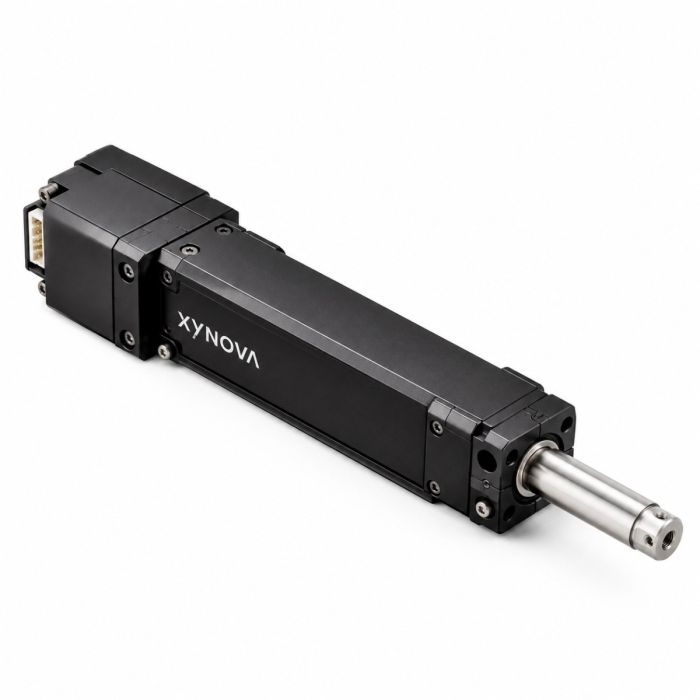
A humanoid arm has very little room to spare, and every cylinder inside it has to earn its place. The Xynova PRM10-20-64-75-F Linear Actuator is built for that tight space: a micro electric cylinder designed for humanoid robots, with a body of 10*13.5*81mm.
The product is available through this page, by quotation.
Background
Xynova and its focus on humanoid robots
Xynova Technology Co., Ltd. is a core component supplier in the field of humanoid robots. The company specializes in the research, development, production and sales of high-dexterity dexterous hands, high-torque density integrated joint modules and micro electric cylinders. That list matters because it shows where this actuator comes from. It is not a general-purpose catalog part adapted for robotics. It is one piece of a component family that serves the same machine: hands, joints and linear drives meant to work together inside a humanoid.
For builders in the Caribbean who are developing robotic systems, research platforms or teaching labs, this lineage is useful. A supplier that makes the hand, the joint and the cylinder understands how the parts must fit together, and that shows in the way the PRM10 cylinder is built: compact, self-contained and ready to be coordinated with other modules.
The PRM10 micro cylinder and its key technology
The Xynova PRM10-20-64-75-F Linear Actuator is one version in the PRM10 micro cylinder series. Its transmission rests on an in-house developed 7mm micro planetary roller screw, which greatly improves transmission efficiency and suits various industrial and everyday applications. The screw is driven by an in-house developed frameless torque motor, a brushless hollow cup motor, which provides higher torque, longer lifespan and quieter operation.
Xynova develops the motor and the screw itself, and it also supplies upper-level software with a rich set of API interfaces. That software makes it easy to coordinate and control multiple modules, which is exactly what a humanoid robot needs when many small actuators must move in step.
Technical Specifications
| Specification | Value |
|---|---|
| Model | PRM10-20-64-75-F |
| Size (L×W×H) | 10*13.5*81mm |
| Operating voltage | DC12±10%V |
| Screw type | In-house developed 7mm micro planetary roller screw |
| Motor | In-house developed frameless torque motor/brushless hollow cup motor |
| Self-locking | No risk of power failure, with easy joint self-locking |
| Software | In-house developed upper-level software with a rich set of API interfaces |
| Intended application | Micro electric cylinders designed for humanoid robots |
Specifications as published by the manufacturer; confirmed against the datasheet at quotation.
The manufacturer has not published the communication interface, the encoder type, the ingress protection rating, the contents of the box, the mounting method, the service life figure or the noise level; they are confirmed at quotation.
What makes the PRM10-20-64-75-F different from an ordinary linear actuator?
Most linear actuators are designed first for factories and adapted later for robots. This one starts from the opposite direction. It is a micro electric cylinder designed for humanoid robots, and the design choices follow from that. The body measures 10*13.5*81mm, a size that suits the limited volume of a forearm, a hand or a joint, where a larger cylinder cannot be fitted.
The second difference is the drive train. Instead of a conventional screw, the actuator uses an in-house developed 7mm micro planetary roller screw, which greatly improves transmission efficiency. Paired with an in-house frameless torque motor of the brushless hollow cup type, the cylinder delivers higher torque, longer lifespan and quieter operation. Because both the screw and the motor come from the same maker, they are developed to work as one unit rather than as parts bought separately and fitted together.
The third difference is software. A cylinder alone is only hardware; a humanoid needs many of them to move in coordination. Xynova supplies upper-level software with a rich set of API interfaces, so engineers can coordinate and control multiple modules from one environment instead of writing low-level control for each unit.
Why does self-locking matter in a humanoid joint?
A robot limb that holds a position only while power is applied is a limb that can fall, drop its load or drive into something when the supply is interrupted. The PRM10-20-64-75-F has no risk of power failure, with easy joint self-locking for enhanced safety during operation. In practice, that means the joint can stay where it is when power is cut, which helps protect the mechanism, the payload and the people working nearby.
Self-locking also helps in everyday work. A joint that holds its position without drawing current is easier to reason about during testing, because you know what will happen when a controller resets or a supply drops. For teams building their first humanoid prototype, that predictability is worth as much as any single performance figure.
If you are comparing options within the series, the Xynova PRM10-20-18-200-F Linear Actuator is another version of the PRM10 cylinder, and the wider Robot Actuators category shows the rotary options as well.
Who is the Xynova PRM10-20-64-75-F for?
The first group is humanoid robot developers. Companies and labs building arms, hands or legs need small linear drives that fit inside the limbs, and this cylinder is designed for that very purpose. The second group is university and research teams. A compact cylinder with an API-driven software layer is a practical tool for studying manipulation, grasping and joint control without building every control layer from scratch.
The third group is integrators and prototype builders who work on custom robotic mechanisms. Where a standard actuator is too large, a micro electric cylinder opens up designs that would otherwise not fit. The fourth group is educators who want students to work with real components from a humanoid supply chain.
Buyers who need a different version of the PRM10 cylinder can look at the Xynova PRM10-20-18-200-F Linear Actuator. Because figures stay with each version, ask us for the datasheet of the version you are comparing before you decide. Buyers who need rotation instead of linear motion will find rotary models in the Robot Actuators category.
What is the Xynova PRM10-20-64-75-F used for?
- Humanoid robot limbs. It is designed as a micro electric cylinder for the compact joints and segments of a humanoid.
- Joint actuation with self-locking. Its self-locking helps hold a joint in place without a power-failure risk.
- Robotic hand and finger mechanisms. The small body makes it a candidate for tight assemblies where space is the main constraint.
- Multi-module coordination. The upper-level software and API interfaces make it easy to control several modules together.
- Research and teaching platforms. Labs can use it to study linear actuation, control and manipulation on a real humanoid component.
- Custom robotic prototypes. Integrators can fit a compact, quiet-running cylinder into mechanisms that larger actuators cannot enter.
Pricing and Availability
Prices are not listed on this page. Every order starts with a quotation, so tell us the quantity, the project and the version you need, and we will respond with a quote. Delivery, customs and support are arranged together with the quotation. The Xynova PRM10-20-64-75-F Linear Actuator is available on this page.
Frequently Asked Questions
What is the size of the Xynova PRM10-20-64-75-F?
The size (L×W×H) of this version is 10*13.5*81mm.
What voltage does it operate on?
The operating voltage is DC12±10%V.
What kind of screw and motor does it use?
It uses an in-house developed 7mm micro planetary roller screw and an in-house developed frameless torque motor, a brushless hollow cup motor. Together they provide higher torque, longer lifespan and quieter operation.
Does the actuator hold its position when power is lost?
Yes. It has no risk of power failure, with easy joint self-locking for enhanced safety during operation.
Can several actuators be controlled together?
Yes. Xynova supplies in-house developed upper-level software with a rich set of API interfaces, which enables easy coordination and control of multiple modules.
What is the actuator designed for?
It is a micro electric cylinder designed for humanoid robots, made by a core component supplier in that field.
Where can I buy the Xynova PRM10-20-64-75-F and what does it cost?
You can request it through this page, and the price is given in a quotation that also covers delivery, customs and support. No price is listed here.
Summary
Space is the scarce resource in a humanoid robot, and the Xynova PRM10-20-64-75-F Linear Actuator answers that with a 10*13.5*81mm micro electric cylinder, a 7mm micro planetary roller screw, a frameless brushless hollow cup motor, joint self-locking and a software layer with a rich set of API interfaces. It comes from a supplier that also makes dexterous hands and joint modules for humanoids. For specifications, version questions and a quotation, this page is the starting point.


