
Unix AI Wanda 2.0 Universal Wheeled Humanoid Robot
In stock
- BRAND:
- UNIXAI
- MODEL:
- WANDA 2.0
- ORIGIN:
- China
- AVAILABILITY:
- SUBJECT TO AVAILABILITY
- SKU:
- Unix-AI-Wanda-2.0
Unix AI Wanda 2.0 Universal Wheeled Humanoid Robot
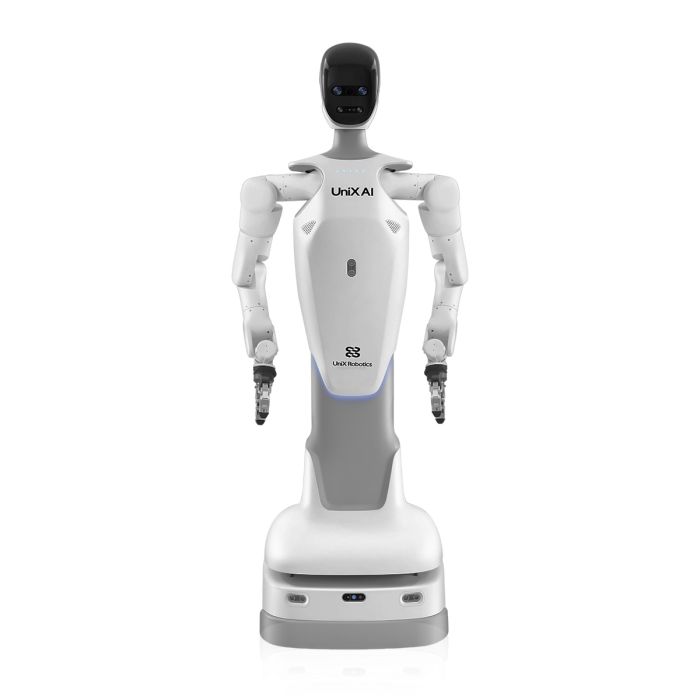
A robot that needs the building rebuilt around it is a laboratory exhibit; a robot that fits the building as it stands is a tool. The Unix AI Wanda 2.0 Universal Wheeled Humanoid Robot is built for the second case. It puts a full-size humanoid upper body with two bionic arms on a silent wheeled base, so it can reach, grasp and travel through spaces that people already use.
The product is available through this page, by quotation.
Background
UniX AI and the Wanda line
UNIXAI develops general-purpose humanoid robots. Wanda 2.0 is a full-size, general-purpose humanoid robot. The name points to a platform meant to be applied across many tasks, rather than a machine tuned to one scripted routine.
The page lists Wanda 2.0 as the single version covered here. Other humanoid platforms from the same brand exist, and we mention them further down for buyers who want a different body type.
Positioning and key technology
The central claim of Wanda 2.0 is its arm. It features the world's first mass-produced 8-DoF bionic arm and adaptive intelligent grippers. The arms use multimodal semantic keypoints and an efficient trajectory imitation learning framework. In plain terms, the robot is meant to learn manipulation tasks from demonstration and carry them out with a hand-like gripper.
Each arm uses a shoulder-elbow-wrist layout in a "4+1+3" configuration for motion planning. The arms are made of high-strength, low-density materials. Around them sit a two-axis head with cameras and microphones, a computing platform of up to 275 TOPs, and a hub-motor chassis with several navigation sensors. The unit comes preloaded with L4-level applications.
Technical Specifications
| Specification | Value |
|---|---|
| Product type | Full-size general-purpose humanoid robot |
| Arm design | 8-DoF bionic arm with adaptive intelligent grippers |
| Arm configuration | Shoulder-elbow-wrist, "4+1+3" |
| Dual-arm load capacity | 12 kg |
| Single-arm payload | 6 kg |
| Single-arm reach | 982 mm |
| Repeatability | ±0.5 mm |
| End effector | Biomimetic Two-Finger Gripper |
| Head motion | 2-DoF; Yaw ±90°, Pitch ±30° |
| Perception system | Head-mounted dual RGB and RGBD camera, 6-mic circular array |
| Chassis system | Differential drive chassis, hub motor base |
| Navigation sensors | 360° LiDAR, ultrasonic sensor, RGBD camera |
| Minimum passage width | 75 cm |
| Computing power | Up to 275 TOPs |
| Battery life | 8-16 h |
| Software | Preloaded L4-level applications |
Specifications as published by the manufacturer; confirmed against the datasheet at quotation.
The manufacturer has not published the weight, the IP rating, the charging time, the battery capacity, the package contents, the operating system, the connectivity options, the operating temperature or the noise level; they are confirmed at quotation.
What makes Wanda 2.0 different from a fixed robot arm?
A fixed industrial arm is excellent at one station. It repeats a motion in one place and it needs the work to come to it. Wanda 2.0 reverses that arrangement: the work stays where it is, and the robot travels to it. The differential drive chassis, the 360° LiDAR, the ultrasonic sensor and the RGBD camera give it the means to find its way, and the two arms give it something to do on arrival.
The arms are also built differently from a typical workstation arm. Each has eight degrees of freedom and a reach of 982 mm, and the pair can carry 12 kg together, with 6 kg available to a single arm. Repeatability is ±0.5 mm. The biomimetic two-finger gripper is adaptive, which matters when the objects are not identical from one task to the next.
The head adds another difference. It moves in yaw by ±90° and in pitch by ±30°, and it carries dual RGB and RGBD cameras plus a six-microphone circular array. A robot that can turn its gaze and listen in several directions can follow a person, check a shelf or look at a work surface without turning the entire body.
How does Wanda 2.0 move through tight spaces?
Narrow aisles and doorways are where a wheeled humanoid is judged. The minimum passage width is 75 cm, which gives planners a number to compare with their own doorways and corridors. It is worth measuring the real route before deciding, including turns and furniture that narrow the path.
The base is a silent chassis with obstacle avoidance. A hub motor base works with ultrasonic radar, LiDAR and an RGBD camera for navigation in complex environments. Quiet running is useful in hotels, clinics, classrooms and shops, where a noisy machine would draw complaints before it drew praise.
Endurance is the other half of mobility. The battery life is 8-16 h. The span is wide because the actual runtime depends on how the robot is used, and your own task mix will decide where in that range you land.
Who is the Unix AI Wanda 2.0 for?
Hospitality and retail operators are one natural group. They have indoor spaces built for people, repeated service tasks and a need for a machine that does not unsettle guests. A wheeled humanoid with two arms can fetch, carry and present items without special infrastructure.
Universities and research laboratories are another. The imitation learning framework, the multimodal perception and the computing power of up to 275 TOPs make the platform a base for work on manipulation and autonomy. Teams that want to teach a robot new tasks from demonstration will find the arm and gripper design central to that work.
Integrators and technology demonstration centers can use Wanda 2.0 as a showcase for service robotics, with preloaded L4-level applications as a starting point. Organizations in the Caribbean that want to evaluate humanoid automation for tourism, healthcare or education can also begin with a quotation and a conversation about the real site.
If your site calls for a different body, compare the Unix AI Panther Next-gen Full-size Wheeled Dual-arm Humanoid Robot, or the Unix AI Martian Bipedal General Purpose Humanoid Robot if you need a walking machine. For wider choice, browse Wheeled Humanoids or the full range of Humanoids.
What is the Unix AI Wanda 2.0 used for?
- Hotel and guest services: carrying and handing over items along corridors and through lobbies.
- Retail support: moving between counter and shelf to pick, place and present products.
- Household and care assistance: lifting and moving everyday objects within the limits of the payload.
- Research in manipulation: training and testing imitation learning on a dual-arm platform with a biomimetic gripper.
- Education and training: showing students how perception, navigation and manipulation work together in one machine.
- Demonstration and exhibition: presenting service robotics at events, showrooms and innovation centers.
Pricing and Availability
We do not print prices on this page. A quotation is the way to proceed, and it lets us match the configuration to your site and your tasks. Delivery, customs and support are arranged together with the quotation. The Unix AI Wanda 2.0 Universal Wheeled Humanoid Robot is available on this page.
Frequently Asked Questions
What can the arms lift?
The dual-arm load capacity is 12 kg, and the single-arm payload is 6 kg. Each arm reaches 982 mm.
How long does the battery last?
Battery life is 8-16 h, depending on how the robot is used.
Can it fit through my doorways?
The minimum passage width is 75 cm. Measure your narrowest doorway or aisle and compare it with that figure.
What sensors does it use to see and navigate?
The head carries dual RGB and RGBD cameras and a six-microphone circular array. The chassis adds 360° LiDAR, an ultrasonic sensor and an RGBD camera for obstacle avoidance.
What kind of hand does it have?
The end effector is a Biomimetic Two-Finger Gripper. The grippers are adaptive and intelligent.
Is software included?
The robot comes preloaded with L4-level applications, ready for the first tasks.
Where can I buy the Unix AI Wanda 2.0 Universal Wheeled Humanoid Robot and what does it cost?
You can request a quotation on this page. The cost depends on the configuration and on delivery, customs and support, so we quote it individually.
Summary
The appeal of Wanda 2.0 is that it comes to your building as it is. A silent wheeled base, a 75 cm minimum passage width, two 8-DoF bionic arms and a head full of sensors let it work where people already work. The figures for payload, reach, repeatability, computing power and battery life are on the table above. If this robot matches your site, this page is the starting point.


