
Unix AI Panther Next-gen Full-size Wheeled Dual-arm Humanoid Robot
In stock
- BRAND:
- UNIXAI
- MODEL:
- PANTHER
- ORIGIN:
- China
- Warranty:
- 12 MONTHS
- AVAILABILITY:
- ALLOW 2-4 WEEKS FOR DELIVERY
- SKU:
- Unix-AI-Panther
Unix AI Panther Next-gen Full-size Wheeled Dual-arm Humanoid Robot
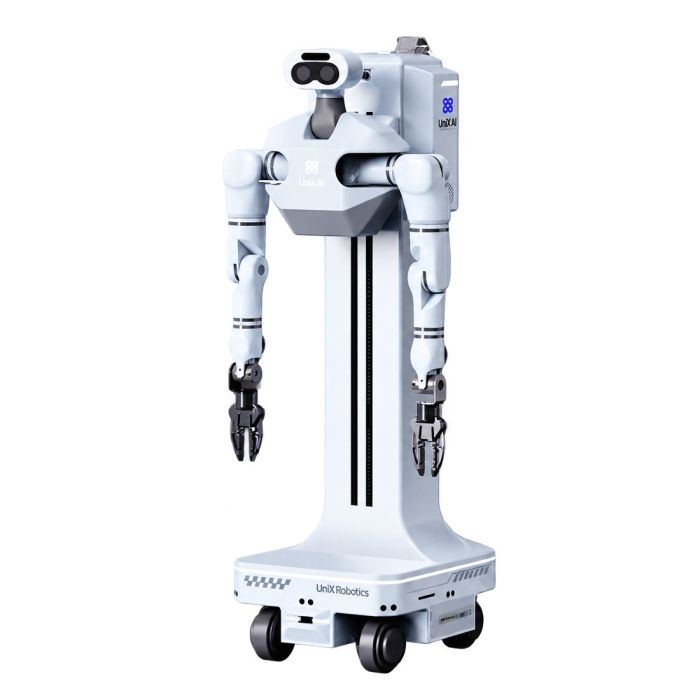
Most humanoid robots ask a building to change for them. The Unix AI Panther Next-gen Full-size Wheeled Dual-arm Humanoid Robot takes the opposite approach: it rolls on an omnidirectional base, reaches from the floor to human working height, and fits through a passage 65 cm wide. It is built for rooms that already exist, with their counters, doorways, shelves and people.
The product is available through this page, by quotation.
Background
UniX AI and the Panther lineage
UNIXAI is the brand behind a family of humanoid platforms, and this store's catalog also lists the Unix AI Wanda 2.0 Universal Wheeled Humanoid Robot and the Unix AI Martian Bipedal General Purpose Humanoid Robot. Panther is the next-generation humanoid in that line. The fact sheet names a single version, Panther, so every figure on this page belongs to that one configuration.
The core of Panther is three things: 34 high-DoF joints, mass-produced 8-DoF bionic arms, and adaptive intelligent grippers. Together they describe a robot meant for real manipulation work rather than demonstration.
Positioning and key technology
Panther is a full-size machine, 1600-1750mm tall, mounted on a wheeled base instead of legs. Buyers who want a humanoid for indoor service and handling work often prefer this layout, because wheels keep the platform steady while the arms work. Browse the wider Wheeled Humanoids range or the full Humanoids category to compare approaches.
The chassis uses four-wheel steering and four-wheel drive, which gives omnidirectional movement. Power comes from an upgraded 48 V platform with a new power architecture, which brings stronger output, greater mobility and higher stability. For onboard intelligence, Panther carries edge computing of up to 2070 TOPS, well suited to AI perception and real-time control.
Perception is built around head-mounted dual RGB and RGBD cameras, with a top 3D LiDAR available as an option. The platform is also compatible with dexterous hands, which opens the door to more complex tasks in confined and varied scenarios.
Technical Specifications
| Specification | Value |
|---|---|
| Product type | Next-gen Full-size Wheeled Dual-arm Humanoid Robot |
| Degrees of freedom | 34 high-DoF joints |
| Arms | 8-DoF bionic arms |
| Height | 1600-1750mm |
| Upper-body lift | 80 cm |
| Torso lifting height | 600-800 mm |
| Power platform | Upgraded 48 V platform |
| Edge computing | Up to 2070 TOPS |
| Battery life | 6-12 h |
| Minimum passage width | 65 cm |
| Dual-arm load capacity | 12kg |
| Single-arm reach | 982mm |
| Repeatability | ±0.5 mm |
| Movement speed | 2m/s |
| Chassis | Four-wheel steering and four-wheel drive omnidirectional chassis |
| Perception | Head-mounted dual RGB and RGBD cameras; top 3D LiDAR (optional) |
| Hands | Compatible with dexterous hands |
Specifications as published by the manufacturer; confirmed against the datasheet at quotation.
The manufacturer has not published the weight, the battery capacity, the charging time, the operating system, the IP rating, the connectivity, the payload per arm, the gripper specifications, the footprint dimensions or what is in the box; they are confirmed at quotation.
What makes Panther different from a bipedal humanoid?
The difference starts at the floor. A bipedal robot spends a great deal of its engineering effort on balance, and that effort shows up in how it moves and where it can work. Panther trades legs for an omnidirectional chassis with four-wheel steering and drive, so it can move in any direction without turning first. Its movement speed is 2m/s, and a minimum passage width of 65 cm tells you how tight a gap the platform can use.
The wheeled base does not limit the body above it. An 80 cm upper-body lift allows ground-level reach, and a torso lifting height of 600-800 mm is also listed. The lift comes with a wider field of view, which supports smoother navigation and more stable manipulation in complex environments. For a robot that must pick something from a low shelf and then hand it across a counter, that vertical range matters more than a walking gait.
If your priority is walking over varied terrain or stairs, the Martian bipedal model is the sibling to examine. If your work happens on flat indoor floors, the wheeled approach is usually the simpler path.
What does the arm and compute package offer?
The arms are the center of the platform. Each is an 8-DoF bionic arm, and the single-arm reach is 982mm. The dual-arm load capacity is 12kg, and repeatability is ±0.5 mm. Those three figures together describe a robot that can reach, carry and place with a consistent result.
Adaptive intelligent grippers complete the arms, and the platform is compatible with dexterous hands for finer work in confined spaces.
On the computing side, up to 2070 TOPS of edge computing sits onboard. In practice that means perception and real-time control can run on the robot itself rather than depending on a remote server. Combined with the dual RGB and RGBD head cameras and the optional top 3D LiDAR, it gives developers and integrators a capable base for embodied AI work. The upgraded 48 V platform supports it with a battery life of 6-12 h.
Who is the Unix AI Panther for?
Research laboratories and university teams will find a full-size dual-arm platform with strong onboard computing and a stated repeatability figure, which suits embodied AI studies and manipulation experiments. Integrators building service solutions for reception areas, offices, malls and similar indoor venues can use the omnidirectional chassis and the 65 cm minimum passage width to plan routes around people and furniture.
Operators of showrooms, visitor centers and training facilities may want a robot that is visibly human in scale, 1600-1750mm tall, yet steady on wheels. Companies exploring light handling tasks will look at the 12kg dual-arm load capacity and the 982mm single-arm reach.
If you want a general-purpose wheeled humanoid from the same brand to compare, look at the Unix AI Wanda 2.0 Universal Wheeled Humanoid Robot linked above. For anyone who needs to walk rather than roll, the Martian sibling is the better starting point.
What is the Unix AI Panther used for?
- Reception and guidance: a human-height presence that can move around a lobby, greet visitors and lead them through a space.
- Service handling: picking up and passing objects at counters, shelves and tables using the dual arms.
- Ground-level tasks: the 80 cm upper-body lift lets the robot reach items near the floor.
- Research in embodied AI: onboard computing of up to 2070 TOPS supports perception and control experiments.
- Work in confined spaces: dexterous hand compatibility and a 65 cm minimum passage width suit narrow and crowded areas.
- Office and mall operations: repeatable movements and omnidirectional mobility for indoor routines.
Pricing and Availability
This page lists no prices. The call to action is a quotation, which we prepare around your configuration, for example whether you need the optional top 3D LiDAR or dexterous hands. Delivery, customs and support are arranged together with the quotation. The Unix AI Panther Next-gen Full-size Wheeled Dual-arm Humanoid Robot is available on this page.
Frequently Asked Questions
How tall is the Unix AI Panther?
Its height is 1600-1750mm. The upper-body lift of 80 cm and the torso lifting height of 600-800 mm are listed as separate figures.
How much can the arms carry?
The dual-arm load capacity is 12kg. Ask for the per-arm payload when you request your quotation.
How long does the battery last?
The battery life is 6-12 h, on an upgraded 48 V platform.
Can it move through narrow spaces?
Yes, within limits. The minimum passage width is 65 cm, and the four-wheel steering and drive chassis moves omnidirectionally at 2m/s.
What sensors does it use?
It has head-mounted dual RGB and RGBD cameras. A top 3D LiDAR is available as an option.
Does it work with dexterous hands?
Yes, the platform is compatible with dexterous hands, for complex tasks in confined and diverse scenarios.
Where can I buy the Unix AI Panther and what does it cost?
You can request it through this page, by quotation. We do not print a price here; the quotation covers your configuration, delivery, customs and support.
Summary
The Unix AI Panther answers a practical question: what if the robot adapted to the building instead of the other way round? A wheeled omnidirectional base, a lifting torso, 8-DoF bionic arms, a 12kg dual-arm load capacity and up to 2070 TOPS of edge computing make it a capable choice for indoor service, handling and research. For a full-size wheeled humanoid that fits real rooms, this page is the starting point.


