
Unitree R1 Air Humanoid Robot
In stock
- BRAND:
- UNITREE ROBOTICS
- MODEL:
- R1-AIR
- PART #:
- R1-AIR
- ORIGIN:
- China
- Warranty:
- 12 MONTHS
- AVAILABILITY:
- SUBJECT TO AVAILABILITY
- SKU:
- Unitree-R1-AIR
Unitree R1 Air Humanoid Robot
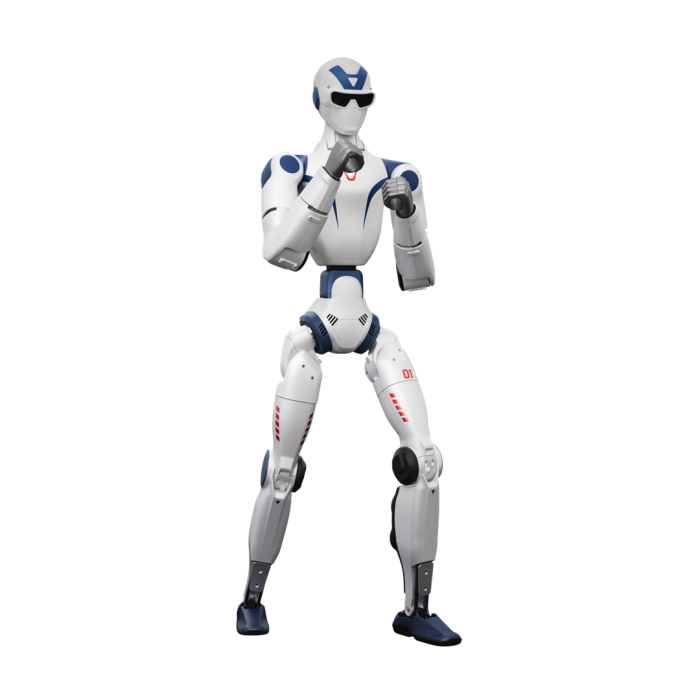
A humanoid robot usually asks you to imagine it. The Unitree R1 Air Humanoid Robot asks you to look at it: a compact biped, standing 1230 mm tall, that listens, looks and answers back. It is the lightest-equipped member of a family built around a simple idea, that a humanoid should be a platform you can put in front of students, visitors and developers rather than a showpiece behind glass.
The Unitree R1 Air Humanoid Robot is available through this page, by quotation.
Background
Unitree Robotics and the R1 family
Unitree Robotics is a manufacturer of legged and humanoid robots, and its machines are common in laboratories, classrooms and demonstration halls. The R1 family brings that experience to a smaller body. The sources name three versions: the R1 Air described here, the R1, and the R1 EDU, which comes in several configurations. All three share the same standing envelope of 1230x357x190mm (height, width and depth), and all three have six degrees of freedom in each leg. They differ in the upper body, in the camera and in the total joint count.
The R1 Air is the entry point of the family. It carries 20 joints in total, while the R1 lists 26 and the R1 EDU lists a range from 26 to 40. Choosing the Air is therefore a choice about how much of the body you need to move and how much sensing you need to see with. You can browse the whole range in the Unitree R1 category.
Positioning and key technology
Two technologies define the R1 Air. The first is the joint motor: a low inertia, high-speed internal rotor PMSM (permanent magnet synchronous motor), which gives better response speed and heat dissipation. For a robot that has to balance on two legs, quick response matters more than almost any other motor property, because corrections must arrive before a lean becomes a fall.
The second is the software. The R1 Air is integrated with a Large Multimodal Model for voice and images, so one model works on what the robot hears and what it sees. Continuous OTA software upgrade and update means the robot can receive new capabilities after it has been delivered. In practice, the hardware you buy today is meant to be improved through software over time.
Technical Specifications
| Specification | Value (R1 AIR) |
|---|---|
| Dimensions, standing (H x W x D) | 1230x357x190mm |
| Weight (with battery) | About 27kg |
| Total degrees of freedom | 20 |
| Single leg degrees of freedom | 6 |
| Single arm degrees of freedom | 4 |
| Maximum torque of arm joint | About 2kg |
| Joint motor | Low inertia high-speed internal rotor PMSM (permanent magnet synchronous motor) |
| Camera | Monocular camera |
| Microphone array | 4-mic array |
| Wireless connectivity | Wi-Fi 6 and Bluetooth 5.2 |
| Software updates | Continuous OTA software upgrade and update |
| AI model | Large Multimodal Model for voice and images |
Specifications as published by the manufacturer; confirmed against the datasheet at quotation.
The manufacturer has not published the maximum walking speed, the IP rating, the battery capacity, the charging time, the camera resolution or the operating system; they are confirmed at quotation.
What makes the R1 Air different from the R1?
The differences are in the upper body and the eyes. The R1 Air has four degrees of freedom in each arm, while the R1 has five. Across the whole body, the Air has 20 joints and the R1 has 26. The Air also weighs about 27kg with its battery, against about 29kg for the R1, so the Air is lighter by about 2kg.
The camera is the other clear difference. The R1 Air uses a monocular camera, and the R1 uses a binocular camera. A binocular camera gives the robot two viewpoints, which suits work where depth perception is the subject of the project. A monocular camera is enough when the robot mainly needs to see who is in front of it and respond to the scene, and the multimodal model handles that kind of image understanding together with voice.
What stays the same is just as useful to know. The standing size is identical, each leg has six degrees of freedom, the arm joint torque is listed at about 2kg for all three versions, and the microphone array, Wi-Fi 6 and Bluetooth 5.2 are shared. If your work is about locomotion, voice interaction and demonstration, the Air gives you the same core platform with a simpler upper body.
What does the R1 EDU line add?
The R1 EDU line is aimed at teams that want to go further than the Air allows. The sources list its total joints as a range from 26 to 40, which means the upper body can be configured with more articulation, and it carries the binocular camera. Several EDU configurations are offered on this site, among them the Unitree R1 Edu Pro A Humanoid Robot and the Unitree R1 Edu Pro B Humanoid Robot. For research programs, the Research Robots category shows the wider field.
Who is the R1 Air for?
Educators are the first group. A 1230 mm humanoid that stands, listens and responds makes robotics tangible in a classroom, and the 20-joint body is simple enough to explain to beginners. Because the robot receives OTA updates, a program can keep using the same unit as the software improves.
Exhibition and visitor-experience teams are the second. A robot that hears questions through a 4-mic array and answers using voice and image understanding gives a stand, a showroom or a lobby something to talk about. The compact standing size of 1230x357x190mm and the weight of about 27kg with battery make it far easier to move and place than a full-size humanoid.
Developers and early-stage researchers form the third group. If you want to test multimodal interaction on a real walking body before committing to a larger program, the Air is a sensible first step. Teams that need binocular vision, five-degree arms or a higher joint count are better served by the R1 or by one of the EDU versions, such as the Unitree R1 Edu Pro E Humanoid Robot.
What is the R1 Air used for?
- Classroom robotics. Students see a walking humanoid with 20 joints and learn how legs, arms and sensors work together.
- Voice-interaction demonstrations. The 4-mic array and the multimodal model let visitors speak to the robot and get a response.
- Vision and image understanding trials. The monocular camera feeds the model that interprets what the robot sees.
- Exhibitions and showrooms. A humanoid of 1230 mm draws a crowd and carries a conversation about your brand or institution.
- Software and AI development. Wi-Fi 6, Bluetooth 5.2 and continuous OTA updates support teams that iterate on behavior over time.
- Entry-level research. Labs can test locomotion and interaction ideas before moving to a version with more joints or binocular vision.
Pricing and Availability
We do not publish prices on this page. A quotation is the way to buy the Unitree R1 Air Humanoid Robot: tell us your quantity, your location and your intended use, and we will respond with a written offer. Delivery, customs and support are arranged with the quotation, so you know what to expect before you commit. The Unitree R1 Air Humanoid Robot is available on this page.
Frequently Asked Questions
How many degrees of freedom does the R1 Air have?
The R1 Air has 20 degrees of freedom in total. Each leg has 6 and each arm has 4.
How tall is the R1 Air and how much does it weigh?
It stands 1230x357x190mm (height, width and depth) and weighs about 27kg with its battery.
Does the R1 Air understand speech and images?
Yes. It is integrated with a Large Multimodal Model for voice and images, and it has a 4-mic array and a monocular camera.
How does it connect?
It supports Wi-Fi 6 and Bluetooth 5.2. It also receives continuous OTA software upgrades and updates.
What is the difference between the R1 Air and the R1?
The R1 has 26 joints, five-degree arms, a binocular camera and a weight of about 29kg. The R1 Air has 20 joints, four-degree arms, a monocular camera and a weight of about 27kg.
Where do I find the walking speed, battery capacity and IP rating?
They are named in the sentence under the specification table, together with the charging time, the camera resolution and the operating system. Ask for them when you request your quotation.
Where can I buy the R1 Air and what does it cost?
You can buy it through this page by requesting a quotation. We do not list a price here; the offer is written for your quantity and destination.
Summary
The R1 Air does not ask you to imagine a humanoid; it gives you one that you can see, hear and talk to. It has 20 joints, a compact 1230 mm body, a fast-responding PMSM joint motor, a multimodal AI model for voice and images, and updates that keep arriving after delivery. It leaves out the extra arm joint and the binocular camera of the R1, and that is exactly what makes it the simple, sensible start of the family. If that is the platform you are looking for, this page is the starting point.


