
Unitree R1-A5-D Smart Ultimate F Humanoid Robot
In stock
- BRAND:
- UNITREE ROBOTICS
- MODEL:
- R1-A5-D-Smart-Ultimate-F
- PART #:
- R1-A5-D-Smart-Ultimate-F
- ORIGIN:
- China
- Warranty:
- 12 MONTHS
- AVAILABILITY:
- SUBJECT TO AVAILABILITY
- SKU:
- Unitree-R1-A5-D-Smart-Ultimate-F
Unitree R1-A5-D Smart Ultimate F Humanoid Robot
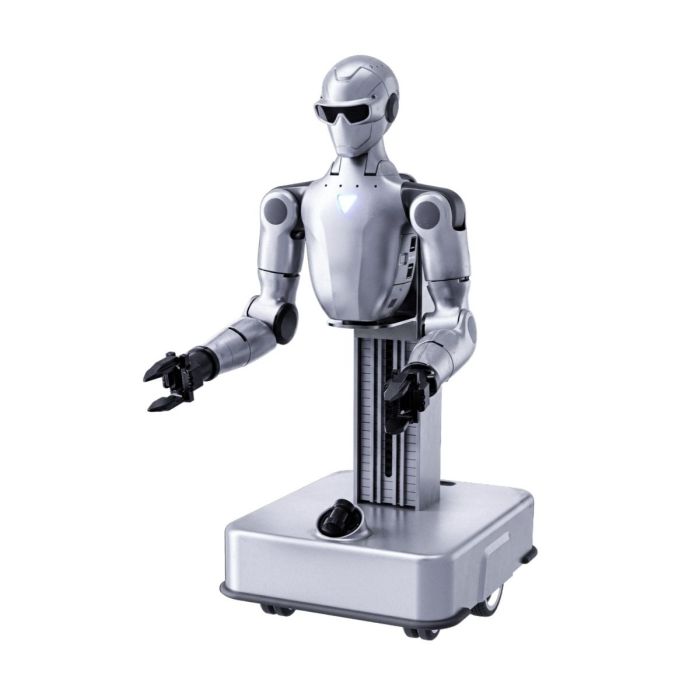
A humanoid robot that stands at a workbench in the morning and reaches a high shelf in the afternoon is a different proposition from one fixed at a single height. The Unitree R1-A5-D Smart Ultimate F Humanoid Robot is built around that idea: a wheeled chassis to travel, a lifting column to change its stance, and two arms with a dexterous hand option for the work itself.
The product is available through this page, by quotation.
Background
Unitree Robotics and the R1 line
UNITREE ROBOTICS is the maker of the R1 family, and the R1-A5 series is the part of that family that carries a two-armed upper body. The versions in the family are R1-A5, R1-A5-D, R1-A5-D Smart F, R1-A5-D Ultimate F, R1-A5-D Smart G, R1-A5-D Ultimate G and R1-A7-D. Each letter marks a configuration, so it pays to read the full model name rather than the family name alone.
Every R1-A5 configuration supports secondary development, with development manuals and ecosystem support. For a lab or an integrator, that matters as much as the hardware, because a robot you cannot program for your own task is only a demonstration.
What the -D variant adds
The R1-A5-D variant adds a wheeled chassis and a lifting column, taking it to 16 degrees of freedom. The count is built up as 5 single arms × 2, plus 1 waist, 2 heads, 1 pillar and 2 bases, which comes to 16. The chassis comes standard with a removable battery and an external power supply.
The Smart Ultimate F name combines the lettered F configuration with the Smart and Ultimate compute tiers. Separate compute figures exist for Smart F and Ultimate F, and they are shown separately below. If you need to know which of the two applies to the unit you are quoting, ask when you request the quotation.
Technical Specifications
| Specification | Value |
|---|---|
| Collapsed dimensions | 683 x 520 x 440 mm (683 is the distance from the top of the unit to the bottom of the chassis wheels, 520 the chassis width, 440 the chassis depth) |
| Elevated dimensions | 1323 x 520 x 440 mm (1323 is the distance from the top of the head to the bottom of the chassis wheels, 520 the chassis width, 440 the chassis thickness) |
| Weight (with battery) | About 30 kg |
| Total degrees of freedom | 16 |
| Maximum arm payload | Approx. 2 kg |
| Forearm + upper arm length | 420 mm |
| Joint motor | Low-inertia, high-speed, inner-rotor permanent magnet synchronous motor |
| Joint output bearings | Crossed-roller + double-row ball |
| Head joint range | Yaw ±115°, pitch ±36° |
| Waist yaw range | ±35° |
| Cooling system | Localized air cooling |
| Base compute | Body: 8-core high-performance CPU; head: 8-core high-performance CPU + 10 TOPS computing power |
| Onboard compute, Smart F | Orin Nano, 40 Tops built in |
| Onboard compute, Ultimate F | Orin NX, 100 Tops built in |
| Dexterous hand, Smart F | LinkerBot Hand O6 (non-tactile version) with RGB camera |
| Sensing | MID360 LiDAR + stereo camera on head |
| Battery life | Approximately 1.5 hours, on the removable lithium-ion battery in the chassis |
| Audio | 4-array microphone and dual 3 W speakers |
| Wireless | Wi-Fi 6 and Bluetooth 5.2 |
| Software updates | Smart OTA updates supported |
Specifications as published by the manufacturer; confirmed against the datasheet at quotation.
The manufacturer has not published the IP rating, the maximum travel speed, the lifting column load capacity, the LiDAR range, the charging time, the battery capacity, the operating temperature range, the operating system or the contents of the box; they are confirmed at quotation.
What makes the R1-A5-D different from a fixed-height humanoid?
The main difference is the lifting column together with the wheeled base. The unit collapses to 683 mm from the top of the unit to the bottom of the chassis wheels and extends to 1323 mm from the top of the head to the bottom of the wheels. Width and depth stay at 520 mm and 440 mm, so the footprint does not change as the robot rises. For a lab with narrow aisles, or a demonstration space shared with people, a compact base and a taller working posture are a practical pairing.
Wheels also change the question of mobility. Instead of working out how a legged robot balances, you work out where the chassis can go and what the arms can do once it arrives.
The arms are the other half of the design. Each pairing of forearm and upper arm measures 420 mm, and the maximum arm payload is approximately 2 kg. That suits light handling, demonstrations and research on manipulation, not heavy lifting. The joints use a low-inertia, high-speed, inner-rotor permanent magnet synchronous motor for better response speed and heat dissipation, with crossed-roller and double-row ball output bearings.
How does the compute differ between the Smart F and Ultimate F?
Every unit in this line has an 8-core high-performance CPU in the body and another in the head, the head adding 10 TOPS of computing power. On top of that, the Smart F carries an Orin Nano with 40 Tops built in, and the Ultimate F an Orin NX with 100 Tops built in. These figures belong to their own versions and should not be exchanged.
In practice, this is the figure to settle first when you request a quotation. Perception tasks, such as processing the MID360 LiDAR and the stereo camera on the head, or running your own models on board, are where the larger compute tier is relevant. The LinkerBot Hand O6, a non-tactile version with an RGB camera, is the dexterous hand listed for the Smart F.
Who is the Unitree R1-A5-D Smart Ultimate F Humanoid Robot for?
University and corporate research groups are the clearest fit. Secondary development, development manuals and OTA updates give them a platform they can program and keep current, and the dexterous hand option puts manipulation research within reach.
Educators and demonstration teams will find the compact collapsed form and the audio hardware, a 4-array microphone and dual 3 W speakers, useful for interaction work. Integrators evaluating a humanoid for service or light-handling tasks can use the wheeled base and column to test reach and positioning before committing to a larger project.
If you want the same chassis with a different configuration, the family includes Unitree R1-A5-D Smart B Humanoid Robot, Unitree R1-A5-D Smart A Humanoid Robot and the Unitree R1-A5-D Mobile Base Dual-Arm Humanoid Robot, which is the base platform. You can compare the wider range in the Unitree R1-A5-D category.
What is the Unitree R1-A5-D Smart Ultimate F Humanoid Robot used for?
- Manipulation research. Two arms, a waist joint and the dexterous hand option give labs a platform for grasping and handling studies.
- Perception and mapping. The head carries a MID360 LiDAR and a stereo camera for environment sensing experiments.
- Human-robot interaction. The microphone array, dual speakers and head movement support voice and gesture demonstrations.
- Teaching robotics. Development manuals and ecosystem support make it workable for courses in control and embedded AI.
- Application prototyping. Integrators can test light-handling tasks at two working heights before planning a deployment.
- On-board AI development. The Orin-based compute lets teams run and test their own models on the robot itself.
Pricing and Availability
We do not publish prices on this page. A quotation is the way to settle the exact configuration, compute tier and hand option you need. Delivery, customs and support are arranged together with the quotation, so you receive one clear answer for your location. Everything you need to start that request is available on this page.
Frequently Asked Questions
How many degrees of freedom does the robot have?
It has 16 in total: 5 single arms × 2, 1 waist, 2 heads, 1 pillar and 2 bases.
How tall is it when the column is raised?
The elevated dimensions are 1323 x 520 x 440 mm, where 1323 is measured from the top of the head to the bottom of the chassis wheels. Collapsed, it measures 683 x 520 x 440 mm.
How long does the battery last?
Battery life is approximately 1.5 hours on the removable lithium-ion battery in the chassis.
What can the arms carry?
The maximum arm payload is approx. 2 kg, which suits light handling and manipulation research.
Can I develop my own software for it?
Yes. Every R1-A5 configuration supports secondary development, with development manuals and ecosystem support, and the robot supports smart OTA updates.
What sensors and connectivity does it have?
The head carries a MID360 LiDAR and a stereo camera, and the robot has Wi-Fi 6 and Bluetooth 5.2.
Where can I buy the Unitree R1-A5-D Smart Ultimate F Humanoid Robot and what does it cost?
You can request it through this page, by quotation. The cost depends on the configuration and your location, and it is given in the quotation, not listed here.
Summary
The Unitree R1-A5-D Smart Ultimate F Humanoid Robot answers the question of height and reach with a wheeled chassis, a lifting column and a 16-degree-of-freedom upper body, supported by an open development path. It is a research and integration tool for light manipulation, not a heavy-duty machine. For a humanoid that changes its working height to suit the task, this page is the starting point.


