
Unitree R1-A5-D Smart Ultimate B Humanoid Robot
In stock
- BRAND:
- UNITREE ROBOTICS
- MODEL:
- R1-A5-D-Smart-Ultimate-B
- PART #:
- R1-A5-D-Smart-Ultimate-B
- ORIGIN:
- China
- Warranty:
- 12 MONTHS
- AVAILABILITY:
- SUBJECT TO AVAILABILITY
- SKU:
- Unitree-R1-A5-D-Smart-Ultimate-B
Unitree R1-A5-D Smart Ultimate B Humanoid Robot
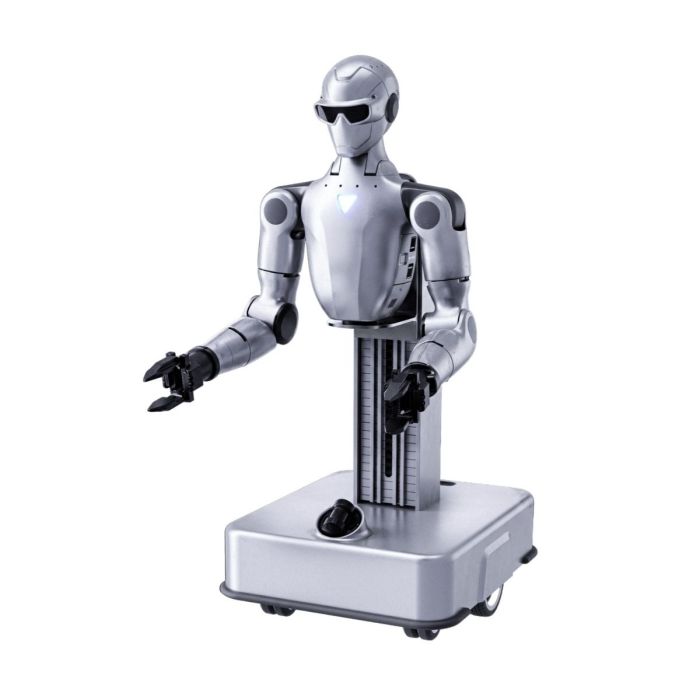
Picture a lab bench with one more colleague at it: one that looks at the same part you do, turns toward whoever is speaking and reaches out with two arms. That is the idea behind the Unitree R1-A5-D Smart Ultimate B Humanoid Robot, a platform meant for people who want to put perception and manipulation in front of students, researchers or integration engineers, not simply watch a machine move around.
The product is available through this page, by quotation.
Background
Unitree and the R1 lineage
UNITREE ROBOTICS is a robotics manufacturer known for legged and humanoid platforms that universities and development teams use for research and teaching. The R1 family sits within that range. Seven versions are named: R1-A5, R1-A7, R1-A5-D, R1-A7-D, R1-A5-D Smart B, R1-A5-D Ultimate B and R1-A5-D Ultimate C.
The store also lists a series of R1-A5-D Smart pages, from Smart A to Smart E, next to the base R1-A5-D. This is a family of closely related configurations rather than a single fixed product, which is why the exact name matters when you request a quotation.
Positioning and key technology
The R1-A5-D belongs to the group of upper-body humanoids built around arms, a waist, a head and a lifting pillar, with a base underneath. Its engineering centers on three things: a jointed body with 16 degrees of freedom, separate processors for the head and the body, and a binocular camera pair in the head.
That combination suits work where the robot has to see an object, decide how to approach it and then reach it. It is less a showpiece than a working platform for software, teaching and trials.
Technical Specifications
| Specification | Value |
|---|---|
| Total degrees of freedom (R1-A5-D) | 16 (5 single arms × 2 + 1 waist + 2 heads + 1 pillar + 2 bases = 16) |
| Forearm + upper arm length (R1-A5-D) | 420 mm |
| Head module computing power | 10 TOPS |
| Head processor | 8-core high-performance CPU |
| Body processor | 8-core high-performance CPU |
| Binocular field of view | Horizontal 146°, Vertical 124° |
| Binocular eye spacing | 60mm |
Specifications as published by the manufacturer; confirmed against the datasheet at quotation. The manufacturer has not published the part number, the IP rating, the box contents, the operating temperature or the maximum chassis speed; they are confirmed at quotation.
What does the dual-processor design mean in practice?
The Unitree R1-A5-D Smart Ultimate B Humanoid Robot carries one 8-core CPU in the head and another in the body. The head module also offers 10 TOPS of computing power. In plain terms, the work of seeing is kept apart from the work of moving. Image processing and perception tasks can run in the head, while the body processor handles the joints.
For a development team, this separation is practical. A vision pipeline can be tried and tuned without competing for the same processor that drives the arms. It also gives teachers a clear way to explain a robot: one part senses, another acts.
How does the binocular vision help?
Two cameras set 60mm apart give the head a stereo view, the same principle that gives people depth perception. The field of view is 146° horizontal and 124° vertical, which is a wide window onto a workspace. A wide view means the robot can keep a table, a tool rack or a person in sight without constant head movement.
The head itself is jointed, and the joint count includes two head degrees of freedom. A camera that can turn on its own is useful when you want the robot to follow a speaker or inspect an item from a slightly different angle.
Who is the Unitree R1-A5-D Smart Ultimate B Humanoid Robot for?
University labs are the clearest fit. A platform with 16 degrees of freedom, two arms and stereo vision gives students and researchers real hardware on which to test grasping, motion planning and human-robot interaction, without building the machine first.
Technical colleges and training centers can use it to teach robotics from sensors to actuators. System integrators can use it to evaluate whether a humanoid upper body fits a service or demonstration application before committing to a larger project. Companies with an innovation team will find it a convenient vehicle for operational trials.
If you are still comparing configurations, the store lists neighbouring pages. The Unitree R1-A5-D Mobile Base Dual-Arm Humanoid Robot is the base model, and the Unitree R1-A5-D Smart B Humanoid Robot is a related Smart version. The wider Unitree R1-A5-D category brings the whole group together. Ask for the differences between these configurations when you request your quotation.
What is the Unitree R1-A5-D Smart Ultimate B Humanoid Robot used for?
- Manipulation research: two arms with a combined forearm and upper arm length of 420 mm on the R1-A5-D give a platform for grasping and reaching experiments.
- Computer vision work: the binocular head provides a stereo view for depth estimation, object detection and tracking studies.
- Human-robot interaction: a head that can turn and a body that can reach suit trials in which a robot responds to a person nearby.
- Teaching robotics: students can follow the path from sensing to processing to motion on one machine.
- Software development: separate head and body processors let teams build and test perception and control code side by side.
- Application evaluation: integrators can test whether a humanoid upper body fits a service, demonstration or inspection task.
Pricing and Availability
This page shows no prices. Every order is handled by quotation: tell us the configuration, the quantity and the destination, and we respond with the details. Delivery, customs and support are arranged with the quotation, so that nothing is left open once you decide. The Unitree R1-A5-D Smart Ultimate B Humanoid Robot is available on this page.
Frequently Asked Questions
How many degrees of freedom does the R1-A5-D have?
The R1-A5-D has 16: five single arms counted as two each, one waist, two head, one pillar and two base degrees of freedom.
What processors does the robot use?
The head and the body each carry an 8-core high-performance CPU, and the head module offers 10 TOPS of computing power.
How wide is the camera view?
The binocular camera has a field of view of 146° horizontal and 124° vertical, with the two eyes set 60mm apart.
What is the IP rating?
Ask us when you request the quotation, and we will come back to you with the answer.
What is in the box?
Ask us for the contents list when you request the quotation.
Are there other versions I can compare?
Yes. Seven versions exist, and the store lists related pages such as the Unitree R1-A5-D Smart A Humanoid Robot and the wider Unitree R1 category.
Where can I buy the Unitree R1-A5-D Smart Ultimate B Humanoid Robot and what does it cost?
You can request it through this page. The cost is given by quotation, which also covers delivery, customs and support, and no price is printed here.
Summary
The Unitree R1-A5-D Smart Ultimate B Humanoid Robot is a colleague for the bench rather than a spectacle: 16 degrees of freedom on the R1-A5-D, two 8-core processors, 10 TOPS in the head and a wide stereo view of 146° by 124°. It suits labs, classrooms and integration teams that want to see, reach and respond with one platform. Anything still open, from the IP rating to the box contents, is settled with the quotation, and this page is the starting point.


