
Unitree R1-A5-D Smart G Humanoid Robot
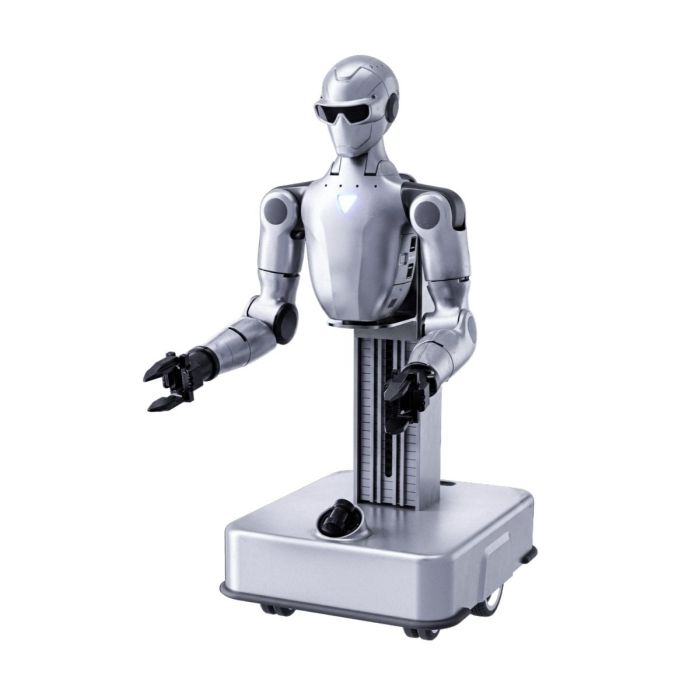
In stock
- BRAND:
- UNITREE ROBOTICS
- MODEL:
- R1-A5-D-Smart-G
- PART #:
- R1-A5-D-Smart-G
- ORIGIN:
- China
- Warranty:
- 12 MONTHS
- AVAILABILITY:
- SUBJECT TO AVAILABILITY
- SKU:
- Unitree-R1-A5-D-Smart-G
Unitree R1-A5-D Smart G Humanoid Robot
Most humanoid demonstrations show a robot walking, but most real jobs ask it to arrive, look and reach. The Unitree R1-A5-D Smart G Humanoid Robot is built around that second list: a mobile base with a chassis LiDAR, a binocular camera in the head, and a body that changes height to meet the work.
This product is available through this page, by quotation.
Background
Unitree and the R1-A5-D family
Unitree Robotics is known for compact, developer-friendly robots that research labs and universities can actually put on a bench. The R1-A5-D family continues that approach. It carries the A5 and A7 naming of the wider R1 line, and the D suffix marks the dual-arm mobile configuration. The Smart G is one named trim of the R1-A5-D. Other trims in the same family are the Smart A to Smart E versions and the Ultimate, and the base platform has its own page: Unitree R1-A5-D Mobile Base Dual-Arm Humanoid Robot.
Where this article gives a figure for the body, such as weight, size and joint ranges, the figure belongs to the R1-A5-D platform. The Smart G is a configuration of that platform, and the figures are kept with the version that carries them. You can browse the whole group in the Unitree R1-A5-D category.
Positioning and key technology
The platform sits between a pure research arm and a full walking humanoid. It gives a team a head with vision and computing, a waist that turns, two arms that take interchangeable end effectors, and a base that carries it all from place to place. That makes it a practical choice where the task is to move to a station, perceive what is there and manipulate it.
The joints use a low-inertia, high-speed inner rotor permanent magnet synchronous motor (PMSM), chosen for superior responsiveness and heat dissipation. The joint output bearing combines a crossed roller with a deep groove ball. In plain terms, the motors react quickly, and the bearings carry load at the joint output.
The head module provides 10 TOPS of computing power. The binocular camera has a horizontal field of view of 146° and a vertical field of view of 124°, with an eye spacing of 60mm. The camera set for the R1-A5-D is a chassis LiDAR plus the binocular camera, with a wrist camera as an option.
Technical Specifications
| Specification | Value |
|---|---|
| Weight (R1-A5-D) | Approx. 30kg |
| Shrunk size (R1-A5-D) | 683x520x440mm |
| Raised size (R1-A5-D) | 1600x520x440mm |
| Waist joint (R1-A5-D) | Yaw±35° |
| Head joint (R1-A5-D) | Yaw±115° Pitch±36° |
| Joint motor | Low-Inertia High-Speed Inner Rotor PMSM |
| Joint output bearing | Crossed Roller + Deep Groove Ball |
| Head module computing power | 10 TOPS |
| Binocular field of view | Horizontal 146°, Vertical 124° |
| Eye spacing | 60mm |
| Sensing (R1-A5-D) | Chassis LiDAR + Binocular Camera + Optional Wrist Camera |
| Speakers | Dual Speakers (3W×2) |
| Wireless | WiFi 6 and Bluetooth 5.2 |
| Battery life (battery-powered) | Approx. 1.5h |
| Power supply | External Power or Li-ion Battery |
| Secondary development | Yes |
| End effector options | Two-finger gripper, three-finger dexterous hand or five-finger dexterous hand (optional) |
Specifications as published by the manufacturer; confirmed against the datasheet at quotation.
The manufacturer has not published the box contents, the IP rating, the chassis drive speed, the lifting column payload, the operating temperature or the chassis battery capacity; they are confirmed at quotation.
What makes the Smart G different from a bench-top arm?
A fixed arm is excellent at repeating a motion in one place. It cannot go and find the next place. The R1-A5-D platform adds the things an arm lacks: a chassis LiDAR for sensing the surroundings, a head that looks around, and a waist that turns the upper body. The head turns ±115° in yaw and ±36° in pitch, and the waist turns ±35° in yaw. Together they let the robot face a target without repositioning the whole base.
The body also changes size. Shrunk, it measures 683x520x440mm, and raised, 1600x520x440mm. The footprint stays the same in both positions, so a team can plan floor space once and still reach at different heights. This is a mechanical feature of the R1-A5-D platform, and it is the main reason the design suits shared spaces.
Perception is the other difference. The binocular camera sees a wide scene, 146° across and 124° top to bottom, and the 10 TOPS head module gives it onboard computing to work with. For teams that want a closer view during manipulation, a wrist camera is available as an option.
What can the hands and software do for my project?
The end of the arm decides what the robot can actually handle. This platform offers three optional end effectors: a two-finger gripper, a three-finger dexterous hand and a five-finger dexterous hand. A two-finger gripper is the simple choice for boxes and tools. The dexterous hands are for work where finger movement is the research question itself.
Secondary development is available, so teams can write their own software on top of the platform instead of relying only on fixed behaviors. Wireless connectivity is WiFi 6 and Bluetooth 5.2, which suits a lab network and nearby accessories. Two 3W speakers allow the robot to speak or signal, which helps in demonstrations and teaching.
Power comes from an external supply or a Li-ion battery. On battery, running time is approx. 1.5h, so plan sessions around that and use external power for long tests on the bench.
Who is the Unitree R1-A5-D Smart G Humanoid Robot for?
University and institute laboratories are the clearest fit. A group studying perception, whole-body control or manipulation gets a platform with a head, a waist, two arms and open development. Students can work on a real robot with vision, rather than a simulation alone.
System integrators are the second group. If you are evaluating a humanoid for a pilot in light logistics, inspection, guided demonstrations or service interaction, this platform lets you test the sensing and manipulation chain before committing to a larger program.
Technical schools and training centers also benefit. The size-changing body, the speakers and the interchangeable hands make it a good teaching tool for mechatronics and robotics courses. Companies that want a showpiece for visitors can use the same features for public demonstrations.
Buyers who want to compare configurations can look at the sibling pages for Smart A and Smart B, or at the base mobile platform. Ask us with your quotation request which package fits your hand, compute and development needs.
What is the Unitree R1-A5-D Smart G Humanoid Robot used for?
- Manipulation research. Dual arms with optional two-, three- or five-finger end effectors for grasping studies.
- Perception development. A binocular camera, a chassis LiDAR and a 10 TOPS head module for vision and mapping work.
- Teaching robotics. A hands-on platform for courses in control, sensing and programming.
- Integration pilots. A test bed for companies assessing a humanoid in light handling or service tasks.
- Human-robot interaction. Dual speakers, a turning head and wireless links for guided demonstrations.
- Custom software projects. Secondary development lets teams build and test their own behaviors.
Pricing and Availability
We do not print prices on this page. Quotation is the way to buy: tell us the configuration, hand option and quantity you need, and we will respond with an offer. Delivery, customs and support are arranged together with the quotation. The Unitree R1-A5-D Smart G Humanoid Robot is available on this page.
Frequently Asked Questions
How heavy is the robot and how big is it?
The R1-A5-D platform weighs approx. 30kg. Its shrunk size is 683x520x440mm and its raised size is 1600x520x440mm.
How long does the battery last?
On the Li-ion battery, running time is approx. 1.5h. The robot can also run on external power.
What hands can be fitted?
Three options are listed: a two-finger gripper, a three-finger dexterous hand and a five-finger dexterous hand. All are optional.
Can I write my own software for it?
Yes. Secondary development is available for this platform, so teams can build their own applications on it.
What sensors does it have?
It has a chassis LiDAR and a binocular camera, with an optional wrist camera. The binocular camera covers 146° horizontally and 124° vertically.
Does it have an IP rating, and what is its operating temperature?
Neither figure is listed for this robot yet. Include the question in your request and we will answer it with your quotation.
Where can I buy the Unitree R1-A5-D Smart G Humanoid Robot and what does it cost?
You can buy it through this page, by quotation. We do not list a price here; send us your requirements and we will prepare an offer.
Summary
The Smart G is a humanoid for work that begins with arriving, looking and reaching, not with walking for its own sake. A body that changes height, a head with vision and computing, a turning waist, two arms and a choice of hands make it a flexible research and integration platform, and open development lets your team shape what it does. For a quotation tailored to your project, this page is the starting point.


