
Unitree R1-A5-D Smart F Humanoid Robot
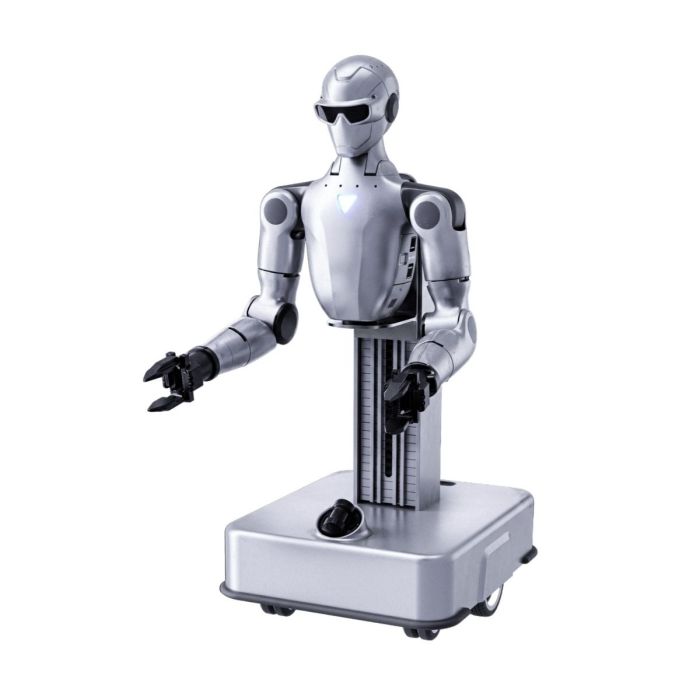
In stock
- BRAND:
- UNITREE ROBOTICS
- MODEL:
- R1-A5-D-Smart-F
- PART #:
- R1-A5-D-Smart-F
- ORIGIN:
- China
- Warranty:
- 12 MONTHS
- AVAILABILITY:
- SUBJECT TO AVAILABILITY
- SKU:
- Unitree-R1-A5-D-Smart-F
Unitree R1-A5-D Smart F Humanoid Robot
A fixed robot arm knows one bench and nothing else. The Unitree R1-A5-D Smart F Humanoid Robot is built on the opposite idea: it carries two arms on a wheeled base, turns its head to look around, bends at the waist, and then reaches. It is a platform for teams who want to study, teach or prototype work that happens in more than one spot in a room.
This product is available through this page, by quotation.
Background
Unitree and the R1 dual-arm line
UNITREE ROBOTICS is the brand behind this robot. The family is the Unitree Dual-Arm Humanoid Robot line, built around ultra-fast deployment and multi-scenario application. The line is organized in versions: R1-A5, R1-A7, R1-A5-D, R1-A7-D and the R1-A5-D Smart F covered here. The letter D marks the wheeled-base models, which move through a space instead of standing in one place.
Within the R1-A5-D group, the Smart configurations have separate pages, lettered A through F. This page deals with Smart F. For the plain base platform, see the Unitree R1-A5-D Mobile Base Dual-Arm Humanoid Robot, and for the wider group, the Unitree R1-A5-D category.
Positioning and key technology
The robot sits between a laboratory arm and a full walking humanoid. It gives a researcher two arms, a head, a waist joint and a mobile chassis without the balance problems of legs. Its joints use a low-inertia, high-speed inner rotor PMSM motor, chosen for superior responsiveness and heat dissipation. For a machine that has to start, stop and reposition its arms constantly, that is a sensible place to put engineering effort.
Sensing on the wheeled-base models combines a chassis LiDAR with a binocular camera, and a wrist camera is optional. Audio is handled by a 4-array microphone and dual speakers, so the robot can be used for voice interaction as well as manipulation. WiFi 6 and Bluetooth 5.2 are on board for connectivity.
Software is open. Full-stack open secondary development is supported, which matters more to most buyers than any single hardware figure, because it means your own control, perception and interaction code can run on the platform.
Technical Specifications
| Specification | Value |
|---|---|
| Product line | Unitree Dual-Arm Humanoid Robot |
| Shrunk size | 683x520x440mm |
| Raised size | 1600x520x440mm |
| Forearm + upper arm length | 420mm |
| Head sensing (wheeled-base models) | Chassis LiDAR + Binocular Camera + Optional Wrist Camera |
| Waist yaw range (-D models) | ±35° |
| Head joint range | Yaw ± 115°, Pitch ± 36° |
| Audio | 4-array microphone + dual speakers |
| Wireless | WiFi 6 & Bluetooth 5.2 |
| Joint motor | Low-Inertia High-Speed Inner Rotor PMSM |
| Secondary development | Full-stack open secondary development supported |
| End effectors | Optional two-finger gripper / three-finger dexterous hand / five-finger dexterous hand |
| High-computing module options | Multiple brands and models available, such as Orin (40-100TOPS) |
Specifications as published by the manufacturer; confirmed against the datasheet at quotation.
The manufacturer has not published the exact weight of the Smart F configuration, the hand weight and grip force, the IP rating, the maximum travel speed, the wheeled chassis payload, the contents of the box or the charging time; they are confirmed at quotation.
How does the robot change its size, and why does it matter?
The dimensions tell the story. In its shrunk size the robot measures 683x520x440mm, and in its raised size 1600x520x440mm. Width and depth stay at 520mm and 440mm, so the footprint on the floor is the same in both states, while the height changes. That is a useful property for a mobile platform: it can travel in a compact posture and extend upward when the task needs reach.
Reach is also a function of the arms. The forearm and upper arm together measure 420mm. Combined with the waist yaw range of ±35° and the head range of ±115° in yaw and ±36° in pitch, the robot can turn its attention and its hands toward a target without moving the whole chassis. For demonstrations and teleoperation studies, that range of motion is often more telling than a headline speed figure.
What can the hands and the compute module do?
The end effector is a choice, not a fixed part. The options are a two-finger gripper, a three-finger dexterous hand and a five-finger dexterous hand. A gripper suits repeatable pick-and-place work. A dexterous hand suits research on grasping, in-hand manipulation and imitation of human movement. Describe your task when you ask for the quotation, and the hand is settled together with it.
On the computing side, multiple brands and models of high-computing module are available, such as Orin at 40-100TOPS. That gives teams running vision models or learning-based control a route to on-board processing instead of relying on an external machine. Combined with the open development stack, the robot can be treated as a general research base rather than a closed product.
Who is Unitree R1-A5-D Smart F Humanoid Robot for?
University and institute labs are the clearest fit. They need a dual-arm mobile platform where students can write control code, test perception and compare hand types. The open development support and the choice of compute modules are the features they will look at first.
Robotics developers and system integrators form a second group. They can use the robot to prototype a service or handling concept before committing to a purpose-built machine. The wheeled base keeps the mechanical complexity lower than a walking robot, so attention goes to the application itself.
Educators and demonstration teams will value the voice hardware, the expressive head and the visible arm movement, which make the robot easy to present to an audience. Teams that want to start from the plain base platform and add their own choices can look at the Unitree R1-A5-D Mobile Base Dual-Arm Humanoid Robot. Those comparing the lettered configurations can also see the Unitree R1-A5-D Smart E Humanoid Robot, then decide which package fits their budget and their task.
Buyers who need a payload, an ingress protection rating or a travel speed for their deployment plan should raise those points when they request the quotation.
What is Unitree R1-A5-D Smart F Humanoid Robot used for?
- Dual-arm manipulation research. Two arms on one body let teams test coordinated grasping and handover tasks.
- Teleoperation and imitation learning. The head, waist and arm range suit studies in which an operator guides the robot and the data trains a model.
- Perception and navigation work. The chassis LiDAR and binocular camera support mapping, obstacle detection and object recognition projects.
- Voice and human-robot interaction. The 4-array microphone and dual speakers allow spoken exchanges with visitors or students.
- Teaching and demonstrations. A mobile humanoid with open software is a strong classroom and exhibition platform.
- Application prototyping. Integrators can test a handling or service idea with a choice of end effectors and compute before building a final system.
Pricing and Availability
No price is listed for this robot, because the configuration, the hand and the compute module all shape the offer. Quotation is the way to buy: tell us your application, the end effector you prefer and the compute module you need, and we will respond with an offer. Delivery, customs and support are arranged with the quotation. The Unitree R1-A5-D Smart F Humanoid Robot is available on this page.
Frequently Asked Questions
What is the size of the robot?
The shrunk size is 683x520x440mm and the raised size is 1600x520x440mm.
Does it support my own software?
Yes. Full-stack open secondary development is supported, so you can run your own control and perception code.
Which hands can be fitted?
The options are a two-finger gripper, a three-finger dexterous hand and a five-finger dexterous hand. Tell us your task and we will settle the hand with your quotation.
What sensors does it carry?
The wheeled-base models use a chassis LiDAR and a binocular camera, with an optional wrist camera. Audio comes from a 4-array microphone and dual speakers.
Can it connect wirelessly?
Yes, it supports WiFi 6 and Bluetooth 5.2.
What is its payload, IP rating or top speed?
Those figures are not in the specification table above. Ask for them when you request your quotation.
Where can I buy Unitree R1-A5-D Smart F Humanoid Robot and what does it cost?
You can request it through this page, by quotation. The cost depends on the configuration you choose, and we provide it with the quotation rather than listing a figure here.
Summary
The Unitree R1-A5-D Smart F Humanoid Robot trades the fixed bench of a single arm for a body that can move, look, bend and reach. It offers a wheeled base, a size that changes in height only, a defined range of head and waist motion, a choice of hands and compute modules, and open software for your own work. For a clear view of the configuration you need, this page is the starting point.


