
Unitree H2-D Ultimate H Humanoid Robot
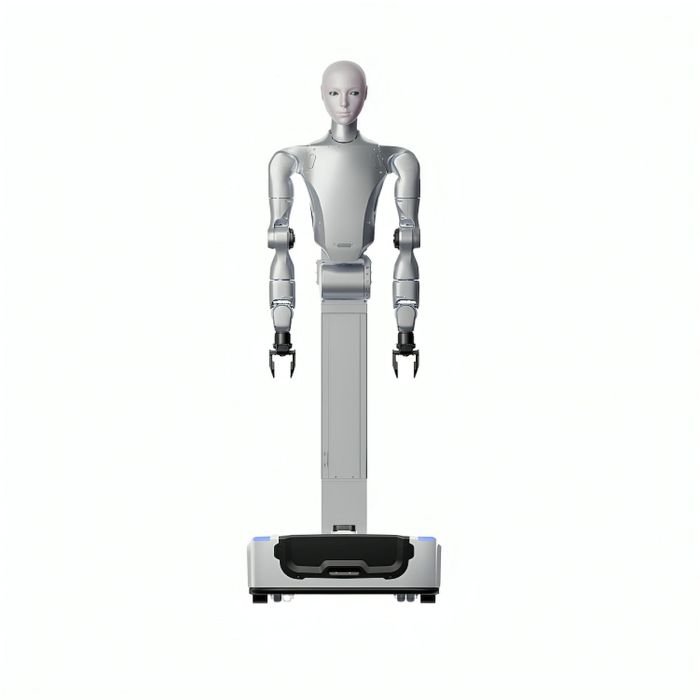
In stock
- BRAND:
- UNITREE ROBOTICS
- MODEL:
- H2-D-Ultimate-H
- PART #:
- H2-D-Ultimate-H
- ORIGIN:
- China
- Warranty:
- 12 MONTHS
- AVAILABILITY:
- SUBJECT TO AVAILABILITY
- SKU:
- Unitree-H2-D-Ultimate-H
Unitree H2-D Ultimate H Humanoid Robot
Walking is the hardest thing a humanoid does, and for many jobs it is not the thing that matters. The Unitree H2-D Ultimate H Humanoid Robot takes the other route: a two-armed upper body that rides a wheeled base and a lifting column, so it can crouch to the floor, stand to full working height and turn on the spot, without ever having to balance on two feet.
The Unitree H2-D Ultimate H Humanoid Robot is available through this page, by quotation.
Background
Unitree and the H2 Series
Unitree Robotics is known for building robots in-house, from the servo motors to the software that drives them. Its H2 Series of dual-arm humanoid robots has two product lines, H2-D and H2-A. The H2-D line is the wheeled, column-mounted one, and the H2-A line is the second branch of the series. The versions the sources name are the H2-A Standard, the H2-D Standard and the H2-D Flagship.
The H2-D Ultimate H sits in the H2-D family, alongside the Ultimate A, B, C, D and E listings in our store. The source material describes the H2-D Flagship, and the figures in this article are given for that version.
Positioning and key technology
The H2-D is built for work that happens at many heights. Its waist supports 0–115° of body pitch, so the robot can reach for items at floor level and handle items overhead while keeping a natural, ergonomic posture. A lifting column changes the overall height of the machine, and a dual-wheel differential drive carries it from place to place.
For navigation, the mobile platform integrates LiDAR, depth cameras and multiple other sensors for autonomous navigation and obstacle avoidance. The body is made of aerospace-grade aluminum, titanium alloy and high-strength engineering plastics. On the software side, Unitree offers comprehensive SDKs and APIs with a mature navigation software stack, which lets developers focus on application innovation and cuts development cycles from months to weeks.
Technical Specifications
| Specification | H2-D Flagship |
|---|---|
| Total weight (with battery) | Approx. 120Kg |
| Overall dimensions, max column height | 1700x576x633mm |
| Overall dimensions, min column height | 1200x576x633mm |
| Lift speed | Up to 200 mm/s |
| Waist pitch range | 0–115° body pitch |
| Maximum mobility speed | Up to 1.5 m/s |
| Drive system | Servo motors, dual-wheel differential drive, 360° in-place rotation |
| Navigation sensors | LiDAR, depth cameras and multiple sensors |
| Battery | Quick-Release Base Battery: 48V/30Ah (1.44 kWh) |
| Battery life | Approx. 5h (Replaceable Battery / Auto Charging) |
| Voice interaction | Microphone array and high-power speaker |
| Wireless connectivity | WiFi 6 and Bluetooth 5.2 |
| End-effector options | 2-Finger Gripper / 3-Finger Dexterous Hand / 5-Finger Dexterous Hand |
| Materials | Aerospace-Grade Aluminum, Titanium Alloy, High-Strength Engineering Plastics |
| Handheld controller | Yes |
Specifications as published by the manufacturer; confirmed against the datasheet at quotation.
The manufacturer has not published the IP rating, the camera resolution, the included hand model, the package contents, the charging time, the operating temperature range or the payload capacity of the chassis; they are confirmed at quotation.
What makes a wheeled, column-mounted humanoid different from a walking one?
A walking humanoid has to spend much of its engineering budget on staying upright. The H2-D spends it elsewhere. Its dual-wheel differential drive moves the robot at up to 1.5 m/s and lets it rotate a full 360° in place, which is useful in narrow aisles and around furniture where there is little room to turn.
The lifting column is the other half of the idea. The overall height runs from 1200 mm with the column lowered to 1700 mm with the column raised, at a footprint of 576 by 633 mm. The column moves at up to 200 mm/s. Combined with the 0–115° waist pitch, the arms can work from floor level up to overhead positions without the robot changing its footing. For tasks such as picking from low bins and loading high shelves, that is a practical advantage over a fixed-height body.
The trade-off is plain. A wheeled base suits floors and flat surfaces, and this article makes no claim about stairs or rough ground. If your site is a warehouse, a lab, a showroom or a service area with level floors, the design fits. If it is not, a different platform may suit you better.
What hands can the H2-D carry?
The end effectors are a choice: an optional 2-finger gripper, a 3-finger dexterous hand or a 5-finger dexterous hand. A simple gripper favors repeatable pick-and-place work, while the dexterous hands are aimed at tasks that need finer manipulation and research on hand control.
Tell us your task when you request a quotation and we will go through the hand options for the Ultimate H configuration with you. Choosing the hand early also helps you plan your software, because the control approach differs between a gripper and a five-finger hand.
Who is the Unitree H2-D Ultimate H Humanoid Robot for?
University and corporate research labs are a natural fit. The SDKs and APIs, the navigation stack and the choice of hands give teams a platform on which to develop manipulation, navigation and human-robot interaction without first building a mobile base.
System integrators can use it as the core of a pilot cell for logistics, light assembly or service tasks, thanks to its variable height, quick-release battery and automatic charging. Training institutions can put a real humanoid in front of students, and the handheld controller makes basic operation straightforward. Innovation centers and showrooms can use the voice interaction hardware, a microphone array with a high-power speaker, for guided demonstrations.
If you want to compare configurations first, see the Unitree H2-D and H2-D Ultimate categories. Buyers who want the entry listing in the family can look at the Unitree H2-D Standard I Humanoid Robot, and those weighing neighboring Ultimate listings can open the Unitree H2-D Ultimate A Humanoid Robot page.
What is the Unitree H2-D Ultimate H Humanoid Robot used for?
- Floor-to-shelf picking. The waist pitch and lifting column let the arms reach low and high positions from one spot.
- Autonomous navigation research. LiDAR, depth cameras and a mature navigation stack provide a base for mapping and obstacle avoidance work.
- Manipulation development. Gripper and dexterous hand options support work from simple grasping to fine hand control.
- Human-robot interaction. The microphone array and high-power speaker support natural voice interaction experiments.
- Teaching and demonstration. A full humanoid with SDKs and APIs gives students and visitors something real to program and observe.
- Pilot automation cells. Integrators can test whether a mobile humanoid fits a task before committing to a larger deployment.
Pricing and Availability
We do not publish prices for this robot. The configuration, the hand choice and the destination all shape the offer, so quotation is the way to proceed. Delivery, customs and support are arranged together with the quotation. Send us your application and the details you need, and the Unitree H2-D Ultimate H Humanoid Robot is available on this page.
Frequently Asked Questions
How fast does the H2-D move?
The H2-D Flagship reaches a maximum mobility speed of up to 1.5 m/s. The drive is a dual-wheel differential system that supports 360° in-place rotation.
How tall is it?
With the column lowered, the overall dimensions are 1200x576x633mm. With the column raised, they are 1700x576x633mm.
How long does the battery last?
The Flagship's battery power supply is approx. 5h, with a replaceable battery and auto charging. The quick-release base battery is 48V/30Ah (1.44 kWh).
Which hands are available?
You can choose a 2-finger gripper, a 3-finger dexterous hand or a 5-finger dexterous hand. Ask for the hand that suits your task when you request a quotation.
Can I develop my own software for it?
Yes. Unitree provides comprehensive SDKs and APIs together with a mature navigation software stack, which reduces development cycles from months to weeks.
What wireless connections does it have?
It supports WiFi 6 and Bluetooth 5.2. It also includes a handheld controller.
Where can I buy the Unitree H2-D Ultimate H Humanoid Robot and what does it cost?
You can buy it through this page, by quotation. We do not list a price here; request a quotation with your application details and we will respond with the offer.
Summary
The Unitree H2-D Ultimate H Humanoid Robot trades the difficulty of walking for a design that works at every height: a dual-arm upper body, a 0–115° waist, a lifting column and a wheeled base that turns on the spot. Add LiDAR and depth-camera navigation, a choice of three hand types, a quick-release 1.44 kWh battery and open SDKs, and it becomes a practical tool for labs, integrators and training programs working on level floors. If that matches your project, this page is the starting point.


