
Unitree H2-D Standard I Humanoid Robot
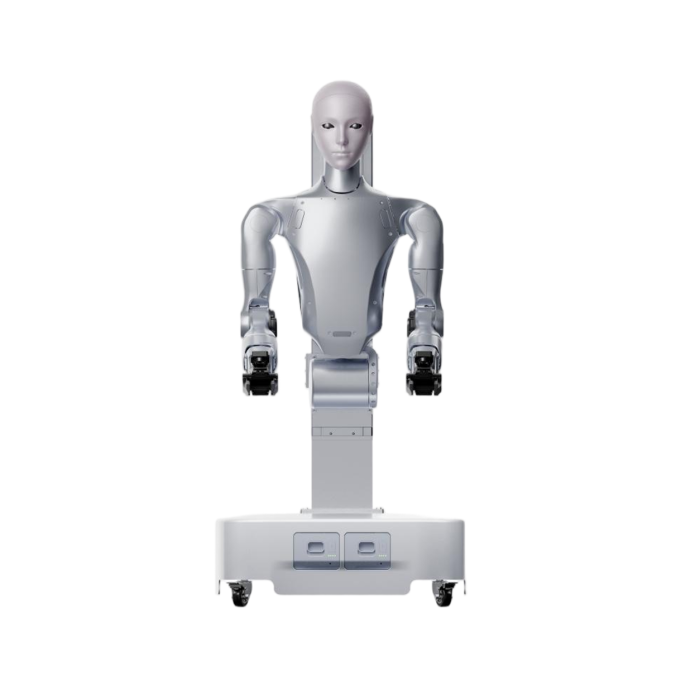
In stock
- BRAND:
- UNITREE ROBOTICS
- MODEL:
- H2-D-Standard-I
- PART #:
- H2-D-Standard-I
- ORIGIN:
- China
- Warranty:
- 12 MONTHS
- AVAILABILITY:
- SUBJECT TO AVAILABILITY
- SKU:
- Unitree-H2-D-Standard-I
Unitree H2-D Standard I Humanoid Robot
A humanoid robot earns its keep not by walking across a stage, but by what a team can do with it the Monday after it arrives. The Unitree H2-D Standard I Humanoid Robot is built around that question: a full-size body with a bionic head, binocular vision and a voice system, delivered ready to run, with a clear line drawn around what it leaves to the EDU versions.
The product is available through this page, by quotation.
Background
Unitree Robotics and the H2 lineage
Unitree Robotics is a manufacturer of legged and humanoid robots, and its machines are common in university labs, research institutes and demonstration programs. The H2 sits in the company's humanoid range and is offered in two variants: the standard H2 and the H2 EDU. Unitree describes both as aimed at research and educational development, and both are sold through direct sales contact.
That lineup matters when you read a listing such as the H2-D Standard I. The figures in this article are those the sources give for the standard H2. Where the EDU version differs, the difference is stated with the EDU name beside it, so one version's capability is never credited to the other.
Positioning and key technology
The standard H2 is the entry-level step in the family. It uses a 31-degree-of-freedom architecture: 6 DoF per leg, 7 DoF per arm, 3 DoF at the waist and 2 DoF at the head. The structure combines aerospace-grade aluminum, titanium alloy and high-strength engineering plastics, which is how a body of this size is kept to approximately 70 kg with its battery fitted.
Its onboard computing is a single unit, PC1 with an Intel Core i5. There is no PC dedicated to user development, no secondary development on the standard version, and no robotic hands are included. In exchange you get a platform with a removable smart battery, intelligent OTA updates, and a bionic head with facial features.
Technical Specifications
| Specification | Value (H2) |
|---|---|
| Standing dimensions | 1820 x 456 x 218 mm |
| Weight with battery | Approximately 70 kg |
| Total degrees of freedom | 31 |
| Degrees of freedom distribution | 6 DoF per leg, 7 DoF per arm, 3 DoF at the waist, 2 DoF at the head |
| Max leg joint torque | 360 N.m |
| Max arm joint torque | 120 N.m |
| Max arm payload | Peak: ~15 kg; nominal: ~7 kg |
| Materials | Aerospace-grade aluminum + titanium alloy + high-strength engineering plastics |
| Battery | 15 Ah (0.972 kWh) |
| Battery life | Approximately 3 h |
| Onboard computing | PC1: Intel Core i5 |
| Vision sensor | Wide-angle humanoid binocular camera |
| Voice interaction | Array microphones + high-power speaker |
| Connectivity | Wi-Fi 6, Bluetooth 5.2 |
| Removable smart battery | Yes |
| Intelligent OTA | Yes |
| Bionic head with facial features | Yes |
Specifications as published by the manufacturer; confirmed against the datasheet at quotation.
The manufacturer has not published the top walking speed, the IP rating, the charging time, the operating temperature range, the noise level or whether a lidar is fitted; they are confirmed at quotation.
What makes the standard H2 different from the H2 EDU?
The difference is not in the body but in what you may do with it. The standard H2 has one computing unit, the PC1 with Intel Core i5, and no PC dedicated to user development. Secondary development is not supported. The H2 EDU is the version on which secondary development is supported, and it adds a high-performance computing module of up to Jetson AGX Thor (2070 TOPS), which the standard H2 does not offer.
This is a useful dividing line for a buyer. If your plan is to run the robot as delivered, show it, study how it moves, or evaluate a humanoid form factor before committing a development budget, the standard version covers that. If your team intends to write its own software stack, train models on the machine or work with external hands and heavier onboard compute, the EDU path is the one to ask about. You can compare the wider family in the Unitree H2-D category.
What does the 31-degree-of-freedom body give you?
Degrees of freedom decide how natural a humanoid's motion can be. Six per leg give each limb the range needed to balance and step, and seven per arm give a reach that resembles a human arm rather than a simple pointer. Three at the waist let the torso turn and bend, so the robot can face a person or a shelf without shuffling its feet. Two at the head let it look toward whoever is speaking.
Strength supports that reach. The maximum leg joint torque is 360 N.m and the maximum arm joint torque is 120 N.m. The arm payload is a peak of about 15 kg and a nominal figure of about 7 kg, so the peak is for short moments and the nominal figure is the one to plan routine tasks around. Note that no robotic hands are included with the standard H2, so the payload applies to the arm itself and not to any gripper you might later consider.
Who is the Unitree H2-D Standard I Humanoid Robot for?
Universities and technical schools are the clearest fit. A full-size humanoid with a facial head, a voice system and binocular vision gives students something real to study, and the removable smart battery keeps a session going without waiting beside a charger. Research groups that want to observe locomotion and interaction, rather than modify the control software, will also find the standard version sufficient.
Exhibition and innovation-center teams form a second group. Visitors respond to a robot that has a face, speaks through a high-power speaker and turns toward them, and OTA updates mean the machine can be kept current without a service visit. Companies in the Caribbean that are weighing humanoid robotics for hospitality, education or training programs can also use it as an evaluation platform before deciding on a larger program.
Teams that need their own software on the robot should look at the EDU versions rather than this one. The H2-D Standard category lists the related configurations, and our team can advise on which suits the project.
What is the Unitree H2-D Standard I Humanoid Robot used for?
- Teaching humanoid robotics. Students see a 31-DoF body at full scale and learn how legs, arms, waist and head work together.
- Research observation. Laboratories study bipedal motion and human-robot interaction on a platform made for research and educational development.
- Public demonstrations. The bionic head, array microphones and speaker give exhibitions a robot that looks at people and talks.
- Interaction trials. Reception, guidance and greeting scenarios can be tried with the voice hardware and binocular camera.
- Light arm tasks. Nominal arm payload of about 7 kg suits trials of simple handling, with no hands included.
- Platform evaluation. Organizations can judge a humanoid body before choosing an EDU version for secondary development.
Pricing and Availability
We publish no prices on this page. Quotation is the way to buy: tell us your use, your location and the version you need, and we will respond with a quote. Delivery, customs and support are arranged with the quotation. The Unitree H2-D Standard I Humanoid Robot is available on this page.
Frequently Asked Questions
How many degrees of freedom does the robot have?
It has 31 in total: 6 per leg, 7 per arm, 3 at the waist and 2 at the head.
How long does the battery last?
Battery life is approximately 3 h from the 15 Ah (0.972 kWh) removable smart battery.
Can I develop my own software on it?
Not on the standard H2, where secondary development is not supported. It is supported on the EDU versions, which also offer a computing module of up to Jetson AGX Thor (2070 TOPS).
What is included with it?
The standard H2 comes with a removable smart battery, a charger and a manual remote controller. No robotic hands are included.
How does it connect?
It supports Wi-Fi 6 and Bluetooth 5.2, and it receives intelligent OTA updates.
What sensors and voice hardware does it have?
It has a wide-angle humanoid binocular camera for vision, and array microphones with a high-power speaker for voice interaction.
Where can I buy the Unitree H2-D Standard I Humanoid Robot and what does it cost?
You can buy it through this page by requesting a quotation. The cost depends on the configuration and delivery, and it is given in the quotation, not printed here.
Summary
The value of this humanoid is in what it does on day one: a 31-DoF body, 360 N.m leg joint torque, binocular vision, a voice system and a face, all running on a removable battery of about 3 h. Its limit is equally clear, since secondary development belongs to the EDU versions. If that balance fits your lab, classroom or exhibition floor, this page is the starting point.


