
Unitree G1 Edu Ultimate F U8 Humanoid Robot (G1EDU-U8)
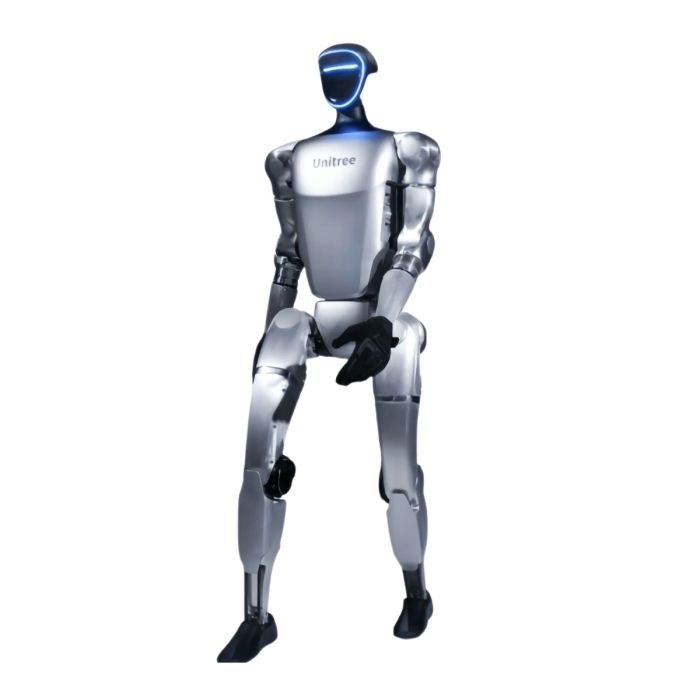
In stock
- BRAND:
- UNITREE ROBOTICS
- MODEL:
- G1 EDU ULTIMATE F
- PART #:
- G1EDU-U8
- ORIGIN:
- China
- Warranty:
- 12 MONTHS
- AVAILABILITY:
- SUBJECT TO AVAILABILITY
- SKU:
- Unitree-G1-Edu-U8
- Buy 2 for $66,825.00 each and save 1%
Unitree G1 Edu Ultimate F U8 Humanoid Robot (G1EDU-U8)
A humanoid with 41 degrees of freedom gives a research team a great deal of motion to work with, but motion alone does not make a useful lab partner. The Unitree G1 Edu Ultimate F U8 Humanoid Robot (G1EDU-U8) pairs that body with two five-finger hands that feel what they touch, so your experiments can move from walking demonstrations to real handling tasks.
The product is available through this page, by quotation.
Background
The G1 Edu line and where the Ultimate F sits
The G1 Edu series is the education and development branch of the Unitree G1 humanoid family. It comprises eight versions: G1 Edu Standard, G1 Edu Plus, and six Ultimate variants lettered A to F. They share one platform and differ mainly in joint count and in the hands they carry. The Standard version has 23 degrees of freedom and the Plus version has 29. The Ultimate A and B versions have 43, and the Ultimate C, D, E and F versions have 41.
The Ultimate F is the version this page covers. Its distinguishing feature is the pair of BrainCo Revo 2 Touch hands. Every figure in this article that belongs to the Ultimate F is labeled as such, and figures that belong to the whole G1 Edu series are labeled as series figures. If you want to see the wider family, the Unitree G1 category lists the other versions side by side.
Positioning: a platform built to be programmed
The Ultimate F is not a show robot. It comes with secondary development enabled, over-the-air updates and a manual controller. That combination matches how universities, laboratories and integrators work: they write their own control software, test it on the hardware and update the robot as the project grows. The robot carries a depth camera and 3D LiDAR for perception. A four-microphone array and a 5 W speaker support voice interaction experiments. Compute is 100 TOPS, which gives onboard room for perception and learning workloads.
Many humanoid platforms stop at the wrist. This version continues into the fingers, and that is the main reason to choose it over a lighter G1 Edu configuration.
Technical Specifications
| Specification | Value |
|---|---|
| Version | G1 Edu Ultimate F (G1EDU-U8) |
| Total degrees of freedom (Ultimate F) | 41 |
| Degrees of freedom per leg (Ultimate F) | 6 |
| Degrees of freedom per arm (Ultimate F) | 7 |
| Degrees of freedom of waist (Ultimate F) | 3 |
| Dexterous hands (Ultimate F) | 2× five-finger BrainCo Revo 2 Touch hands with tactile sensing for pressure, friction, direction and proximity |
| AI computing (Ultimate F) | 100 TOPS |
| Secondary development (Ultimate F) | Yes |
| Knee joint torque (G1 Edu series) | 120 N·m |
| Sensors (G1 Edu series) | Depth camera + 3D LiDAR |
| Microphone array (G1 Edu series) | 4 microphones |
| Speaker (G1 Edu series) | 5 W |
| Battery (G1 Edu series) | Smart battery, 9000 mAh, quick release |
| Charger (G1 Edu series) | 54 V / 5 A |
| Connectivity (G1 Edu series) | Wi-Fi 6 / Bluetooth 5.2 |
| Joint encoders (G1 Edu series) | Dual encoder |
| Cooling (G1 Edu series) | Local air cooling |
| Travel speed (G1 Edu series) | Up to 2 m/s |
| Over-the-air updates (G1 Edu series) | Yes |
| Manual controller (G1 Edu series) | Yes |
Specifications as published by the manufacturer; confirmed against the datasheet at quotation.
The manufacturer has not published the standing dimensions, the weight, the payload, the battery runtime, the IP rating or the full contents of the box for this version; they are confirmed at quotation.
What makes the Ultimate F different from the lighter G1 Edu versions?
The first difference is the body. The Standard version has 23 degrees of freedom, with 5 per arm and 1 in the waist. The Ultimate F has 41, with 7 per arm and 3 in the waist, so the torso and arms can reach and orient in ways a simpler configuration cannot. Each leg has 6 degrees of freedom in every version of the series, so the walking base is shared across the family.
The second difference is the hands. The Ultimate F carries two five-finger BrainCo Revo 2 Touch hands. Their tactile sensing covers pressure, friction, direction and proximity. For a research group, this means a grasp can be studied through contact data rather than judged by eye alone. Slip, grip force and approach to an object become signals you can record and train on.
The third difference is the complexity that comes with it: more joints and sensing mean more to configure. A team that only wants to study locomotion may be better served by a lighter version, for example the Unitree G1 Edu Plus Humanoid Robot with Fake Hands (G1EDU-U2), which has 29 degrees of freedom.
How does the Ultimate F handle development work?
Secondary development is available, so your own code can drive the robot. Over-the-air updates let you refresh software without a workshop visit, and a manual controller gives you a direct way to move the robot while you test. Dual encoders sit on the joints, and local air cooling is fitted to the series. The knee joint torque is 120 N·m.
Connectivity is Wi-Fi 6 and Bluetooth 5.2, which suits a lab network and nearby accessories. The depth camera and 3D LiDAR give the robot a view of its surroundings, and the 100 TOPS of AI computing is there for running that perception on the robot itself. Travel speed is up to 2 m/s. The 9000 mAh smart battery is quick release, so it can be swapped, and the charger is rated 54 V / 5 A.
Who is the Ultimate F for?
University laboratories are the clearest fit. A group studying manipulation, tactile learning or whole-body control gets a platform with legs, a waist, arms and sensing fingers in one body. Doctoral students can write their own control code and test it on real hardware instead of in simulation alone.
Technical colleges and training centers can use the robot to teach robotics beyond the classroom slides, since students see joints, sensors and software working together. Integrators and corporate research teams can use it to evaluate whether humanoid handling suits a future product or service before committing to a larger program.
If your work centers on walking and balance, or you prefer a simpler hand, look at other versions. The Unitree G1 Edu Pro A U9 Humanoid Robot (G1EDU-U9) is one sibling to compare, and the Research Robots category shows other platforms for academic work.
What is the Ultimate F used for?
- Manipulation research. Test grasping strategies with five-finger hands that sense pressure, friction, direction and proximity.
- Whole-body control. Develop coordinated motion across 41 joints, including the 3-degree-of-freedom waist and 7-degree-of-freedom arms.
- Perception and navigation. Run experiments with the depth camera and 3D LiDAR, using the 100 TOPS of onboard computing.
- Human-robot interaction. Use the four-microphone array and the 5 W speaker to study voice and speech-driven behavior.
- Teaching and training. Give students a real humanoid to program through secondary development and over-the-air updates.
- Prototype evaluation. Let integrators assess humanoid handling for future applications before larger investment.
Pricing and Availability
Pricing for the Unitree G1 Edu Ultimate F U8 Humanoid Robot is given by quotation, because the final configuration, accessories and support terms are agreed with each buyer. Send us your requirements and we will prepare a quotation for you. Delivery, customs and support are arranged with the quotation. The robot is available on this page.
Frequently Asked Questions
How many degrees of freedom does the Ultimate F have?
It has 41 in total, with 6 per leg, 7 per arm and 3 in the waist.
What hands does this version carry?
It carries two five-finger BrainCo Revo 2 Touch hands with tactile sensing for pressure, friction, direction and proximity.
Can I write my own software for it?
Yes. Secondary development is available, and the series supports over-the-air updates and a manual controller.
What sensors does it have?
The G1 Edu series carries a depth camera and 3D LiDAR, along with a four-microphone array and a 5 W speaker.
How fast can it travel, and how is it powered?
The series travels at up to 2 m/s and uses a 9000 mAh quick-release smart battery with a 54 V / 5 A charger.
Which wireless connections does it support?
The G1 Edu series supports Wi-Fi 6 and Bluetooth 5.2.
Where can I buy the Unitree G1 Edu Ultimate F U8 Humanoid Robot and what does it cost?
You can request it through this page. The cost is given by quotation, based on your configuration and delivery needs.
Summary
Motion is where most humanoid projects begin, and touch is where the harder questions start. The Unitree G1 Edu Ultimate F U8 Humanoid Robot (G1EDU-U8) answers both with 41 degrees of freedom, sensing five-finger hands, 100 TOPS of AI computing and an open development path. It suits teams that want to study how a humanoid handles objects, not only how it walks. For a quotation and delivery planning, this page is the starting point.
Specifications
General
Physical
Software
Shipping
Feature
| Equipped with all the functions of G1-Edu standard version |
| Upgraded from 1 to 3 degrees of freedom in the waist. |
| Single arm freedom upgraded from 5 to 7, both arms upgraded. |
| Up to 29 DOF for whole robot |


