
Unitree B2 Industry Grade Quadruped Robot Dog Basic B2 Kit with Battery, Navigation Kit
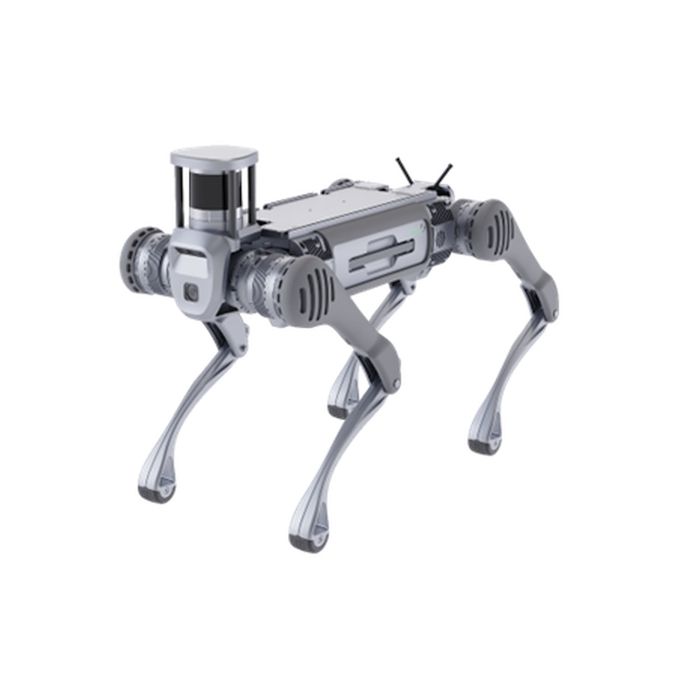
In stock
- BRAND:
- UNITREE ROBOTICS
- MODEL:
- B2-ROBOT-KIT
- PART #:
- B2-ROBOT-KIT
- ORIGIN:
- China
- Warranty:
- 12 MONTHS
- AVAILABILITY:
- SUBJECT TO AVAILABILITY
- SKU:
- Unitree-B2-ROBOT-KIT
Unitree B2 Industry Grade Quadruped Robot Dog Basic B2 Kit with Battery, Navigation Kit
Most robot dogs are judged by how they look walking across a showroom floor. An industrial machine is judged by what it can still do on hour five, with a payload on its back and a flight of steps ahead. The Unitree B2 Industry Grade Quadruped Robot Dog Basic B2 Kit with Battery, Navigation Kit is built for that second test: a large legged platform with a big battery, strong joints and a perception package for work outside the laboratory.
The Unitree B2 Industry Grade Quadruped Robot Dog Basic B2 Kit with Battery, Navigation Kit is available through this page, by quotation.
Background
Unitree Robotics and the B2 lineage
Unitree Robotics is a manufacturer of legged robots, with a catalog that runs from compact companion and education machines to humanoids and heavier industrial quadrupeds. The B2 sits at the industrial end of the quadruped range. Its family is named in the sources as B2, B2-W (the wheeled version), B2-Ex and B2-NAV-KIT, the B2 with a navigation kit as described by one retailer. You can browse the wider family in the Unitree B2 category.
The idea behind the line is simple. A quadruped can go where wheeled and tracked vehicles struggle, such as stairs, uneven ground, narrow passages and cluttered plant rooms. The B2 pushes this idea toward longer working shifts and heavier loads than a small research robot can manage.
Positioning and key technology
The B2 is presented as an industry grade platform. Three design choices stand out in the sources. First, the battery supports quick change, and autonomous charging solutions are available as an option, which suits routines where the robot returns to a dock and keeps working. Second, the structural design allows switching between legged and wheeled forms as an option. Third, the software side supports continuous OTA software upgrade and update.
For perception and control, the standard configuration lists an Intel Core i5 for platform functions and an Intel Core i7 for user development. The sensor set is one 3D LiDAR, two depth cameras and two optical cameras, and it varies with different configurations. This kit is sold with a battery and a navigation kit, so it is aimed at buyers who want to start with an autonomy-ready package rather than a bare chassis.
Technical Specifications
| Specification | Value |
|---|---|
| Dimensions, standing | ≈ 1098mm×450mm×645mm |
| Dimensions, lying prone | ≈ 880mm×460mm×330mm |
| Weight | ≈ 60kg total weight (battery included) |
| Battery | 45Ah (2250Wh), voltage 58V |
| Battery life | 4-6h |
| Endurance, no load | Walking without load > 5h, mileage > 20km |
| Endurance, 20kg load | Walking with 20kg load > 4h, mileage > 15km |
| Max joint torque | About 360N.m |
| Standing load | ≥ 120kg |
| Continuous walking load | > 40kg |
| Obstacle crossing | Max 40cm |
| Continuous stair climbing | Stairs of 20~25cm |
| Ditch jumping width | 0.5~1.2m |
| Operating temperature | -20℃ ~ 55℃ |
| Control and perception computing | Intel Core i5 (platform function), Intel Core i7 (user development) |
| Sensors | 3D LiDAR ×1 + depth camera ×2 + optical camera ×2 (varies with different configurations) |
Specifications as published by the manufacturer; confirmed against the datasheet at quotation.
The manufacturer has not published the remote controller specifications, the charging time, the charger specifications, the contents of the navigation kit or the software and SDK details; they are confirmed at quotation.
What makes the B2 different from a small research quadruped?
The first difference is endurance. The B2 is listed with a battery life of 4-6h. Walking without load it is listed at more than 5h and more than 20km, and with a 20kg load at more than 4h and more than 15km. For a patrol or inspection round, those figures decide whether one battery covers a shift or whether the robot needs a swap midway, and the quick-change battery design is there for exactly that case.
The second difference is load. The standing load is listed at 120kg or more, and the continuous walking load at more than 40kg. Alongside a maximum joint torque of about 360N.m, this tells you the robot is meant to carry equipment such as sensor masts, inspection payloads or tools, rather than only its own electronics. The running speed is realized in special configurations, and in practice there is a speed limit for security purposes, so plan your routes around dependable walking rather than top speed.
The third difference is terrain. The B2 is listed to cross obstacles of up to 40cm, climb stairs of 20~25cm continuously and jump ditches of 0.5~1.2m. The operating temperature range of -20℃ ~ 55℃ covers cold stores, outdoor yards and hot plant rooms alike.
What does the navigation kit add to the basic B2?
A walking platform alone gives you mobility. A navigation kit is what turns that mobility into repeatable routes. The sensor set on the B2 includes a 3D LiDAR, depth cameras and optical cameras, and the computing options include an Intel Core i7 for user development. That combination suits teams who want to build their own autonomy, mapping or inspection software on top of the robot.
The manufacturer's page does not publish the contents of the navigation kit, nor the software and SDK details, so we do not describe them here. Ask for both when you request a quotation, so you can match the kit to your development plan before you commit.
Who is the Unitree B2 kit for?
Industrial operators are the clearest fit: plants, utilities, energy sites and warehouses where a round has to be walked often, on stairs and uneven floors, in hard conditions. A legged robot with long endurance can take over the repetitive part and leave people with the decisions.
Research labs and universities with advanced robotics programs also benefit, particularly when the project needs real payload capacity, a capable onboard computer and a platform that receives OTA updates. System integrators can use the B2 as a mobile base for sensors, manipulators or custom inspection modules.
If your site is mostly flat, smooth floors over long distances, consider the wheeled option. The Unitree B2-W Industry Grade Quadruped Robot Dog with Wheels is the version to review for that case. Buyers who plan to run the robot for long periods may also want to look at the Accessories page for related items.
What is the Unitree B2 used for?
- Industrial inspection. Carries cameras and sensors along fixed routes past gauges, pumps and cable trays, including up and down stairs.
- Payload carrying. Moves equipment or sensor packages using its continuous walking load capacity.
- Autonomy development. Gives engineering teams a LiDAR and camera platform with a development-grade computing option.
- Research and education. Supports advanced university work in locomotion, perception and navigation.
- Hazardous or remote sites. Keeps people out of hot, cold or awkward areas, within the stated temperature range.
- System integration. Serves as a mobile base for custom modules, with optional autonomous charging for repeated missions.
Pricing and Availability
We do not print prices on this page. Pricing is provided by quotation, and the quotation is where you confirm the configuration, the kit contents and the options you need. Delivery, customs and support are arranged with the quotation, so you see the full picture before you order. The Unitree B2 Industry Grade Quadruped Robot Dog Basic B2 Kit with Battery, Navigation Kit is available on this page.
Frequently Asked Questions
How long does the battery last?
The battery life is listed as 4-6h. Walking without load it is listed at more than 5h, and with a 20kg load at more than 4h.
What is the battery capacity?
The battery is 45Ah (2250Wh) at 58V. It supports quick change, and autonomous charging solutions are available as an option.
How much can the robot carry?
The standing load is 120kg or more, and the continuous walking load is more than 40kg.
Can it climb stairs?
Yes. It is listed for continuous climbing of stairs of 20~25cm, and for crossing obstacles up to 40cm.
What temperatures can it work in?
The operating temperature range is -20℃ ~ 55℃.
Is there a wheeled version?
Yes. The B2-W is the wheeled version, and the B2 design also supports switching between legged and wheeled forms as an option. See the B2-W kit for details.
Where can I buy the Unitree B2 kit and what does it cost?
You can buy it through this page by requesting a quotation. The cost depends on the configuration and is given in the quotation, not printed here.
Summary
The B2 answers the question that matters on a real site: what does the robot still do after hours of work with a load on its back? Long endurance, a large battery that swaps quickly, strong joints and a LiDAR and camera package make this kit a serious industrial platform. The figures above tell you what it is built to do, and the quotation confirms the rest, including the navigation kit contents and software details. If the Unitree B2 fits your route, your payload and your terrain, this page is the starting point.


