
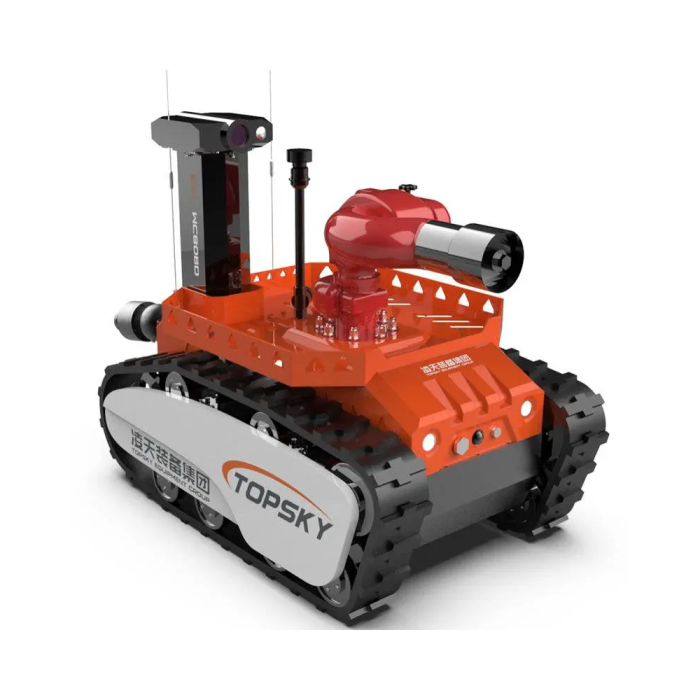
Topsky Tianlong Conquest D5 Explosion-Proof Fire Fighting Robot (RXR-MC80BD)
In stock
- BRAND:
- TOPSKY
- MODEL:
- TIANLONG CONQUEST D5
- PART #:
- RXR-MC80BD
- ORIGIN:
- China
- AVAILABILITY:
- SUBJECT TO AVAILABILITY
- SKU:
- Topsky-D5-RXR-MC80BD
Topsky Tianlong Conquest D5 Explosion-Proof Fire Fighting Robot (RXR-MC80BD)
Some fires cannot be fought by the people best trained to fight them, because the air itself may ignite. The Topsky Tianlong Conquest D5 Explosion-Proof Fire Fighting Robot (RXR-MC80BD) is built for that gap: a tracked machine that goes where the vapor is, so the crew can stay where it is safe.
The product is available through this page, by quotation.
Background
Topsky and the Tianlong Conquest line
TOPSKY is a manufacturer of firefighting and reconnaissance robots for industrial and emergency-response work. The Tianlong Conquest D5 sits in that family as the model made for explosive atmospheres. It is designed and certified for fire-extinguishing and reconnaissance in explosive environments, such as petrochemical refining, oil and fuel gas storage, and other chemical manufacturing, storage and transportation sites.
The model code RXR-MC80BD identifies the base version. Related variants also exist: RXR-MC80BD - M (3kW), RXR-MC80BD-GX0 and RXR-M80BD. The fact sheet gives figures only for the base RXR-MC80BD, so everything on this page describes that version and nothing is borrowed from the others.
Positioning and key technology
The D5 is not a general-purpose utility robot with a nozzle added. Its design starts from the hazard. It is explosion-proof certified and carries IP67 and IP68 ratings. Its tracks use heat-tolerant, fire-retardant rubber with a metal lining. An automatic water curtain cooling system helps protect the machine while it works close to the fire.
The robot is composed of four parts: the robot itself, the fire cannon, the environment detection device and the remote control box. This split matters in practice. The operator works from the control box with a view of the scene, while the vehicle and cannon do the exposed work. An integrated gas detection platform reports gas and environmental parameters, so the same machine that fights the fire can also tell the team what the atmosphere is doing.
Technical Specifications
| Specification | Value |
|---|---|
| Model | RXR-MC80BD |
| Intended use | Fire-extinguishing and reconnaissance in explosive environments |
| Certification and protection | Explosion-proof certified; IP67 and IP68 |
| Track | Heat-tolerant, fire-retardant rubber with metal lining |
| Cooling | Automatic water curtain cooling system |
| Gas detection | Integrated gas detection platform for gas and environmental parameters |
| Hose towing | Can drag two 100M lengths of DN80 fire hose filled with water |
| Monitor control | Remote control of rotation, pitching and multiple spraying modes; easy switch between water and foam |
| Remote control distance | Exceeds 1 kilometer |
| Image system | HD image system with real-time monitoring |
| System composition | Robot, fire cannon, environment detection device, remote control box |
| Thermal imaging | Optional: heat eye detection through infrared thermal imaging |
| Cloud upload | Optional: 4G/5G upload |
| Hose handling | Optional: knotting prevention and auto drop-off function |
Specifications as published by the manufacturer; confirmed against the datasheet at quotation.
The manufacturer has not published the battery capacity, the maximum speed, the operating temperature range, the network connectivity details or the list of included accessories; they are confirmed at quotation.
What makes the D5 different from an ordinary fire monitor on wheels?
A conventional trailer monitor or wheeled unit assumes the surrounding air is merely hot. The D5 assumes it may be explosive. That single assumption changes the build: the explosion-proof certification, the sealing to IP67 and IP68, and the track material chosen to tolerate heat and resist burning. These are not cosmetic extras. They decide whether a machine can be sent into a tank farm or a process area at all.
The second difference is endurance of reach. The remote control distance exceeds 1 kilometer, thanks to its communication technology. For a site where the safe standoff position may be far from the incident, that distance gives the incident commander real choices about where to stand and where to set up the control box.
The third difference is that it works the hose line as well as the monitor. The robot can drag two 100M lengths of DN80 fire hose filled with water. A filled hose is heavy and stubborn, and moving it forward is exactly the task that puts people in danger. Optional knotting prevention and an auto drop-off function address the practical problems of laying hose from a moving vehicle.
How does the D5 stay aware of the fire and the atmosphere?
Fighting blind is how crews make bad decisions. The D5 carries an HD image system for real-time monitoring, and its communication technology transmits stably over a long distance. Heat eye detection through infrared thermal imaging is available as an option, tracking and monitoring a heat source. That is useful when smoke hides the flame or when a hot spot needs to be followed after the main fire is knocked down.
The integrated gas detection platform adds the invisible part of the picture. It detects the gas and environmental parameters around the robot, so the team has information about the atmosphere in addition to what the cameras show. If a 4G or 5G upload is wanted, that is also offered as an option, which lets the picture be shared beyond the control box.
The monitor itself can be controlled remotely for rotation, pitching and multiple spraying modes, and the operator can switch easily between water and foam. Matching the agent to the fuel is a core decision in industrial fires, so having that switch within the operator's reach, rather than at the nozzle, is part of the value.
Who is the D5 for?
The first buyer is the industrial site that carries its own fire risk: refineries, petrochemical plants, fuel and oil gas storage facilities, and chemical manufacturing and transport sites. For these operators, an explosion-proof machine can be part of the on-site emergency plan, ready before an incident rather than borrowed after one.
The second is the public or industrial fire brigade responsible for such sites. A brigade that expects to be called to hazardous-atmosphere incidents can use a robot to take the first and most dangerous position at the fire, while crews stay back.
The third is the safety planner or integrator specifying equipment for a new facility, who needs a machine that combines suppression, hose towing and gas detection in one system.
If your need is mainly scouting, a lighter machine such as the Topsky Small fire reconnaissance robot may be worth comparing. If smoke exhaust is a priority, look at the Topsky Firefighting smoke exhaust and fire extinguishing robot or the Topsky Explosion proof fire extinguishing and smoke exhaust robot. For the wider range, browse the Firefighting Robots category.
What is the D5 used for?
- Fire-extinguishing in explosive atmospheres. Water or foam is delivered from a remotely controlled monitor while crews stay at a distance.
- Reconnaissance. The HD image system and optional thermal imaging let the team see the scene before anyone enters it.
- Gas and environment checks. The integrated detection platform reports gas and environmental parameters at the robot's position.
- Hose laying and towing. The robot can pull two 100M lengths of water-filled DN80 hose toward the fire.
- Long-distance dangerous cargo response. Control from more than 1 kilometer away suits incidents involving hazardous goods.
- Cooling of exposed equipment. The automatic water curtain cooling system protects the robot, and the monitor can wet down adjacent plant where the incident plan calls for it.
Pricing and Availability
No price is printed on this page, because the configuration decides the offer: the base RXR-MC80BD or a related variant, and whether options such as thermal imaging, 4G/5G upload or the hose handling function are included. Quotation is the next step. Delivery, customs and support are arranged together with the quotation, so the Caribbean buyer receives one clear proposal. The D5 is available on this page.
Frequently Asked Questions
Is the D5 certified for explosive environments?
Yes. It is explosion-proof certified, with IP67 and IP68 protection.
How much hose can it drag?
It can drag two 100M lengths of DN80 fire hose filled with water.
Can it spray both water and foam?
Yes. The operator can switch easily between water and foam from the remote control, along with rotation, pitching and multiple spraying modes.
How far away can it be controlled?
The remote control distance exceeds 1 kilometer.
Does it have thermal imaging?
Heat eye detection through infrared thermal imaging is an option. It tracks and monitors a heat source.
What are the battery capacity and top speed?
Neither figure is available yet. We confirm both at quotation.
Where can I buy the Topsky Tianlong Conquest D5 (RXR-MC80BD) and what does it cost?
It is available through this page, by quotation. The cost depends on the version and options you choose, so please request a quotation and we will answer with a full proposal.
Summary
The D5 answers one hard question: who goes in when the air itself is dangerous? A certified explosion-proof, IP67 and IP68 tracked machine with a heat-tolerant track, water curtain cooling, a remotely controlled water and foam monitor, gas detection and the strength to tow two 100M DN80 hose lengths does that job for refineries, fuel storage and chemical sites. Optional thermal imaging, 4G/5G upload and hose handling extend it. For a quotation matched to your site, this page is the starting point.


