
SIASUN Conveyor-Type Mobile Robot (Transporting Type Mobile Robot)
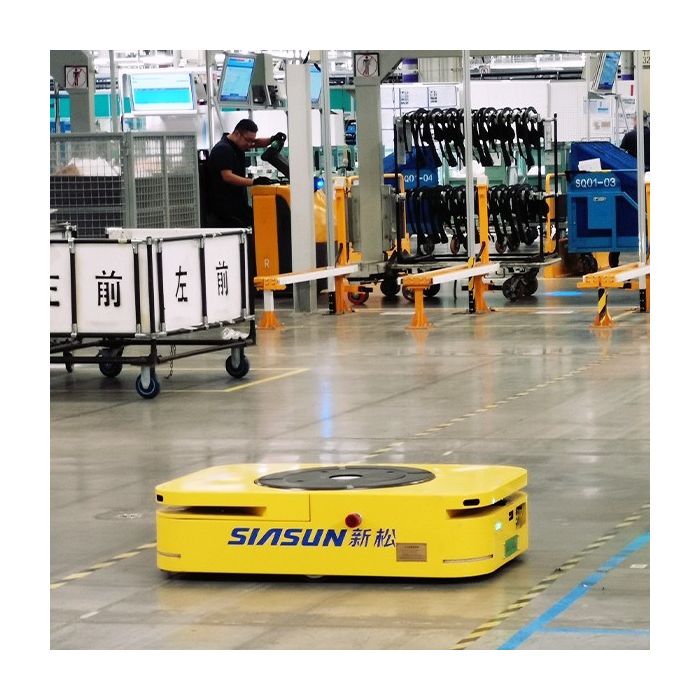
In stock
- BRAND:
- SIASUN
- PART #:
- Transporting Type Mobile Robot
- ORIGIN:
- China
- AVAILABILITY:
- SUBJECT TO AVAILABILITY
- SKU:
- SIASUN-Transporting-Type-Mobile-Robot
SIASUN Conveyor-Type Mobile Robot (Transporting Type Mobile Robot)
Most factories do not struggle to move goods; they struggle to move them the same way twice when the process changes. The SIASUN Conveyor-Type Mobile Robot (Transporting Type Mobile Robot) answers that problem with a conveyor that travels to the work instead of waiting for the work to arrive, and that can be redirected whenever the process is.
The product is available through this page, by quotation.
Background
Where conveyor-type mobile robots come from
When mobile robots were first introduced, their job was simple to state: automate the transport of goods according to their point of origin and destination. A load was picked up in one place and delivered to another, and a person no longer had to walk it across the floor. Conveyor-type mobile robots grow out of that idea. They keep the purpose, which is moving goods between defined points, and they are built to take on the heavier rhythm of production and storage.
SIASUN offers this product as a family rather than a single fixed design. The forms named in the sources are Warehouse robots, Universal Roller Conveyor Shift Mobile Robots, the Electricity meter box push-pull load handling mobile robot, and the Simple Mobile Robot. Each one suits a different handling task, but all of them work on the same principle of replacing a fixed conveyor with a mobile one. You can browse the wider range under the SIASUN category.
Why a mobile conveyor instead of a fixed line
Compared with traditional conveyor lines and similar equipment, conveyor-type mobile robots do not need rails to be laid or the ground to be broken up. Construction is simple and operation is flexible. For a site in the Caribbean, where a building may be shared, leased or modified over the years, that matters: the floor stays as it is, and the system adapts to the building rather than the other way around.
The robots are also connected with the production management system, so that logistics handling efficiency is optimal. The transport task is then coordinated with what the line actually needs, not run as a separate activity on the side.
Technical Specifications
| Specification | Value |
|---|---|
| Product type | Conveyor-type mobile robot for transporting goods between a point of origin and a destination |
| Forms offered | Warehouse robots; Universal Roller Conveyor Shift Mobile Robots; Electricity meter box push-pull load handling mobile robot; Simple Mobile Robot |
| Installation | No rails to lay and no ground to destroy; simple construction |
| Operation | Flexible operation |
| System integration | Connected with the production management system |
| Route logic | Conveyor logical route can be changed at any time according to process changes |
| Fleet size | Number of robots can be adjusted when production increases or decreases |
| Duty profile | Long-distance, high-frequency and high-intensity transport |
Specifications as published by the manufacturer; confirmed against the datasheet at quotation.
The manufacturer has not published the dimensions, the weight, the rated payload, the battery capacity, the travel speed, the navigation method, the positioning and docking accuracy, the safety sensors, the contents of the box, the operating run time or the charging method; they are confirmed at quotation.
What makes a conveyor-type mobile robot different from a fixed conveyor line?
A fixed line is built for one layout. A conveyor-type mobile robot is built for change. The logical route of the conveyor can be changed at any time according to process changes, so when a workstation moves, a new product is introduced or a packing area is relocated, the route is revised in the system and the floor is left untouched. Nothing has to be cut, drilled or removed.
The second difference is how capacity is scaled. With a fixed line, capacity is decided when the line is installed. With mobile robots, the number of units can be flexibly adjusted when production increases or decreases. A site can begin with a modest fleet and add robots as volumes grow, or reduce the fleet in a slow season, without rebuilding anything.
The third difference is the work done. These robots take on long-distance, high-frequency and high-intensity transport, replacing human transport and greatly improving automation efficiency. That is the kind of repetitive walking and carrying that tires people and slows a plant down.
Which form of the SIASUN transporting robot fits which task?
The four forms named in the sources point to four different handling situations. The Warehouse robots address storage areas and the movement of goods within them. The Universal Roller Conveyor Shift Mobile Robots suit connections between roller conveyors, where goods need to be shifted from one conveying point to another. The Electricity meter box push-pull load handling mobile robot is a specialized form for push-pull load handling of that particular type of load. The Simple Mobile Robot is the straightforward option where the task is basic transport.
The sources do not give figures that separate one form from another, so the right choice is made by describing your load, your route and your connecting equipment. If your task is forklift-style handling rather than conveyor transfer, the SIASUN 2000 Kg Forklift Mobile Robot (Handling B20S-1) is a different product worth comparing.
Who is the SIASUN Conveyor-Type Mobile Robot for?
Manufacturers with a changing process are the clearest fit. If product lines are updated, stations are reorganized or the plant layout is expected to evolve, a mobile conveyor avoids the cost and downtime of reworking a fixed one. The sources describe this type of robot as widely used in various industries because of its high degree of automation and intelligence and its flexibility to change with the production process and storage space.
Warehouse and distribution operators are a second group. Where goods move over long distances, many times a day, replacing human transport with robots can free staff for work that needs judgment. Plants with a production management system already in place are a third group, because the robots connect to it and follow its instructions.
Operators who rent their premises, or who cannot break up the floor, are the fourth. Without rails to lay, the installation leaves the building as it was.
What is the SIASUN Conveyor-Type Mobile Robot used for?
- Point-to-point transport. Moving goods from their point of origin to their destination without a person carrying them.
- Replacing fixed conveyor lines. Connecting stations where laying rails or breaking the ground is not wanted.
- Long-distance transport. Covering the distances between production areas and storage that tire human workers.
- High-frequency, high-intensity handling. Running repeated transport cycles through a shift.
- Production-linked logistics. Working with the production management system so handling follows the process.
- Flexible fleet operation. Changing routes and adjusting robot numbers as production rises or falls.
Pricing and Availability
We do not print prices on this page. A quotation is the way forward: tell us the load, the route and the systems the robots must connect to, and we prepare an offer based on that. Delivery, customs and support are arranged with the quotation. The SIASUN Conveyor-Type Mobile Robot (Transporting Type Mobile Robot) is available on this page.
Frequently Asked Questions
Do I need to lay rails or modify the floor?
No. Compared with traditional conveyor lines, conveyor-type mobile robots do not need rails to be laid or the ground to be destroyed, so construction is simple.
Can the route be changed after installation?
Yes. The logical route of the conveyor can be changed at any time according to process changes.
Can I add more robots later?
Yes. The number of mobile robots can be flexibly adjusted when production increases or decreases.
Does it connect to our production system?
Yes. The robots are connected with the production management system so that logistics handling efficiency is optimal.
Which forms are available?
The forms named by the manufacturer are Warehouse robots, Universal Roller Conveyor Shift Mobile Robots, the Electricity meter box push-pull load handling mobile robot and the Simple Mobile Robot.
What is the payload, speed or battery life?
Those figures are listed in the table above only where they are available, and they are not among the published specifications. Send us the load and the route you have in mind and we will address them in your quotation.
Where can I buy the SIASUN Conveyor-Type Mobile Robot and what does it cost?
You can request it through this page. The cost depends on the form and configuration you need, so it is given in a quotation rather than printed here.
Summary
A conveyor that can move to the work, change its route and grow or shrink with production is a different proposition from one fixed to the floor. The SIASUN Conveyor-Type Mobile Robot (Transporting Type Mobile Robot) offers simple construction, flexible operation, connection to the production management system and a design for long-distance, high-frequency and high-intensity transport. Whichever of the four forms suits your site, this page is the starting point.


