
SIASUN P-T1000D (P-T1000D)
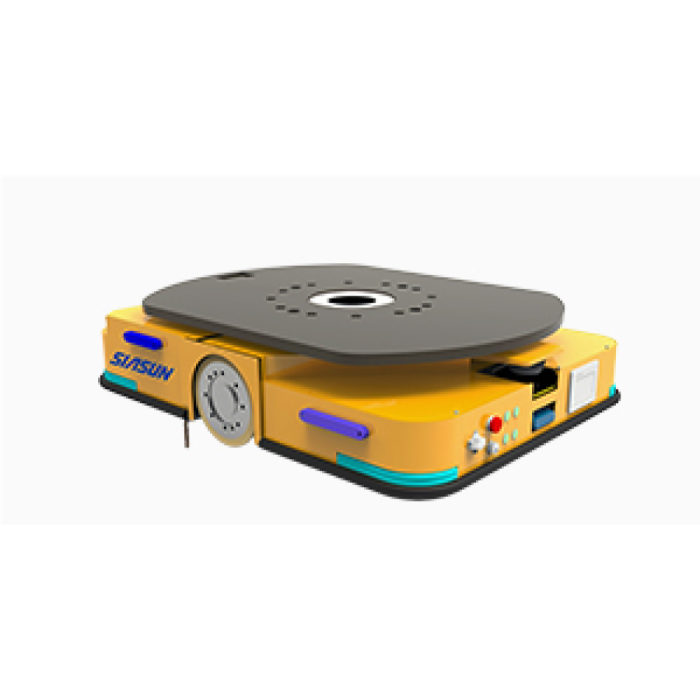
In stock
- BRAND:
- SIASUN
- MODEL:
- P-T1000D
- PART #:
- P-T1000D
- ORIGIN:
- China
- Warranty:
- 12 MONTHS
- AVAILABILITY:
- SUBJECT TO AVAILABILITY
- SKU:
- SIASUN-P-T1000D
SIASUN P-T1000D (P-T1000D)
The most valuable space in a busy plant is often the space nobody looks at: the gap beneath a loaded cart. The SIASUN P-T1000D (P-T1000D) is built to work in that gap. It slips under the load, lifts it, carries it along its route and sets it down again, so aisles stay clear and the work keeps moving without a driver.
The product is available through this page, by quotation.
Background
The SIASUN under-ride line
The P-T1000D belongs to a family of SIASUN under-ride lift mobile robots. The family covers multiple payload options ranging from 600 to 3,000 kg, so a plant can match the robot to the load instead of forcing every load onto one machine. The versions named by the sources are the P-T600D, the P-T1000D, the P-T1500D, the P-T2000D and the P-T3000D, and this page describes the P-T1000D only.
These robots are widely deployed in industrial production logistics. They automate material transfers between stations, lines and storage points, and they are meant to give enterprises a dependable, adaptable route to efficient intralogistics. You can see the whole family in the Under-ride Lift Mobile Robots category.
Positioning and key technology
The defining idea is the under-ride design. The robot drives beneath its pick-up point, which allows precise access, and its lifting actions remain smooth, stable and efficient. Because the robot does the lifting itself, the carrier it moves needs no separate handling equipment at the pick-up point.
Behind the hardware sits a set of navigation and sensing features. Multi-sensor data fusion supports high-precision task execution and seamless docking. Multi-navigation fusion switches smoothly between navigation modes, and a layered safety system supports worry-free operation. The P-T1000D lists SLAM combined with QR Code, or QR Code alone, as its navigation method.
The software side is the IMRS 2.0 platform. All SIASUN solutions are supported by it, and it enables multi-robot dispatching, route optimization, data analytics and digital twins for end-to-end intelligent control.
Technical Specifications
| Specification | Value |
|---|---|
| Rated load | 1000kg |
| Overall dimensions | 1176/898/280mm |
| Lifting height | 60mm |
| Rated operating time | 6–8 hours |
| Positioning accuracy | ± 10mm/±1° |
| Navigation method | SLAM + QR Code / QR Code |
Specifications as published by the manufacturer; confirmed against the datasheet at quotation.
The manufacturer has not published the weight, the battery type and capacity, the charging time, the travel speed, the IP rating, the safety certifications, the power supply voltage, the package contents or the gradeability; they are confirmed at quotation.
What makes the P-T1000D different from a forklift or a tugger?
A forklift needs a driver, a turning area and clear space in front of the load. A tugger needs a cart with a hitch and often a person to couple it. The P-T1000D needs neither. It goes under the carrier, lifts it and moves it, which is why the overall dimensions of 1176/898/280mm matter: the low profile is what lets it reach its pick-up points.
Positioning is the other difference. The robot works to a positioning accuracy of ± 10mm/±1°, and its multi-sensor fusion supports seamless docking. Repeatable positioning is what lets a carrier be picked up and set down at the same spot cycle after cycle, without a person correcting it.
Finally, the robot does not work alone. Fleet-level dispatching through the IMRS 2.0 platform means several robots can share one set of routes and tasks, which a human-driven vehicle cannot offer in the same way.
How does the P-T1000D compare with the other payload classes?
The P-T1000D sits in the middle of the line, with a rated load of 1000kg. Lighter loads point toward the P-T600D. Heavier carriers point toward the P-T1500D, the P-T2000D or the P-T3000D. Each version keeps its own figures, so please read its page rather than assuming the P-T1000D values carry over.
Where none of the standard versions fits, non-standard customization is available to meet customer requirements across diverse scenarios.
Who is the P-T1000D for?
The first buyer is the production logistics manager who moves racks, carts or shelf units between stations and wants fewer forklifts in the aisles. A rated load of 1000kg suits carriers of that class, and a rated operating time of 6–8 hours covers a working stretch before attention to power is needed.
The second is the warehouse or smart-factory planner who is automating one flow at a time. The robot can start on a single route and grow into a fleet under the same dispatching platform. Planners who want to compare options across the range can browse the category page, while those with heavier or lighter loads should look at the sibling versions named above.
The third is the integrator or engineering team that needs a carrier with strong compatibility and a route to customization. Teams across the Caribbean that run manufacturing, distribution or processing sites will find the model easy to place in a quotation conversation, since every project is configured to the site.
What is the P-T1000D used for?
- Production line feeding: carries material carriers to the stations that consume them, on a repeatable route.
- Station-to-station transfer: moves work in progress between process steps without a driver.
- Warehouse transport: brings racks or shelf units from storage areas to picking and dispatch zones.
- Cart and rack handling: drives under a carrier, lifts it 60mm and sets it down at the destination.
- Fleet-based intralogistics: several robots share routes and tasks through the IMRS 2.0 platform.
- Custom material flows: a non-standard configuration adapts the robot to a site with unusual requirements.
Pricing and Availability
This product is sold by quotation, and no price is shown on the page. Tell us your load, your route and your site, and we will prepare a quotation for the P-T1000D. Delivery, customs and support are arranged with the quotation. The SIASUN P-T1000D (P-T1000D) is available on this page.
Frequently Asked Questions
What load can the P-T1000D carry?
Its rated load is 1000kg. Other versions in the line cover 600 to 3,000 kg, each with its own figures.
How high does it lift?
The lifting height is 60mm. The lift is described as smooth, stable and efficient.
How does it navigate?
The navigation method is SLAM + QR Code / QR Code. Multi-navigation fusion switches smoothly between modes.
How long does it run?
The rated operating time is 6–8 hours. Battery type, capacity and charging time are confirmed at quotation.
How accurate is its positioning?
The positioning accuracy is ± 10mm/±1°. Multi-sensor data fusion supports seamless docking.
Can several robots be managed together?
Yes. The IMRS 2.0 platform enables multi-robot dispatching, route optimization, data analytics and digital twins.
Where can I buy the P-T1000D and what does it cost?
You can request a quotation on this page. The cost depends on the configuration and the project, so no price is listed here.
Summary
The P-T1000D works where the load already is, underneath it. A rated load of 1000kg, a 60mm lift, SLAM + QR Code navigation and ± 10mm/±1° positioning make it a practical carrier for repeatable material flows, and the IMRS 2.0 platform lets it grow from one robot into a coordinated fleet. Where your load is lighter or heavier, the sibling versions are a click away. To plan a deployment, this page is the starting point.


