
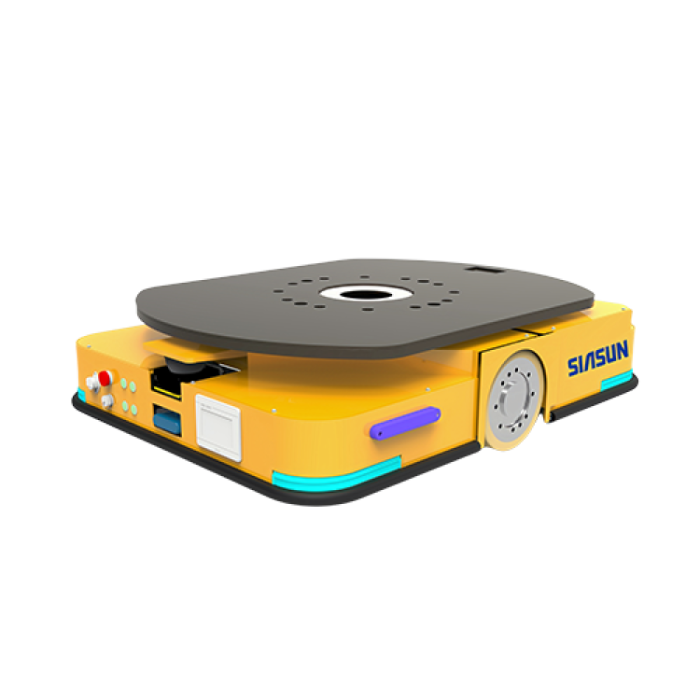
SIASUN 2000 Kg Under-ride Lift Mobile Robot (P-T2000D)
In stock
- BRAND:
- SIASUN
- MODEL:
- P-T2000D
- PART #:
- P-T2000D
- ORIGIN:
- China
- Warranty:
- 12 MONTHS
- AVAILABILITY:
- SUBJECT TO AVAILABILITY
- SKU:
- SIASUN-P-T2000D
SIASUN 2000 Kg Under-ride Lift Mobile Robot (P-T2000D)
Most of the cost of moving a carrier across a plant is not the driving; it is the waiting, the hand-offs and the fork truck that is always somewhere else. The SIASUN 2000 Kg Under-ride Lift Mobile Robot (P-T2000D) answers with a simple idea: slide beneath the load, raise it and go, with no operator walking alongside.
The product is available through this page, by quotation.
Background
SIASUN and the P-T line
SIASUN is the brand behind a family of under-ride lift mobile robots that spans several payload classes. Five versions are named: the P-T600D, the P-T1000D, the P-T1500D, the P-T2000D and the P-T3000D. Together they offer payload options from 600 to 3,000 kg, so a plant can match the robot to the carrier instead of forcing every task into one size.
The P-T2000D sits in the middle of that range, with a rated load of 2000kg. If your carriers are lighter, the SIASUN P-T1500D or the P-T1000D may be the better fit. If they are heavier, look at the SIASUN P-T3000D. All of them belong to the category of Under-ride Lift Mobile Robots.
Positioning and key technology
An under-ride robot works differently from a forklift-style vehicle. It does not approach a load from the front or side. It drives into the space beneath a rack, cart or carrier, lifts it and carries it away. The under-ride design gives precise access to pick-up points, with lifting that stays smooth, stable and efficient.
The P-T2000D adds multi-sensor data fusion, which supports high-precision task execution and seamless docking. Navigation is SLAM combined with QR Code, or QR Code alone. Multi-navigation fusion with smooth switching between methods comes with a layered safety system for worry-free operation.
Behind the individual robot is a fleet layer. The solutions run on the IMRS 2.0 platform, which enables multi-robot dispatching, route optimization, data analytics and digital twins for end-to-end intelligent control. In practice this means the P-T2000D is designed to be one member of a coordinated fleet, not a standalone vehicle.
Technical Specifications
| Specification | Value |
|---|---|
| Product type | Under-ride lift mobile robot |
| Rated load | 2000kg |
| Navigation method | SLAM + QR Code / QR Code |
| Positioning accuracy | ± 10mm/±1° |
| Rated operating time | 6–8 hours |
| Lifting height | 100mm |
| Overall dimensions (mm) | 1514/1163/336mm |
Specifications as published by the manufacturer; confirmed against the datasheet at quotation.
The manufacturer has not published the robot weight, the travel speed, the battery capacity and type, the charging method, the IP rating, the safety certifications, the gradeability, the obstacle sensors, the drive type or the wireless communication; they are confirmed at quotation.
What makes the under-ride design different from a conventional forklift?
A forklift needs aisle width to turn, a mast to lift and an operator to judge the fork entry. An under-ride robot removes all three. With an overall height of 336mm, the P-T2000D is built to travel beneath the carrier it will lift, so the carrier itself becomes the working surface. The lifting height is 100mm, which is enough to raise a carrier clear of the floor for transport, though not to place it on a high shelf.
That difference suits repeatable, floor-level movements between stations, such as carrying a rack from a line-side position to a staging area. It is less suited to stacking in tall storage, and a buyer who needs that should say so when requesting a quotation.
Accuracy matters just as much as height. The positioning accuracy is ± 10mm/±1°, and that figure is what lets the robot find and engage a carrier reliably. Together with sensor fusion, it supports consistent docking at the pick-up point.
How does the P-T2000D navigate?
The robot is offered with SLAM plus QR Code navigation, or with QR Code navigation alone. SLAM lets it build an understanding of its surroundings, while QR codes give it fixed reference points on the floor for precise stops. Combining them allows the robot to move through open areas and still land accurately at defined stations.
Switching between navigation methods is smooth. For a plant that has some zones with floor markers and some without, this is a practical advantage: the robot is not limited to one way of knowing where it is. Which configuration suits your site is a question for the quotation stage, once the layout is known.
Endurance is part of the picture too. The rated operating time is 6–8 hours, and the line is noted for extended endurance, high drivetrain efficiency, strong carrier compatibility and fleet-level dispatching. Non-standard customization is available for requirements that fall outside the standard configuration.
Who is the SIASUN P-T2000D for?
The first group is the production-logistics manager in a factory, who needs to move heavy racks or carts between workstations on a fixed rhythm. The P-T2000D carries 2000kg, which covers many loaded carriers, and its fleet software suits repeated routes.
The second group is the warehouse or distribution planner who wants to automate internal transfers without rebuilding the building. Because the robot uses SLAM with QR Code or QR Code navigation, it can be fitted into an existing floor plan, and customization is available for unusual cases.
The third group is the integrator or engineering team that already has carriers and wants a robot to match them. For this buyer the dimensions of 1514/1163/336mm and the 100mm lifting height are the first figures to check against the carrier design.
If your loads are consistently lighter, the P-T1500D may be more sensible; if they approach the upper end, the P-T3000D deserves a look. You can also browse the wider range of Lifting Robots.
What is the SIASUN P-T2000D used for?
- Line-side material transfer: carrying racks or carts of parts from storage to the production line and back.
- Work-in-process movement: moving loaded carriers between workstations in a process-driven plant.
- Warehouse internal transport: shifting heavy carriers between receiving, storage and dispatch zones.
- Fleet-coordinated logistics: running several robots under the IMRS 2.0 platform with dispatching and route optimization.
- Precise docking tasks: engaging carriers at defined pick-up points where accurate positioning is required.
- Custom handling projects: adapting the robot to non-standard carriers or scenarios through customization.
Pricing and Availability
This robot is sold by quotation. Tell us the carrier you want to lift, the route and the number of robots, and we will prepare an offer around them. Delivery, customs and support are arranged together with the quotation. The SIASUN 2000 Kg Under-ride Lift Mobile Robot (P-T2000D) is available on this page.
Frequently Asked Questions
What is the rated load of the P-T2000D?
The rated load is 2000kg. Other versions in the line are rated differently, within the 600 to 3,000 kg range.
How does the robot navigate?
It uses SLAM + QR Code or QR Code navigation, with multi-navigation fusion and smooth switching.
How accurate is its positioning?
The positioning accuracy is ± 10mm/±1°.
How long can it work between charges?
The rated operating time is 6–8 hours. Battery and charging details are not listed in our sources, so ask for them with your quotation.
How high does it lift?
The lifting height is 100mm, and the overall dimensions are 1514/1163/336mm.
Can several robots be managed together?
Yes. The solutions run on the IMRS 2.0 platform for multi-robot dispatching, route optimization, data analytics and digital twins.
Where can I buy the P-T2000D and what does it cost?
You can request it through this page. The cost depends on configuration and project scope, so it is given in a quotation rather than listed here.
Summary
The idea behind the P-T2000D is that the best way to move a heavy carrier is to go underneath it. With a 2000kg rated load, a 336mm-high overall build, ± 10mm/±1° positioning accuracy and a 6–8 hour rated operating time, it is built for repeatable floor-level transport inside a factory or warehouse. IMRS 2.0 fleet software and non-standard customization extend it from one robot to a managed system. If that matches your carriers and routes, this page is the starting point.


