
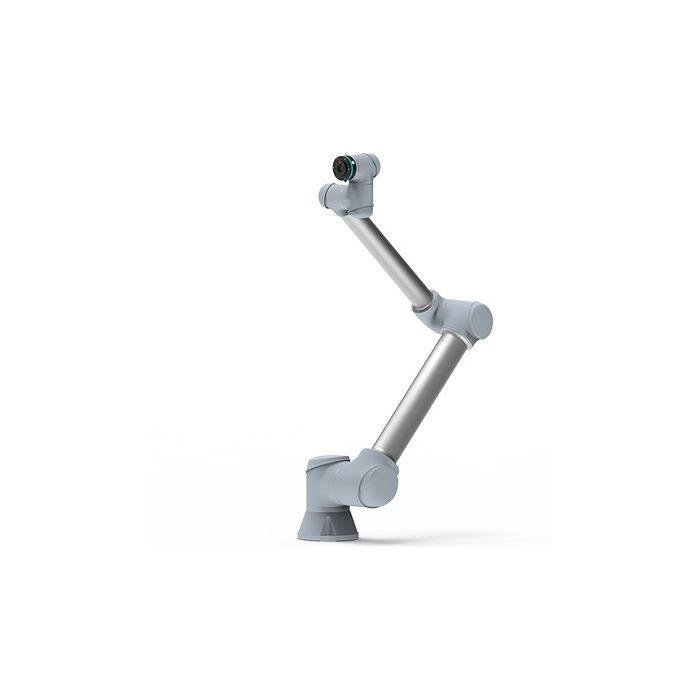
SIASUN Collaborative Robot (GCR25-1800)
In stock
- BRAND:
- SIASUN
- PART #:
- GCR25-1800
- ORIGIN:
- China
- AVAILABILITY:
- SUBJECT TO AVAILABILITY
- SKU:
- SIASUN-GCR25-1800
SIASUN Collaborative Robot (GCR25-1800)
Most robot arms ask you to choose: either the reach to serve a big workspace, or the manners to share it with people. The SIASUN Collaborative Robot (GCR25-1800) is built to refuse that choice, pairing a long arm and a heavy lifting rating with safety features certified for work beside operators.
The product is available through this page, by quotation.
Background
SIASUN and the GCR series
SIASUN is a robotics manufacturer, and the GCR series is its family of collaborative robots. SIASUN describes the GCR25-1800 as a high-end, general-purpose collaborative robot in that series. The words "general-purpose" matter: this arm is not tied to one process. It is meant to be set up for a task, put to work, and moved to a new task when production changes.
The series includes other models, such as the SIASUN Collaborative Robot (GCR16-2000), the SIASUN Collaborative Robot (GCR16-960), the SIASUN Collaborative Robot (GCR20-1400) and the SIASUN Collaborative Robot (GCR30-1100). Each has its own page, and each keeps its own figures. Nothing on this page should be read as applying to those models.
A second version of this model, the GCR25-1800-EX, also exists. No figures are listed here for it, so every figure below belongs to the GCR25-1800 only.
Positioning and key technology
The GCR25-1800 sits at the strong end of what a collaborative arm can do. It has six degrees of freedom, a maximum payload of 25kg and a reach of 1800mm. For a buyer, that means a single arm can serve a wide area, such as a pallet position, a pair of machines or a conveyor junction, without the cost and floor space of a traditional caged cell.
Three technology themes run through the product's description:
- Safety. The robot carries 16 TUV-certified safety features for human-machine collaboration, with a focus on safety.
- Perception. It integrates 2D/3D vision depth fusion with high-sensitivity force perception and control.
- Software and connectivity. It comes with scenario-specific software packages and support for multiple external interfaces. It also offers cloud-based robot data monitoring and remote OTA upgrades.
Programming is by drag-and-drop teaching, which lowers the usage threshold and makes operation easier. In practice, this matters most to teams without a dedicated robot programmer.
Technical Specifications
| Specification | Value |
|---|---|
| Model | GCR25-1800 |
| Type | High-end, general-purpose collaborative robot (GCR series) |
| Max payload | 25kg |
| Reach | 1800mm |
| Repeatability | ±0.05mm |
| Max TCP speed | 2.5m/s |
| Max straight-line speed | 1.5m/s |
| IP class | IP54/IP65 |
| Degrees of freedom | 6 |
| Safety certification | 16 TUV-certified safety features for human-machine collaboration |
| Programming | Drag-and-drop teach programming |
Specifications as published by the manufacturer; confirmed against the datasheet at quotation.
The manufacturer has not published the joint ranges and speeds, the robot dimensions, the noise level, the contents of the box, the control cabinet dimensions or the rated payload at the flange; they are confirmed at quotation.
What makes the GCR25-1800 different from a conventional industrial robot?
A conventional industrial arm of similar size usually works behind a fence or light curtain. The fence is part of the safety concept, and it takes floor space, engineering time and money. The GCR25-1800 is designed around a different idea. Its 16 TUV-certified safety features for human-machine collaboration are there so that people and the robot can share a workspace, with the exact arrangement settled by a proper risk assessment for each site.
That does not make it a lightweight tool. A 25kg maximum payload and an 1800mm reach put it in territory where many collaborative arms stop. The ±0.05mm repeatability suits tasks where the arm must return to the same point again and again. The maximum TCP speed is 2.5m/s and the maximum straight-line speed is 1.5m/s, so it is built to keep up with real production rhythm.
The other difference lies in how the arm perceives its work. The combination of 2D/3D vision depth fusion and high-sensitivity force perception means the robot can be given eyes and a sense of touch within one control concept. For a plant that handles parts which are not always presented in exactly the same position, that is a practical advantage over a blind, position-only arm.
What do the IP class and the software add in daily use?
The IP class is IP54/IP65. Dust and splash resistance matter in the Caribbean, where humidity, salt air and wash-down routines are part of many sites, from packing houses to workshops. The two ratings are printed together, so ask us which one applies to which part of the robot.
On the software side, the scenario-specific packages are meant to shorten the path from delivery to a working application. Cloud-based robot data monitoring lets a maintenance team see how the robot is running, and remote OTA upgrades mean software updates do not necessarily require a technician on site. For organizations far from a service center, that is a meaningful point to discuss when you request a quotation.
Who is the GCR25-1800 for?
The GCR25-1800 suits buyers who need the strongest features of a collaborative arm in one machine. Typical segments include:
- Manufacturers and packers who move heavy cartons, crates or containers and want to avoid a full guarded cell.
- Workshops and machine shops that need one arm to serve a machine, or two machines from one position, with a wide working envelope.
- Logistics and distribution sites that want flexible handling at pallet positions and conveyor ends.
- Integrators who build turnkey cells for clients and value an arm with vision, force sensing and external interfaces.
- Teams new to robotics who value drag-and-drop teach programming over a long learning curve.
If your task is lighter or needs a different reach, the other models in the SIASUN GCR series may be a better match. Tell us the task, and we will help you compare. If the GCR25-1800-EX version is of interest, ask for its details when requesting your quotation.
What is the GCR25-1800 used for?
- Palletizing and depalletizing. The payload and reach let one arm work at a pallet position with people nearby.
- Machine tending. Loading and unloading a machine, or serving two machines from a single position.
- Material handling. Moving parts, cartons or containers between conveyors, stations and storage.
- Assembly and force-sensitive tasks. Force perception supports work where contact must be controlled.
- Vision-guided picking. 2D/3D vision depth fusion helps when parts are not presented in a fixed position.
- General-purpose automation. Scenario-specific software packages help adapt the arm to new tasks as production changes.
Pricing and Availability
We do not publish prices on this page. Quotation is the next step: tell us your application, your site conditions and the version you need, and we will respond with a proposal. Delivery, customs and support are arranged together with the quotation, so you know the whole picture before you decide. The SIASUN Collaborative Robot (GCR25-1800) is available on this page.
Frequently Asked Questions
What is the maximum payload of the GCR25-1800?
The maximum payload is 25kg. For the rated payload at the flange, please ask when you request your quotation.
How far can the arm reach?
The reach is 1800mm, which gives one arm a wide working area.
How precise is it?
The repeatability is ±0.05mm. The maximum TCP speed is 2.5m/s and the maximum straight-line speed is 1.5m/s.
Can it work next to people?
It is a collaborative robot with 16 TUV-certified safety features for human-machine collaboration. The final safety arrangement for your site still needs a risk assessment of the complete application.
How is the robot programmed?
It uses drag-and-drop teach programming, designed to lower the usage threshold and make operation easier.
Does it support remote monitoring and updates?
Yes. It supports cloud-based robot data monitoring and remote OTA upgrades, along with multiple external interfaces.
Where can I buy the GCR25-1800 and what does it cost?
You can request it through this page, by quotation. We do not list a price here; the cost depends on the version, the configuration and the delivery to your location, and it is given in the quotation.
Summary
Reach and closeness to people rarely go together, and the SIASUN Collaborative Robot (GCR25-1800) is built to bring them together. It offers a 25kg maximum payload, an 1800mm reach, ±0.05mm repeatability and 16 TUV-certified safety features for human-machine collaboration. Vision, force sensing, drag-and-drop teaching and cloud monitoring round out the package. If this arm fits your work, this page is the starting point.


