
OLEI Laser / Camera (LR-1BS2)
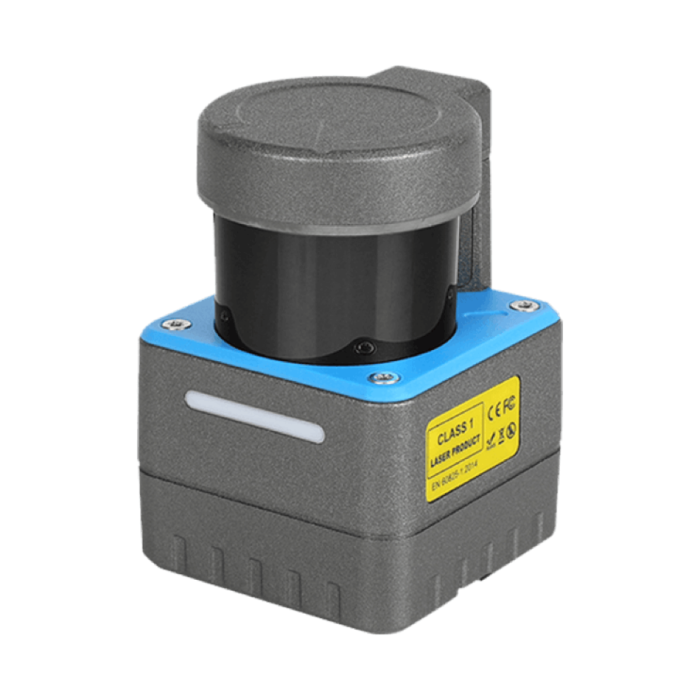
In stock
- BRAND:
- OLEI
- MODEL:
- LR-1BS2
- PART #:
- LR-1BS2
- ORIGIN:
- China
- Warranty:
- 12 MONTHS
- AVAILABILITY:
- SUBJECT TO AVAILABILITY
- SKU:
- SEER-Robotics-OLEI-LR-1BS2
OLEI Laser / Camera (LR-1BS2)
Most robots do not fail because they cannot plan a route; they fail because they cannot trust what is directly in front of them. The OLEI Laser / Camera (LR-1BS2) is a 2D LiDAR sensor built for exactly that moment, when a machine has to notice an obstacle and act before contact happens.
The product is available through this page, by quotation.
Background
OLEI and the SEER Robotics catalog
OLEI is the brand behind the LR-1BS2, and the sensor is listed in the SEER Robotics range of components for robot builders. That context matters to a buyer. The LR-1BS2 is not a finished robot. It is a building block, meant to be fitted to autonomous mobile robots, vehicles and machines that need to see their surroundings and react to them.
The sources name two versions of this sensor: the LR-1BS2 and the LR-1BS2H. The figures given for the LR-1BS2 are the ones used throughout this page, and no figure on this page is borrowed from another model.
Positioning: obstacle avoidance at a sensible cost
The manufacturer describes the LR-1BS2 as an obstacle avoidance LiDAR with excellent cost performance. It is a 2D 270° sensor, which means it scans a flat plane across a wide arc rather than building a full three-dimensional picture. For a vehicle that travels along floors and aisles, that flat plane is often exactly what is needed: a dependable view of what lies across the path of travel.
The sensor measures distance using the time-of-flight principle. It sends out light, measures how long the reflection takes to return, and turns that timing into a distance. The result can be used in two ways: as a switching output that works through a PLC, or as point cloud data for a computer to process.
Technical Specifications
| Specification | Value |
|---|---|
| Product type | 2D 270° Obstacle Avoidance LiDAR Sensor |
| Field of view | 270° |
| Angular resolution | 0.225° |
| Horizontal angle accuracy | ±1° |
| Detection capability (manufacturer page) | up to 20m |
| Range (distributor page, LR-1BS2 Series) | 10 m |
| Operating principle | Time-of-flight |
| Safety zones | Freely settable safe area, 16-bank, 3-level protection |
| Outputs | Switching output with point cloud data (through PLC or point cloud data); analog zone alarm available |
| Output current | Not to exceed 20mA per output port |
| Data interface | RJ-45 Ethernet |
| Cable | 2-meter "Power/IO" cable and an "Ethernet" connection |
| Protection class | IP65 or optional |
| Certifications | FCC, EMC, CE, RoHS, REACH, FDA |
Specifications as published by the manufacturer; confirmed against the datasheet at quotation.
The manufacturer has not published the weight, the dimensions, the power consumption, the scanning frequency, the measurement range by reflectivity, the operating temperature or the contents of the box; they are confirmed at quotation.
What do the two range figures mean for the LR-1BS2?
A careful buyer will notice that two range figures circulate for this sensor. The manufacturer page speaks of detection capability up to 20m for obstacle avoidance and safety area protection, while a distributor listing for the LR-1BS2 Series gives a range of 10 m. They come from different pages and are worded differently, so we show both in the table and do not merge them into one number.
In practice, the sensible way to size a project is to start from the distance at which your vehicle must react. A slow vehicle in a narrow aisle needs less reach than a faster one in an open hall. Tell us the speed, the load and the environment, and we will talk through the right range for your case.
How do the safety zones work?
The safe area of the LR-1BS2 can be set freely, with 16 banks and 3 levels of protection. That structure suits a vehicle that changes behavior with its situation. You might define a wide outer zone that makes the vehicle slow down, a middle zone that makes it prepare to stop, and an inner zone that stops it. A different bank can then be selected when the vehicle carries a wider load or enters a tighter corridor.
The switching output reaches a PLC directly, and each output port should not carry more than 20mA. If you prefer to do the thinking on your own computer, the point cloud data goes out over the RJ-45 Ethernet interface, so the same sensor serves both a simple stop-and-go design and a more elaborate navigation stack.
Who is the OLEI Laser / Camera (LR-1BS2) for?
Robot builders and integrators are the first group. If you are assembling an autonomous mobile robot and need a wide-angle sensor that can protect the front of the vehicle, the 270° field of view and the programmable zones give you a solid starting point. The sensor suits projects where cost matters but obstacle detection cannot be compromised.
Factory and warehouse operators are the second group. Those who run vehicles on mixed floors, with people walking among pallets and trolleys, need a sensor that supports safe area protection. You may also want to browse our Factory Robots and Logistics Robots categories to see the kinds of machines this sensor is meant to serve.
Security and general industrial users form the third group, since security is named among the fields of use. If your project calls for a different OLEI model, you can also look at the OLEI Laser / Camera (LR-1BS5H) and ask us how it compares for your case. For the LR-1BS2H version, the sources give no separate figures, so none are shown here.
What is the OLEI Laser / Camera (LR-1BS2) used for?
- Mobile obstacle avoidance. The sensor watches the path ahead of an autonomous vehicle and lets it react to what it finds.
- Safe area protection. Freely defined zones with 3 protection levels guard the space around a machine.
- Intelligent logistics. Vehicles moving goods through warehouses and plants use it to keep their routes clear.
- Industrial automation. Fixed or moving equipment on a production line can use the switching output to trigger a stop or a slowdown.
- Security applications. Security is among the listed fields of use, where a scanned area is watched for intrusion.
- Robot development. Point cloud data over Ethernet gives developers a live view of the environment for testing navigation software.
Pricing and Availability
We do not publish prices for this product. A quotation is the way to start: tell us the version, the quantity and the application, and we respond with the details. Delivery, customs and support are arranged together with the quotation, so you see the whole picture before you commit. The OLEI Laser / Camera (LR-1BS2) is available on this page.
Frequently Asked Questions
What type of sensor is the LR-1BS2?
It is a 2D 270° obstacle avoidance LiDAR sensor that measures distance by the time-of-flight principle. It is meant for mobile obstacle avoidance and safe area protection.
How does the sensor connect to my system?
It comes with a 2-meter "Power/IO" cable and an "Ethernet" connection. Point cloud data goes to a computer through the RJ-45 Ethernet interface, and switching outputs can be used through a PLC.
How many protection zones can I set?
The safe area can be set freely, with 16 banks and 3 levels of protection. This lets one sensor serve several operating situations.
What are the angle and resolution figures?
The field of view is 270°, the angular resolution is 0.225° and the horizontal angle accuracy is ±1°.
Is the sensor protected against dust and water?
The protection class is given as IP65 or optional.
Which certifications does it carry?
The listed certifications are FCC, EMC, CE, RoHS, REACH and FDA.
Where can I buy the OLEI Laser / Camera (LR-1BS2) and what does it cost?
You can request it through this page. The price is given in a quotation, prepared once we know your version, quantity and application.
Summary
A robot that cannot see is only a heavy object with wheels. The OLEI Laser / Camera (LR-1BS2) gives it a wide, 270° view, programmable safety zones and two ways to hand its findings to your system, through a PLC output or through point cloud data over Ethernet. Its range figures differ between sources, so tell us the distance your application really needs. If you are planning a vehicle, a line or a security area that needs dependable obstacle detection, this page is the starting point.


