
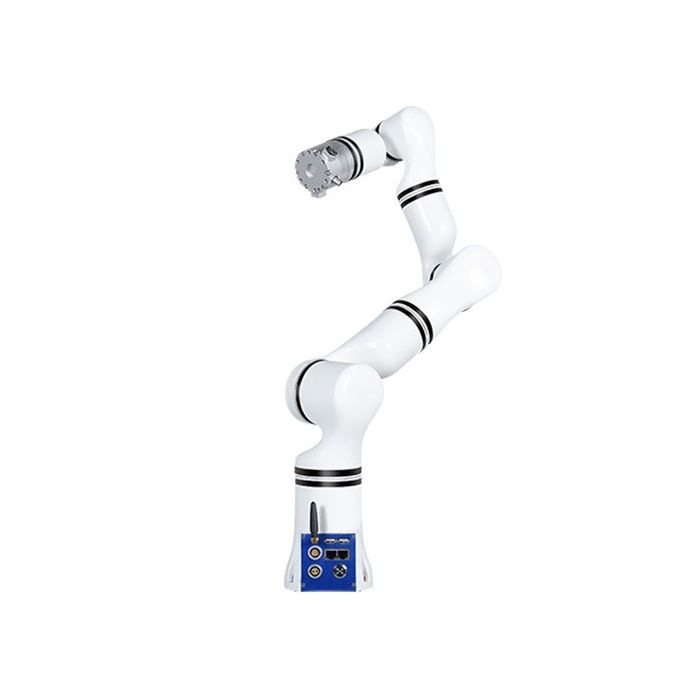
Realman Robotics Ultra-Lightweight Robotic Arm (RM75-6F)
In stock
- BRAND:
- REALMAN
- PART #:
- RM75-6F
- AVAILABILITY:
- SUBJECT TO AVAILABILITY
- SKU:
- Realman Robotics-RM75-6F
Realman Robotics Ultra-Lightweight Robotic Arm (RM75-6F)
Most robotic arms ask you to choose between a light frame and a sense of touch. The Realman Robotics Ultra-Lightweight Robotic Arm (RM75-6F) is built to refuse that choice: an aluminum-alloy arm with seven joints, an integrated controller and a six-axis force sensor, all in a body that weighs 7.9kg.
This product is available through this page, by quotation.
Background
Realman and the RM series
Realman Robotics builds compact robotic arms, and the RM65 and RM75 families are its ultra-lightweight line. The series comprises five models: the RM65 and RM75 basic versions (RM65-B and RM75-B) and the RM65 and RM75 six-axis force versions (RM65-6F and RM75-6F). The RM65 models have six degrees of freedom, and the RM75 models have seven.
The idea behind the series is simple. A robot arm that is light, powered by a single DC24V supply and carries its own controller is easier to mount on a mobile base, a bench or a cart. It does not need a separate control cabinet. If you are comparing it with other machines, our Robot Arms category shows the wider range.
Where the RM75-6F sits in the line
The RM75-6F is the seven-axis version with force sensing. The extra joint gives the arm more freedom to reach around obstacles and to approach a workpiece from different angles. The six-axis force sensor lets the arm feel what it is touching, which matters for polishing, insertion, assembly and any task where contact must be controlled instead of avoided.
The basic RM75-B has the same seven joints but no force sensor. The RM75-6F is the choice when contact information is part of the job. Its working radius is also listed longer than the basic version, at 638.5mm against 610mm. Teams building humanoid or service platforms may also want to browse our Humanoids category.
Technical Specifications
| Specification | RM65-B | RM65-6F | RM75-B | RM75-6F |
|---|---|---|---|---|
| Degrees of freedom | 6 | 6 | 7 | 7 |
| Payload | 5kg | 5kg | 5kg | 5kg |
| Peak payload | 9kg | 9kg | 9kg | 9kg |
| Body weight | 7.2kg | 7.3kg | 7.8kg | 7.9kg |
| Repeatability | ±0.05mm | ±0.05mm | ±0.05mm | ±0.05mm |
| Working radius | 610mm | 638.5mm | 610mm | 638.5mm |
| Six-axis force range | / | 200N/7Nm | / | 200N/7Nm |
| Six-axis force accuracy | / | <0.1% FS | / | <0.1% FS |
| Power supply voltage | DC24V | DC24V | DC24V | DC24V |
| Power consumption | Maximum 200W, comprehensive 100W | Maximum 200W, comprehensive 100W | Maximum 200W, comprehensive 100W | Maximum 200W, comprehensive 100W |
| Protection level | IP54 (arm body) | IP54 (arm body) | IP54 (arm body) | IP54 (arm body) |
| Material | Aluminum alloy | Aluminum alloy | Aluminum alloy | Aluminum alloy |
| Controller | Integrated | Integrated | Integrated | Integrated |
| Communication mode | WIFI/network port/Bluetooth/USB serial port/RS485 | WIFI/network port/Bluetooth/USB serial port/RS485 | WIFI/network port/Bluetooth/USB serial port/RS485 | WIFI/network port/Bluetooth/USB serial port/RS485 |
| Control mode | Drag and drop teaching/Teaching pendant/API/JSON | Drag and drop teaching/Teaching pendant/API/JSON | Drag and drop teaching/Teaching pendant/API/JSON | Drag and drop teaching/Teaching pendant/API/JSON |
| Joint motion range | Not stated | Not stated | J1 ±178°, J2 ±130°, J3 ±178°, J4 ±135°, J5 ±178°, J6 ±128°, J7 ±360° | J1 ±178°, J2 ±130°, J3 ±178°, J4 ±135°, J5 ±178°, J6 ±128°, J7 ±360° |
| Joint maximum speed | Not stated | Not stated | J1-J2 180°/s, J3-J7 225°/s | J1-J2 180°/s, J3-J7 225°/s |
Specifications as published by the manufacturer; confirmed against the datasheet at quotation. The manufacturer has not published the dimensions of the arm, the package contents, the certifications or the tool flange interface details; they are confirmed at quotation.
What does the six-axis force sensor add to the RM75-6F?
The basic RM75-B moves precisely, but it does not feel. The RM75-6F adds an integrated six-axis force/torque sensor with a range of 200N/7Nm. That turns the arm from a positioning device into one that can respond to contact. A part that does not seat, a surface that pushes back or a hand that touches the arm can all be detected and acted upon.
The arm also has a built-in safety module that stops operation upon contact. This supports safe human-machine collaboration and makes drag-and-drop teaching easier: an operator can take the arm by hand, guide it through a motion and save it. For labs, training cells and small workshops where people and robots share space, this combination is the main reason to step up from the basic version.
The six-axis versions weigh a little more than their basic counterparts: 7.9kg for the RM75-6F against 7.8kg for the RM75-B. That is a difference of only 0.1kg, which is a small price in weight for the added sensing.
How does the seven-axis RM75-6F differ from the six-axis RM65-6F?
Both six-axis force versions carry the same payload, the same peak payload, the same repeatability and the same listed working radius of 638.5mm. The difference is the number of joints. The RM75-6F has seven degrees of freedom, while the RM65-6F has six. The RM75-6F weighs 7.9kg and the RM65-6F weighs 7.3kg.
A seventh joint gives redundancy. In practice this helps the arm work in cluttered spaces, such as inside a cabinet, around a fixture or beside a mobile base, because the elbow can move without moving the tool. If your task is simple and open, the six-axis RM65-6F may be enough. If space is tight or the approach angle matters, the RM75-6F is the better fit. The last joint, J7, has a range of ±360°, which is useful for tool rotation.
Who is the Realman RM75-6F for?
Research and education groups will find a seven-axis arm with force sensing, several communication options and API and JSON control. It suits experiments in contact manipulation without a separate controller to set up.
Builders of mobile manipulators and service robots benefit from the light body, the integrated controller and the single DC24V supply. Light industrial teams can use it for assembly, inspection and finishing tasks where contact needs to be measured. Integrators who want to teach by hand will value the drag-and-drop teaching mode.
If the job does not need force feedback, the RM75-B gives the same seven joints without the sensor. If six joints are enough, the RM65 versions are the alternatives. For a wider view of arms in the catalog, see Robot Arms.
What is the RM75-6F used for?
- Research and education. A seven-axis arm with force sensing for labs and training programs.
- Mobile manipulation. A light body and a single DC24V supply suit mounting on a mobile base.
- Precision contact tasks. Assembly, insertion and polishing, where force feedback guides the motion.
- Human-robot collaboration. The safety module stops operation upon contact, so people can work nearby.
- Teaching by demonstration. Drag-and-drop teaching lets an operator guide the arm by hand and save the path.
- Service-robot platforms. A compact arm with an integrated controller for humanoid and service builds.
Pricing and Availability
We do not print prices on this page. Please request a quotation and we will answer with the details for your project. Delivery, customs and support are arranged together with the quotation. The Realman Robotics Ultra-Lightweight Robotic Arm (RM75-6F) is available on this page.
Frequently Asked Questions
How many degrees of freedom does the RM75-6F have?
The RM75-6F has seven degrees of freedom. The RM65 versions in the same series have six.
What payload can the RM75-6F carry?
The payload is 5kg, with a peak payload of 9kg. Continuous operation under a 5 kg load for over 30,000 hours without failure is part of the testing the manufacturer describes.
How precise is the arm?
Repeatability is ±0.05mm. The TCP linear speed is up to 1.8 m/s.
How is the arm programmed and connected?
Control modes are drag and drop teaching, teaching pendant, API and JSON. Communication runs over WIFI, network port, Bluetooth, USB serial port or RS485.
Is the arm safe to use near people?
It has a built-in safety module that stops operation upon contact, which supports human-machine collaboration. A risk assessment of your own cell is still your responsibility.
What power does it need?
The supply voltage is DC24V. Maximum power consumption is 200W and comprehensive power consumption is 100W.
Where can I buy the RM75-6F and what does it cost?
You can request a quotation on this page. The cost is given in the quotation, together with delivery, customs and support arrangements.
Summary
The RM75-6F answers the question that opens this page: a light arm that can also feel. It combines seven joints, an integrated controller, a six-axis force sensor and a safety module in an aluminum-alloy body of 7.9kg. It suits research, mobile manipulation and contact-driven work. To ask about the RM75-6F for your project, this page is the starting point.


