
Galileo X Ground Mobility Platform Quadruped Robots Dog
In stock
- BRAND:
- GALILEO
- ORIGIN:
- China
- Warranty:
- 12 MONTHS
- AVAILABILITY:
- SUBJECT TO AVAILABILITY
- SKU:
- GALILEO-X
Galileo X Ground Mobility Platform Quadruped Robots Dog
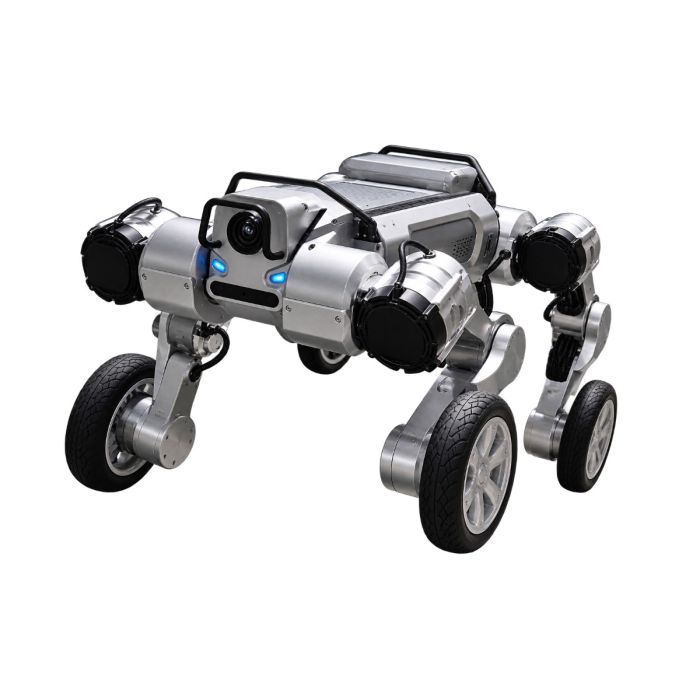
Most robots make you choose: the precision of a warehouse vehicle, the reach of an off-road truck, or the footwork of a legged machine. The Galileo X Ground Mobility Platform Quadruped Robots Dog is built on the idea that you should not have to choose. It puts four articulated legs under one chassis, and each leg ends in a wheel, so the machine can roll when the ground is kind and step when it is not.
The Galileo X is available through this page, by quotation.
Background
Galileo Robotics and its lineage
Galileo Robotics is a Tianjin-based embodied-AI company founded in 2013. It is a leading Chinese embodied-intelligence robotics company, and it has built a technology system that covers robot platforms, core components, motion control and systems engineering. Its core components and underlying technologies are developed in-house, in a full-stack approach.
That background matters to a buyer. A platform whose hardware, motion control and software come from one team is easier to support and to adapt than one assembled from many outside parts. The Galileo X was unveiled at the 2026 World Robot Conference (WRC 2026) in Beijing as Galileo's new Embodied Ground Mobility System.
Positioning and key technology
The Galileo X is a next-generation, general-purpose ground mobility platform designed for diverse future operational needs. Its capabilities are powered by Galileo's proprietary Unified Embodied Ground Mobility System.
The concept combines three things that are normally sold separately: the high-precision indoor transport of wheeled AGVs, the vehicle-level long-range off-road mobility of a ground vehicle, and the complex-terrain traversal of legged robots. All three are highly integrated within a single platform. The aim is one chassis that serves several jobs, rather than a fleet of specialist machines.
Technical Specifications
| Specification | Value |
|---|---|
| Product type | General-purpose ground mobility platform |
| Locomotion layout | Four articulated legs, each terminating in a wheel |
| Joint rotation | Full 360-degree rotation |
| Rated payload (target) | Approximately 200 kg; the concept demo carried around 70 kg, and 200 kg is the mass-production target |
| Core technology | Unified Embodied Ground Mobility System |
| Manufacturer | Galileo Robotics, Tianjin, founded 2013 |
| Unveiled | WRC 2026, Beijing |
Specifications as published by the manufacturer; confirmed against the datasheet at quotation.
The manufacturer has not published the dimensions, the weight, the battery capacity, the runtime, the maximum speed, the sensors, the connectivity, the IP rating, the contents of the box, the software or SDK details, the climbing angle, the operating temperature or the final rated payload; they are confirmed at quotation.
What makes the Galileo X different from a standard quadruped?
A standard quadruped walks everywhere. That is impressive on rubble and stairs, but it is slow and costly in energy on a smooth warehouse floor. The Galileo X puts a wheel at the end of every leg, so on flat ground it can roll, and when rolling stops working it can step over obstacles.
The second difference is in the joints. They offer full 360-degree rotation, which allows posture adjustments and maneuvers that standard quadrupeds cannot execute. For a buyer, this means the body is not limited to one stance. It can change its posture to suit the task and the surface.
The third difference is the payload target. The goal is approximately 200 kg rated payload, which puts the platform in heavy-duty carrier territory rather than in the class of a light sensor scout. It is important to read this correctly: the concept demo carried around 70 kg, and 200 kg is the mass-production target. We give both so that your planning starts from the right figure.
How does the Galileo X compare with a wheeled AGV or an off-road vehicle?
A wheeled AGV is precise and efficient indoors, but it stops at a curb, a threshold or a muddy yard. An off-road vehicle covers long distances outdoors, but it is not made for tight indoor transfers. Each is good at one job, and a site that needs both has had to buy both.
The Galileo X is designed to bring these strengths into a single platform. It combines indoor transport precision, long-range off-road mobility and legged terrain traversal. If your site mixes smooth floors, rough ground and obstacles, one machine that handles all three can simplify your operation. If your work is only ever on one flat floor, a simpler wheeled machine may be enough, and we will tell you so when you ask for a quotation.
Who is the Galileo X for?
The Galileo X suits operators with varied ground and varied tasks. Logistics managers with warehouse floors that connect to yards or loading areas will see the value of a platform that rolls indoors and steps outdoors. Teams doing heavy-duty off-road handling will look at the payload target.
Developers and integrators of humanoid robots may use it as a mobile chassis. Inspection and perception teams, and companies building mobile operation platforms, can treat it as a base to build on.
If your needs are different, other models may fit better. Browse the Wheeled Quadrupeds category, or look at the Large Industrial Grade Wheeled Quadruped Robot Dog if your work is industrial. Our team can help you compare them against your site.
What is the Galileo X used for?
- Heavy-duty off-road handling. Carrying loads over rough ground where a wheeled AGV would stall.
- Warehouse logistics. Moving goods indoors with the precision expected of a wheeled transport platform.
- Directional transfer. Repositioning and transferring loads in a controlled direction within a logistics flow.
- Mobile chassis for humanoid robots. Giving a humanoid upper body a mobile base that handles varied terrain.
- Inspection and perception. Carrying inspection and sensing equipment across sites with mixed ground.
- Mobile operation platforms. Serving as a movable base for work that must be done away from a fixed station.
Pricing and Availability
We do not print prices on this page. Quotation is the way to buy: tell us your site, your load and your use case, and we will prepare an offer for the Galileo X. Delivery, customs and support are arranged together with the quotation, so you see the full picture before you decide. The Galileo X is available on this page.
Frequently Asked Questions
What is the Galileo X?
The Galileo X is a next-generation general-purpose ground mobility platform from Galileo Robotics. It has four articulated legs, each ending in a wheel.
Where was the Galileo X introduced?
It was unveiled at the 2026 World Robot Conference (WRC 2026) in Beijing as Galileo's new Embodied Ground Mobility System.
What payload can the Galileo X carry?
The target is approximately 200 kg rated payload. The concept demo carried around 70 kg, and 200 kg is the mass-production target.
How is it different from a regular robot dog?
Each leg ends in a wheel, so it rolls on flat ground and steps over obstacles. Its joints rotate a full 360 degrees, which allows maneuvers that standard quadrupeds cannot perform.
What are the battery life, speed and IP rating?
Ask for them with your quotation, together with the weight, dimensions and sensors.
Which jobs is it designed for?
Heavy-duty off-road handling, warehouse logistics and directional transfer, mobile chassis for humanoid robots, inspection, perception, and mobile operation platforms.
Where can I buy the Galileo X and what does it cost?
You can buy it through this page by requesting a quotation. We do not list prices; the cost is given in the quotation, together with delivery, customs and support arrangements.
Summary
The question behind the Galileo X is simple: why buy three machines when one chassis might do? With four legs that end in wheels, joints that rotate a full 360 degrees and a payload target of approximately 200 kg, it is built to move between smooth floors and rough ground. Galileo Robotics, founded in 2013 and developing its core components in-house, is behind the design. Any remaining figures come with your quotation. For a buyer who wants one platform for logistics, inspection and off-road work, this page is the starting point.


