
Dexforce W1 Core General Purpose Embodied Intelligence Wheeled Humanoid Robot
In stock
- BRAND:
- DEXFORCE
- PART #:
- W1 Core
- ORIGIN:
- China
- AVAILABILITY:
- SUBJECT TO AVAILABILITY
- SKU:
- DexForce-W1-Core
Dexforce W1 Core General Purpose Embodied Intelligence Wheeled Humanoid Robot
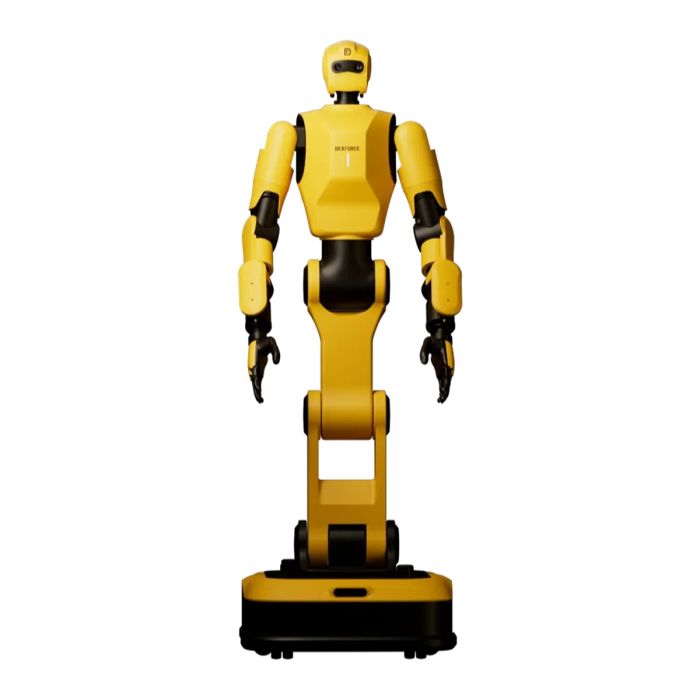
Two cameras set 6cm apart, the baseline of the Dexforce humanoid head, give a robot a view of the world that is close to the one its human coworkers have. The Dexforce W1 Core General Purpose Embodied Intelligence Wheeled Humanoid Robot is built on that idea: see the work the way a person sees it, then reach for it with two capable arms.
This product is available through this page, by quotation.
Background
The company and its lineage
The W1 Core is made by DexForce Technology Co., Ltd., based in Shenzhen, China. The company works in embodied intelligence, which means robots that learn to act in the physical world through perception and manipulation instead of following a fixed script. The W1 family is its general-purpose humanoid line, and the W1 Core is the upper-body version of that family.
The family has two named versions. The W1 Pro is the full-body version, and the W1 Core is the upper-body version. The Core keeps the head, the torso, the two arms and the end-effectors that do the real work at a station, and it is designed for stationary operation. Buyers who need the full-body form should look at the Dexforce W1 Pro General Purpose Embodied Intelligence Wheeled Humanoid Robot (W1 Pro).
Positioning and key technology
The W1 Core is aimed at teams that need a humanoid upper body for real manipulation work, not a showpiece. Its technology rests on three things. The first is humanoid binocular vision in the head, with a 6cm baseline and a large-model binocular algorithm. The second is a pair of seven-degree-of-freedom arms. The third is high-frequency motion control at 1kHz, which keeps the joints responsive when the arms move through a task.
Computing is configurable. The standard setup is a single-PC architecture rated at 150 TOPS or more. An optional dual-PC architecture raises that to 300 TOPS or more. Buyers whose workloads lean on heavier on-board models can plan for the larger option from the start.
The robot sits within our range of Wheeled Humanoids, and organizations that are looking at service roles may also want to browse Retail Robots.
Technical Specifications
| Specification | Value |
|---|---|
| Model | W1 Core |
| Form factor | Upper-Body |
| Dimensions (L×W×H) | 682mm*550mm*1636mm |
| Weight | 110kg |
| Torso DOF | Neck: 2 DOF, Waist: 2 DOF, Leg: 2 DOF |
| DOF of single arm | 7 DOF (Shoulder: 3; elbow: 1; wrist: 3) |
| Max payload (single arm) | 10kg |
| Arm repeatability (without hand) | ±0.5 mm |
| End-effector type | Standard: 2-Finger Gripper; Optional: Dexterous Hand |
| Head vision | 6cm Baseline Humanoid Binocular Vision + Large-Model Binocular Algorithm |
| Wrist vision | Standard: N/A; Optional: Supports RGBD Cameras on both wrists |
| Computing & AI power | Standard: Single-PC Architecture (≥150 TOPS); Optional: Dual-PC Architecture (≥300 TOPS) |
| High-frequency motion control | 1kHz |
| Application type | Stationary Operation |
| Typical industries | Data Collection & Training, Research & Education, Commercial Services, Industrial Manufacturing |
| Manufacturer | DexForce Technology Co., Ltd., Shenzhen, China |
Specifications as published by the manufacturer; confirmed against the datasheet at quotation.
The manufacturer has not published the battery life, the battery capacity, the connectivity, the IP rating, the operating temperature, the power consumption, the contents of the box or the details of the wheeled chassis; they are confirmed at quotation.
What makes the W1 Core different from the W1 Pro?
The difference is the form factor. The W1 Core is the Upper-Body version and the W1 Pro is the Full-body version. The Core is described as a stationary-operation platform, so it suits workcells, benches and stations where the robot stays in one place and the work comes to it.
In practice this means a team can put its attention on what the arms and eyes are doing instead of on getting around. A robot that stays at one station gives you demonstrations you can compare from one run to the next, and it is simpler to set up for repeated manipulation tasks. If a project needs the full-body form, the W1 Pro is the version to ask about, and we will compare the two with you when you request a quotation.
What does the manipulation hardware offer?
Each arm has seven degrees of freedom: three at the shoulder, one at the elbow and three at the wrist. That layout gives the arm the flexibility to approach an object from different angles instead of from one fixed direction. Each arm carries a maximum payload of 10kg, and arm repeatability without the hand is ±0.5 mm.
Above the arms, the torso adds more freedom of movement: two degrees of freedom at the neck, two at the waist and two in the leg. The head can look where the hands are working, and the waist helps the arms reach across a bench.
The standard end-effector is a 2-finger gripper, which suits picking, placing and holding. A dexterous hand is available as an option for tasks that need finer finger work. Wrist cameras are not part of the standard configuration, but RGBD cameras can be supported on both wrists as an option. Teams who want close-up views of the grasp should include them in the request.
Who is the Dexforce W1 Core for?
Research and education groups. Universities and training centers can use the W1 Core to study manipulation, perception and learning on a humanoid upper body, with the same hardware serving teaching and experiments.
Data collection and training teams. A stationary robot with a fixed viewpoint and a high-frequency controller is a sound source of consistent demonstrations for model training.
Industrial manufacturing teams. Engineers who want to test a humanoid at an assembly or handling station can evaluate the W1 Core without committing to a full mobile platform.
Commercial service operators. Businesses exploring counter or display-side roles can look at the Core alongside our Retail Robots category. Buyers who find that their application needs the full-body form should ask us about the W1 Pro instead.
What is the Dexforce W1 Core used for?
- Data collection and training. Record consistent demonstrations from a fixed station to feed learning models.
- Research and education. Give students and researchers a humanoid upper body for hands-on work in manipulation and perception.
- Industrial manufacturing tasks. Test handling and assembly-style operations at a fixed workcell.
- Commercial services. Pilot stationary service tasks where a humanoid presence and two arms are useful.
- Vision-guided manipulation. Combine the binocular head vision, and optional wrist cameras, with arm motion for pick-and-place work.
- Dexterous manipulation trials. Add the optional dexterous hand to explore finer grasping than the standard gripper allows.
Pricing and Availability
We do not publish prices on this page. Please ask for a quotation, naming the configuration you want: the computing option, the end-effector and whether wrist cameras are needed. Delivery, customs and support are arranged together with the quotation. The Dexforce W1 Core General Purpose Embodied Intelligence Wheeled Humanoid Robot is available on this page.
Frequently Asked Questions
Is the W1 Core a full-body robot?
No. The W1 Core is the Upper-Body version, while the W1 Pro is the Full-body version. The Core is designed for stationary operation.
How many degrees of freedom does each arm have?
Each arm has 7 DOF: 3 at the shoulder, 1 at the elbow and 3 at the wrist. The neck, waist and leg each add 2 DOF.
What can each arm carry?
The maximum payload is 10kg for a single arm. Arm repeatability without the hand is ±0.5 mm.
Which hands can the robot use?
The standard end-effector is a 2-finger gripper. A dexterous hand is available as an option.
What computing options are there?
The standard option is a single-PC architecture of 150 TOPS or more. A dual-PC architecture of 300 TOPS or more is available as an option.
Does the W1 Core come with wrist cameras?
Not as standard. RGBD cameras on both wrists can be supported as an option, while the head carries the binocular vision system.
Where can I buy the W1 Core and what does it cost?
You can buy it through this page by requesting a quotation. We do not list a price here, and the quotation covers the configuration, delivery, customs and support.
Summary
The Dexforce W1 Core puts its engineering where much of the work happens: the eyes, the arms and the hands. It combines humanoid binocular vision, seven-degree-of-freedom arms with a 10kg single-arm payload, 1kHz motion control and a choice of computing power, in an upper-body form made for stationary operation. It suits research, data collection, manufacturing trials and service pilots. If that matches your plans, this page is the starting point.


