
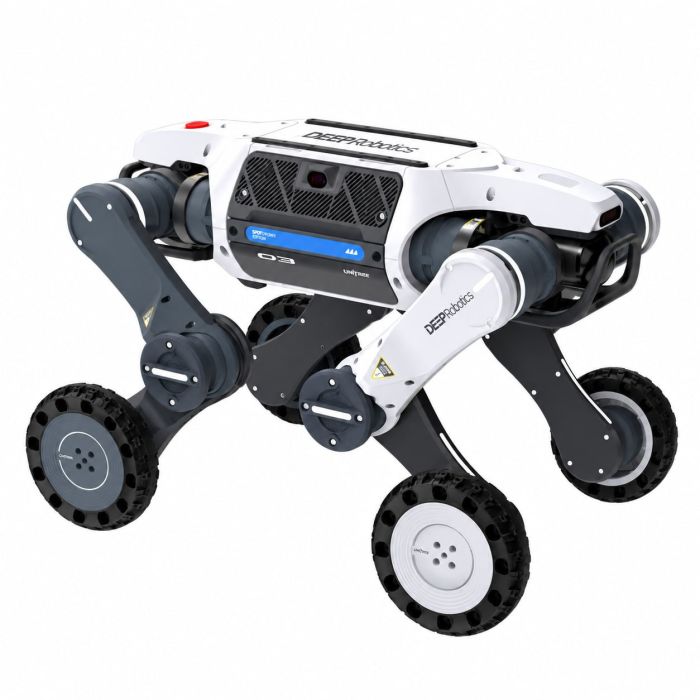
Deep Robotics LYNX S10 Pro Wheeled Quadruped Robot Dog
In stock
- BRAND:
- DEEP ROBOTICS
- MODEL:
- LYNX S10 PRO
- ORIGIN:
- China
- AVAILABILITY:
- ALLOW 2-4 WEEKS FOR DELIVERY
- SKU:
- Deep-Robotics-LYNX-S10-Pro
Deep Robotics LYNX S10 Pro Wheeled Quadruped Robot Dog
Some robots roll when the floor is kind and step when it is not. The Deep Robotics LYNX S10 Pro Wheeled Quadruped Robot Dog is built on that idea: a small wheeled-legged machine that a single person can carry to the site, set down and put to work in places where a larger vehicle would never fit. For teams that inspect, patrol and respond in tight quarters, that mix of wheels for speed and legs for obstacles is the whole point.
The product is available through this page, by quotation.
Background
Deep Robotics and the Lynx line
Deep Robotics is a Hangzhou-based maker of legged and wheeled-legged robots for industrial and professional use. Its Lynx family brings wheels and legs together on one chassis. The family covers several sizes and roles, from the larger Deep Robotics LYNX M20 Omni Terrain Industrial Wheeled Quadruped Robot Dog to the compact S10 platform described here. Buyers who want to see the whole range can browse our Wheeled Quadrupeds category.
The S10 platform comes in two versions, the Lynx S10 and the Lynx S10 Pro. The base machine is listed on its own page as the Deep Robotics LYNX S10 Wheeled Quadruped Robot Dog. This page covers the Pro version. The figures below describe the Lynx S10 platform that both versions share. Where the two versions differ, your quotation sets it out.
Positioning: a small robot for narrow spaces
The manufacturer describes the Lynx S10 as filling the market gap for small wheeled-legged robots in narrow spaces and lightweight operations. In plain terms, it is meant for jobs that do not need a heavy machine but do need a robot that can get through doors, between equipment and over obstacles. It is not meant to be a miniature version of a large platform.
Two things define it. The first is size and weight: the robot weighs no more than 20 kg including its battery, so one person can carry it and deploy it quickly. The second is its software. A next-generation AI motion control and gait algorithm handles extreme maneuvers, while mapping, localization and navigation algorithms give it autonomous path planning and intelligent obstacle avoidance.
Technical Specifications
| Specification | Value (Lynx S10 platform) |
|---|---|
| Product type | Small wheeled-legged robot for narrow spaces and lightweight operations |
| Weight | ≤20 kg (including battery) |
| Portability | Compact body for single-person portability and rapid deployment |
| Top speed (flat ground) | 8 m/s |
| Obstacle clearance height | Up to 50 cm |
| Protection rating | IP66 |
| Operating temperature | -20°C to 55°C |
| Navigation | Autonomous path planning and intelligent obstacle avoidance |
| Motion control | Next-generation AI motion control and gait algorithm |
| Cameras | Four-directional ultra-wide-angle cameras with high dynamic range |
| Effective payload | Exceeding 8 kilograms |
| Maximum load capacity | 120 kilograms |
| Battery life | Exceeds three hours; supports autonomous charging |
Specifications as published by the manufacturer; confirmed against the datasheet at quotation.
The manufacturer has not published the dimensions, the battery capacity, the processor, the connectivity, the contents of the box, the charging time or the maximum slope angle; they are confirmed at quotation.
What makes the LYNX S10 Pro different from a larger wheeled quadruped?
The answer starts with how you get the robot to the job. A heavy platform needs a vehicle, a ramp or two people. The S10 platform weighs no more than 20 kg with its battery, so one person can pick it up, carry it into a plant room or substation and start work. For teams that visit many small sites in a day, that speed of deployment matters as much as any figure on a datasheet.
The second difference is how it moves. On flat ground it reaches 8 m/s on wheels, and it can clear obstacles up to 50 cm high. Wheels cover distance quickly, and the legs take over when a threshold, a cable run or a low step gets in the way. Together they suit the access needs of lightweight operations.
Larger models in the range suit different work. If your tasks call for a bigger platform, compare this robot with the LYNX M20 or the LYNX M20S. If your priority is narrow access and carry-in deployment, the S10 platform is the closer fit.
How does the LYNX S10 Pro see and find its way?
Perception starts with four-directional ultra-wide-angle cameras with high dynamic range. They keep perception stable and reliable in difficult lighting such as backlight or strong glare, and they capture scene details accurately. Glare and shadow are everyday conditions around plant equipment, loading bays and outdoor yards, so this matters in practice.
On top of that sit the mapping, localization and navigation algorithms. They allow the robot to plan its own path and avoid obstacles intelligently. Motion control runs on a next-generation AI gait algorithm, which is what lets the machine perform extreme maneuvers instead of simply following a smooth floor. Battery life exceeds three hours, and the system supports autonomous charging, which is useful for repeated patrol or inspection rounds.
Autonomy is at the heart of this design, and the Pro is the version to ask about when it is your main requirement.
Who is the LYNX S10 Pro for?
The manufacturer names four industries: power inspection, security patrol, emergency firefighting, and education and scientific research. Each has its own reasons to choose a small, rugged, portable robot.
Utility and plant operators gain a robot that can walk through substations and equipment rooms where space is tight. Security teams get a machine fast enough for patrol rounds and sealed to IP66 against dust and water jets. Emergency services can use a robot light enough to carry to an incident and send ahead of people; see also our Emergency Response category. Universities and research labs get a capable platform for work on locomotion, navigation and perception.
Buyers who want the standard machine without the Pro features can look at the standard Lynx S10 listed above. Buyers who need a very large load or a bigger body should compare the M20 models first.
What is the LYNX S10 Pro used for?
- Power inspection. Rounds through substations and equipment rooms, with cameras that cope with glare and low light.
- Security patrol. Repeated routes over a site, using autonomous path planning and obstacle avoidance.
- Emergency firefighting support. A portable robot that can go ahead of responders into spaces that are hard to reach.
- Education and scientific research. A platform for study of AI motion control, gait and navigation.
- Outdoor exploration. Work in conditions from -20°C to 55°C, with IP66 protection.
- Light carrying tasks. Equipment moved with an effective payload exceeding 8 kilograms.
Pricing and Availability
We do not list prices on this page. Quotation is the way to buy: tell us your site, your use and your quantity, and we will respond with an offer. Delivery, customs and support are arranged together with the quotation. The Deep Robotics LYNX S10 Pro Wheeled Quadruped Robot Dog is available on this page.
Frequently Asked Questions
How much does the LYNX S10 Pro weigh?
The Lynx S10 platform weighs no more than 20 kg including the battery. That is light enough for one person to carry and deploy.
How fast is it?
Its flat-ground top speed is 8 m/s. It can also clear obstacles up to 50 cm high.
Can it work outdoors and in harsh weather?
It has an IP66 protection rating and operates in temperatures from -20°C to 55°C.
How long does the battery last?
Battery life exceeds three hours, and the system supports autonomous charging.
How much can it carry?
The effective payload exceeds 8 kilograms, and the maximum load capacity is 120 kilograms.
Does it navigate on its own?
Yes. Its mapping, localization and navigation algorithms enable autonomous path planning and intelligent obstacle avoidance.
Where can I buy the LYNX S10 Pro and what does it cost?
You can request it through this page, by quotation. We do not publish prices; the offer is prepared once we know your requirements.
Summary
The idea behind the LYNX S10 Pro is simple: wheels for speed, legs for obstacles, and a body small enough to carry. It brings an 8 m/s top speed, 50 cm obstacle clearance, IP66 protection, a -20°C to 55°C operating range and a battery life beyond three hours into a machine of no more than 20 kg. For power inspection, security patrol, emergency response and research teams working in narrow spaces, that combination is the case for it. If it fits your site, this page is the starting point.
Specifications
General
Physical
Performance
Battery + Power
Related Products
Out of stock


