
Casbot W1 Wheeled Humanoid Robot (W1)
In stock
- BRAND:
- CASBOT
- PART #:
- W1
- ORIGIN:
- China
- AVAILABILITY:
- SUBJECT TO AVAILABILITY
- SKU:
- Casbot-W1
Casbot W1 Wheeled Humanoid Robot (W1)
Most humanoid demonstrations show a robot walking, yet most real work happens while standing still in front of a shelf, a bench or a conveyor. The Casbot W1 Wheeled Humanoid Robot (W1) is built around that observation: it rolls to the workstation, adjusts its height and then goes to work with two arms. For teams in logistics, retail and manufacturing, that is often the more practical shape for a humanoid.
The product is available through this page, by quotation.
Background
CASBOT and the lineage of the W1
The W1 is made by CASBOT, listed as Beijing Zhongke Huiling Robotics Technology Co., Ltd. The company builds humanoid and manipulation hardware for embodied AI, which means robots that connect what they see and feel to what they do with their bodies. Its range is not limited to one body type. Alongside this wheeled platform, the family includes bipedal machines such as the Casbot 02 Bipedal Humanoid Robot and the Casbot Mini Bipedal Humanoid Robot, as well as dexterous hands such as the Casbot Handle L1 Dexterous Robotic Hand.
Within that family, the W1 is the platform for work that happens at a fixed spot after a short trip. It trades the walking gait for a mobile base, and in return it concentrates on what the arms and hands can do once the robot has arrived.
Positioning and key technology
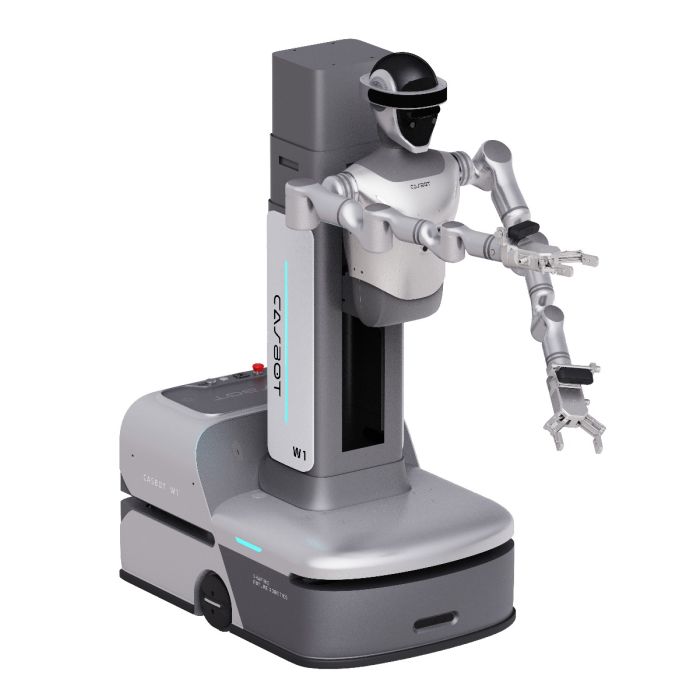
The W1 is a wheeled humanoid robot platform that blends mobile navigation with dual-arm manipulation for embodied AI tasks in logistics, retail and manufacturing workflows. Its mobile base is paired with adjustable lift mechanics, so the arms can work at different heights. That single design choice matters a great deal in practice, because shelves, bins and workbenches are rarely at the same level.
The perception suite includes RGB-D vision, LiDAR, tactile and force sensors, and an IMU. Cameras are RGB-D structured light units plus stereo vision. Each arm has 7 degrees of freedom and ends in a 3-finger gripper, and the robot has 20 degrees of freedom overall. Motion comes from industrial electric servos, and the structure is built from alloy and engineering plastics. Compute is an industrial PC with an i9 CPU and an NVIDIA 4060 GPU, and the software side is ROS-compatible with a proprietary robotics stack.
Technical Specifications
| Specification | Value |
|---|---|
| Product type | Wheeled humanoid robot platform, mobile navigation with dual-arm manipulation |
| Degrees of freedom, overall | 20 |
| Degrees of freedom, hands | 7 per arm |
| Height | 112-210 cm |
| Max speed | 4.3 km/h |
| Weight | ~260 kg |
| Runtime per charge | ~4–5 hours |
| CPU/GPU | Industrial PC (i9 CPU + NVIDIA 4060 GPU) |
| Connectivity | 4G, Bluetooth 5.2, Ethernet, Wi-Fi 6 |
| Cameras | RGB-D structured light units + stereo vision |
| Grippers | 3-finger grippers |
| Operating system | ROS-compatible with proprietary robotics stack |
| Main structural material | Alloy + engineering plastics |
| Motor technology | Industrial electric servos |
| Manufacturer | CASBOT / Beijing Zhongke Huiling Robotics Technology Co., Ltd. |
Specifications as published by the manufacturer; confirmed against the datasheet at quotation.
The manufacturer has not published the payload per arm, the IP rating, the battery capacity, the charging time, the dimensions, the contents of the box, the drive and wheel configuration or the LiDAR model; they are confirmed at quotation.
What makes the W1 different from a bipedal humanoid?
A bipedal humanoid spends a large share of its engineering effort on balance. That effort is worthwhile when the robot must climb stairs or step over obstacles, but many commercial sites are flat and planned around carts, pallets and aisles. On such floors a wheeled base is a natural fit. The W1 moves at up to 4.3 km/h, which is a steady working pace rather than a sprint, and it keeps its attention on the job at the workstation.
The second difference is the way the body is organized. The W1 combines a mobile base with lift mechanics, so the torso position changes with the task. A fixed-height torso has to bend or reach, while the W1 raises or lowers the whole upper body so both arms face the work. If your use case truly needs legs, the Humanoids category shows the wider range. If the work is shelf, bench and conveyor, the Wheeled Humanoids category is the closer match for comparison.
How does the W1 reach different working heights?
The W1 stands between 112 and 210 cm in height, and the adjustable lift is what covers that range. Low bins, mid-level tables and upper shelves can each be approached with the arms in a comfortable working posture, which is easier on the joints and simpler for the control software than stretching one fixed body to every position.
Once at the right height, the robot relies on its senses. RGB-D structured light units and stereo vision let it see objects and distances, LiDAR supports navigation, and tactile and force sensors tell the hands how an object is being held. The IMU adds information about the robot's own motion. With 7 degrees of freedom in each arm and a 3-finger gripper at the end, it can pick, sort, scan and place items when instructed.
Who is the Casbot W1 for?
Logistics operators are the first group. Sorting stations, scanning points and shelf-side picking all involve repeated reaching at varied heights, and the W1 was designed for such tasks. Retail teams are a second segment, particularly where stock must be handled near shelving or back-of-house counters.
Manufacturing teams form a third. Light workstation tasks, material handling between benches and structured pick-and-place routines suit a robot that arrives, adjusts and manipulates. Research labs and integrators are a fourth group: with a ROS-compatible system and a proprietary robotics stack, the platform gives developers a base for embodied AI experiments on real hardware.
It is less suited to buyers who need a robot to walk across uneven ground; the bipedal models in the family are the better place to start for them. Buyers who only need a hand for an existing arm may prefer one of the dexterous robotic hands instead.
What is the W1 used for?
- Picking items. The arms and 3-finger grippers lift objects from shelves, bins and tables when instructed.
- Sorting. Items are placed into the right location after the robot identifies them with its vision system.
- Scanning. The robot holds items in view of its sensors so they can be identified and recorded.
- Placing and shelving. The lift mechanism lets it set items down at different heights, from low racks to upper shelves.
- Material handling between stations. The mobile base carries the robot from one workstation to the next in logistics and manufacturing flows.
- Embodied AI development. Integrators and labs use the ROS-compatible platform to test perception, planning and manipulation on one machine.
Pricing and Availability
Every W1 project differs in site layout, tasks and integration needs, so the product is offered by quotation and not at a listed amount. Send us your use case and we will prepare a quotation. Delivery, customs and support are arranged with the quotation, so the details are settled in one place. The Casbot W1 Wheeled Humanoid Robot (W1) is available on this page.
Frequently Asked Questions
How many degrees of freedom does the W1 have?
The W1 has 20 degrees of freedom overall, with 7 per arm. Each arm ends in a 3-finger gripper.
How tall is the W1?
Its height runs from 112 to 210 cm, set by the adjustable lift mechanism. This lets the arms work at different heights.
How long does it run on a charge?
Runtime per charge is about 4 to 5 hours, which suits a working shift of picking, sorting and scanning.
What sensors and compute does it use?
Perception includes RGB-D vision, LiDAR, tactile and force sensors, and an IMU. Compute is an industrial PC with an i9 CPU and an NVIDIA 4060 GPU.
Can it connect to my network and software?
It offers 4G, Bluetooth 5.2, Ethernet and Wi-Fi 6. The operating system is ROS-compatible with a proprietary robotics stack.
What is the W1 built from?
The main structure is alloy and engineering plastics, and motion comes from industrial electric servos. The robot weighs about 260 kg.
Where can I buy the Casbot W1 and what does it cost?
You can request it through this page. The cost is given in a quotation prepared for your project, with delivery, customs and support arranged alongside it.
Summary
Walking makes a good demonstration, but standing at the right height makes the work get done. The W1 puts that idea into hardware: a mobile base to reach the station, adjustable lift to meet the shelf or bench, and two 7-degree-of-freedom arms with 3-finger grippers to handle the items. Add RGB-D and stereo vision, LiDAR, force and tactile sensing, and a ROS-compatible stack, and you have a platform that fits logistics, retail and manufacturing tasks. For a quotation on the Casbot W1 Wheeled Humanoid Robot (W1), this page is the starting point.


