
Casbot Handle L1 Dexterous Robotic Hand
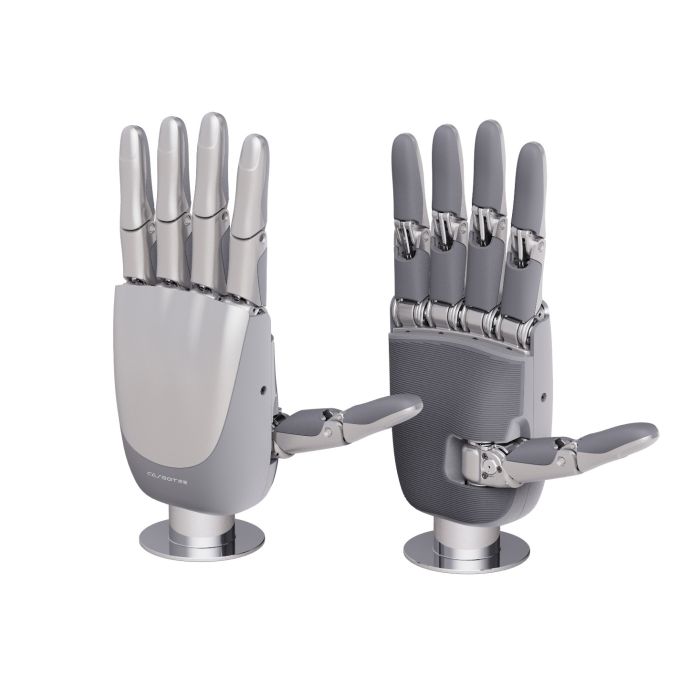
In stock
- BRAND:
- CASBOT
- PART #:
- Handle L1
- ORIGIN:
- China
- AVAILABILITY:
- SUBJECT TO AVAILABILITY
- SKU:
- Casbot-Handle-L1
Casbot Handle L1 Dexterous Robotic Hand
A band does not need the most joints in the world; it needs timing, repetition and stamina. That is the idea behind the Casbot Handle L1 Dexterous Robotic Hand, a hand built to keep working rather than to show off how many axes it can pack into a palm. Four robots fitted with it once played guitar, bass, keyboard and drums on a live stage, and the lesson was plain: for many real jobs, a simpler hand that runs well all day beats a complicated one that needs constant care.
The product is available through this page, by quotation.
Background
CASBOT Hands and its lineage
The Handle L1 comes from CASBOT Hands, a technology company focused on dexterous hands and embodied manipulation. It was established in July 2026. Its product and technology foundation originates from CASBOT, a Beijing-based robotics company that has spent several years developing embodied intelligence technologies and deploying them in real-world environments.
CASBOT Hands was jointly established by CASBOT, Lens Technology and Hunan Huaxia Investment Group. That mix of a robotics developer and two partners from outside the robot itself points to a company that intends to make hands in a form that can be produced and deployed, not only demonstrated. If you follow the wider brand, our Casbot category gathers the other products in the family.
The L1 was introduced on August 7 in Changsha, China, together with two siblings, the D1 and the M1. CASBOT Hands described itself at that launch as an embodied intelligence company specializing in robotic dexterous manipulation, and the three hands were presented as new dexterous hand products from one team, each with its own role.
Positioning and key technology
The L1 follows a lightweight design with a streamlined degree-of-freedom configuration. It is designed around cost efficiency, stability, long service life and ease of deployment. Those four goals read like the checklist of a buyer who has to keep a robot working in the field, not in a laboratory.
The reasoning behind the streamlined configuration is simple. Reducing the number of degrees of freedom helps simplify the control system and lower product cost, while the lightweight structure reduces the load placed on the end of a robotic arm. Fewer joints mean less to command, less to calibrate and less to go wrong, and a lighter hand is easier on the arm that carries it.
By contrast, the D1 is positioned as a general-purpose five-finger dexterous hand with a higher degree of freedom. The L1 therefore sits on the other side of the trade-off: it gives up some of that range in return for simpler control and a lower cost of ownership. Its relatively fast opening, closing and response are intended for high-frequency movements and continuous operation.
Technical Specifications
| Specification | Value |
|---|---|
| Model | Casbot Handle L1 Dexterous Robotic Hand (L1) |
| Manufacturer | CASBOT Hands |
| Introduced | August 7, in Changsha, China, together with the D1 and M1 |
| Design concept | Lightweight design with a streamlined degree-of-freedom configuration |
| Design goals | Cost efficiency, stability, long service life and ease of deployment |
| Control approach | Fewer degrees of freedom to simplify control and lower cost |
| Effect on the arm | Lightweight structure reduces the load on the end of a robotic arm |
| Motion character | Relatively fast opening, closing and response for high-frequency movements and continuous operation |
Specifications as published by the manufacturer; confirmed against the datasheet at quotation.
The manufacturer has not published the degrees of freedom, the weight, the dimensions, the grip force, the payload, the opening and closing speed, the communication interface, the operating voltage, the tactile sensing, the actuation type, the contents of the box, the software and SDK, or the list of compatible robot arms; they are confirmed at quotation.
What makes the Handle L1 different from a general-purpose hand?
Most dexterous hands are sold on the promise of range: more fingers, more joints, more of the human hand reproduced. The L1 argues for something else. Its makers chose a streamlined degree-of-freedom configuration on purpose, and they say why: a simpler control system and a lower product cost. For a team that must deploy many hands, or keep one working through long shifts, that is a sound argument.
The comparison with the D1 makes the point. The D1 is a general-purpose five-finger hand with a higher degree of freedom, meant for work where versatility matters most. The L1 is aimed at work where repetition, stability and service life matter most. Neither is better in every case; they answer different questions.
The second difference is weight on the arm. A lightweight structure reduces the load placed on the end of a robotic arm, and anyone who has watched an arm struggle with a heavy tool at the wrist will see the value. We do not claim a weight figure here, but the design intent is clear.
How has the Handle L1 been shown in public?
The L1 was demonstrated at the World Artificial Intelligence Conference. There, four robots equipped with the hand formed the CASBOT BAND and performed live music using real instruments, including guitar, bass, keyboard and drums. Playing an instrument takes steady timing and many repeated motions, which fits the stated purpose of the hand: high-frequency movements and continuous operation.
A stage show is not a factory trial, and we do not present it as proof of any particular payload or accuracy. It does show that the hand was built to be used repeatedly in front of an audience, which is a fair test of reliability in itself.
Who is the Handle L1 for?
The L1 suits integrators and robot builders who want a hand that is easy to deploy and easy to control, and who care about the cost of running it over time. It also suits teams that need a lighter hand at the end of an arm, and groups that expect repeated, fast motions in their work.
Universities and training centers around the Caribbean may find it a practical way to teach manipulation without the control burden of a hand with many more joints. Companies planning pilot projects in service, hospitality or light assembly may also value a hand designed around stability and long service life.
If your task needs the widest possible range of finger movement, look at the wider range in our Robot Hands category. The Casbot Handle L1 PRO Dexterous Robotic Hand is listed as its own product, and its figures are quoted with it, not borrowed from the L1. If you plan a complete humanoid platform, the Casbot 02 Bipedal Humanoid Robot is one of the bodies in the brand family.
What is the Handle L1 used for?
- Repetitive handling. Fast opening and closing suits tasks that repeat many times in a shift.
- Continuous operation. The design is intended for work that does not stop for long periods.
- Robot arm end-effector. The light structure keeps the load on the end of the arm down.
- Embodied intelligence research. A simpler hand gives researchers a controllable platform for manipulation studies.
- Live demonstrations. Four robots with this hand played a full band at a major conference.
- Cost-conscious deployment. Fewer degrees of freedom lower product cost, which helps projects that need several hands.
Pricing and Availability
We do not print prices on this page. Please request a quotation and tell us your application, the arm or robot you plan to use, and the number of units. Delivery, customs and support are arranged with the quotation, so you see the full picture before you commit. The Casbot Handle L1 Dexterous Robotic Hand is available on this page.
Frequently Asked Questions
Who makes the Casbot Handle L1?
It is made by CASBOT Hands, a company jointly established by CASBOT, Lens Technology and Hunan Huaxia Investment Group. Its technology foundation comes from CASBOT, a Beijing-based robotics company.
When was the Handle L1 introduced?
It was introduced on August 7 in Changsha, China, together with the D1 and M1 hands.
How is the L1 different from the D1?
The D1 is a general-purpose five-finger hand with a higher degree of freedom. The L1 uses a streamlined configuration to simplify control and lower cost.
Is the Handle L1 designed for continuous work?
Yes. Its relatively fast opening, closing and response are intended for high-frequency movements and continuous operation, and long service life is one of its design goals.
What are the grip force, weight and payload?
Please ask us for these figures when you request a quotation, and we will come back to you with them.
Which robot arms is it compatible with?
Tell us the arm you use and we will check the fit when we prepare your quotation.
Where can I buy the Casbot Handle L1 and what does it cost?
You can buy it through this page by requesting a quotation. We do not list prices here; the quotation sets out the cost, delivery, customs and support for your project.
Summary
The Casbot Handle L1 Dexterous Robotic Hand makes a quiet argument: a hand does not need every joint to be useful, it needs to be steady, light and ready to repeat its work. Its streamlined degree-of-freedom layout, lighter load on the arm and focus on continuous operation were shown in the most visible way possible, with four robots playing a live band. When you are ready to talk about your project, this page is the starting point.


