
Booster T1 with Dexterous Hands Humanoid Robot
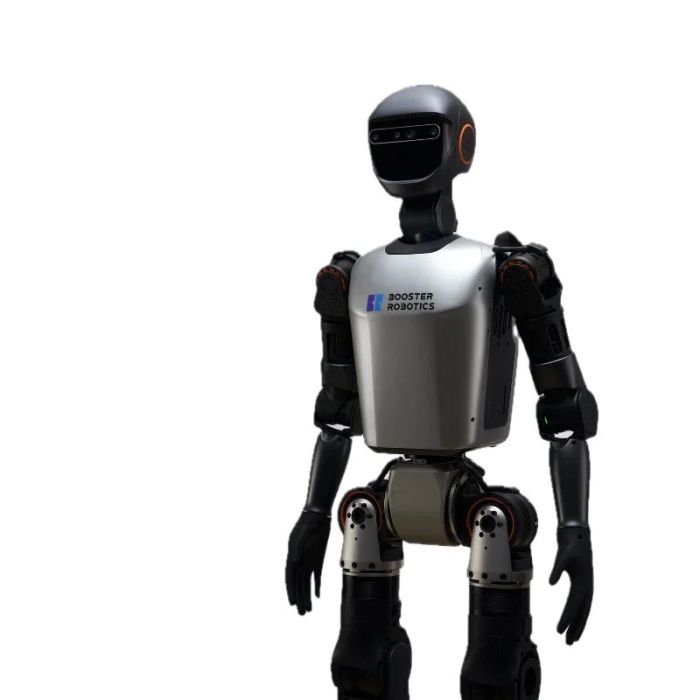
In stock
- BRAND:
- BOOSTER ROBOTICS
- MODEL:
- BOOSTER T1 WITH DEXTEROUS HANDS
- ORIGIN:
- China
- Warranty:
- 12 MONTHS
- AVAILABILITY:
- SUBJECT TO AVAILABILITY
- SKU:
- Booster-T1-Dexterous-Hands
- Buy 2 for $48,975.50 each and save 0%
Booster T1 with Dexterous Hands Humanoid Robot
Walking is the part of humanoid robotics that gets the applause, but the work starts when the robot reaches for something. The Booster T1 with Dexterous Hands Humanoid Robot is the T1 family's answer to that moment: a bipedal frame that has been proven on the football pitch, now fitted with two hands that can be programmed to handle objects rather than just carry them.
The product is available through this page, by quotation.
Background
Booster Robotics and the T1 lineage
Booster Robotics builds humanoid platforms for developers, researchers and competitive teams. Its robots are best known from RoboCup, where the company's name has become a regular feature in the results. At RoboCup 2025 in Brazil, teams using Booster robots took the top two places in both the AdultSize and the KidSize divisions. For a young company, that is a record that speaks to how well the platform stands up to real play: falls, contact, quick changes of direction and long days of tuning.
The T1 family is organized around one body and several levels of hand equipment. The sources name four versions: T1 Basic, T1 Standard, T1 Gripper and T1 Dexterous hand. They differ mainly in total degrees of freedom and in what is fitted at the end of the arm. This page describes the Dexterous hand version, which sits at the top of that ladder.
Positioning and key technology
The Booster T1 with Dexterous Hands is configured with 41 degrees of freedom (DoF). That total includes 7 DoF arms and two 6 DoF dexterous hands. Below the arms, the body shares its breakdown with the Standard and Gripper versions: 6 DoF per leg, 1 waist DoF and 2 head DoFs. In other words, the legs, waist and head that carry the competition reputation are the same, and the extra capability is concentrated in the arms and hands.
Each joint uses a dual encoder, which gives the control software two position readings per joint to work with. The robot weighs about 30kg and runs on a 10.5 Ah battery, and it is supplied with a remote control. That makes it a platform a small team can set up on a bench or a classroom floor, rather than an installation that needs a dedicated facility.
Technical Specifications
| Specification | Value |
|---|---|
| Version | T1 Dexterous hand |
| Total degrees of freedom | 41 DoF |
| Arms | 7 DoF |
| End effector | Two 6 DoF dexterous hands |
| Legs | 6 DoF per leg |
| Waist | 1 DoF |
| Head | 2 DoF |
| Joint encoder | Dual Encoder |
| Weight | About 30kg |
| Battery | 10.5 Ah battery |
| Included | Remote Control |
Specifications as published by the manufacturer; confirmed against the datasheet at quotation.
The manufacturer has not published the payload, the IP rating, the hand grip force, the hand weight, the operating temperature, the battery voltage or the maximum speed; they are confirmed at quotation.
What does the Dexterous hand version add over the other T1 versions?
The clearest way to understand this version is through the family's own numbers. Total degrees of freedom run 23 for the T1 Basic, 23 for the T1 Standard, 31 for the T1 Gripper and 41 for the T1 Dexterous hand. The end effector follows the same path: none on the Basic, optional on the Standard, a gripper on the Gripper version and a dexterous hand on this one.
The difference from the gripper version is the most useful comparison. A gripper opens and closes, which is enough for picking up and placing simple items. Two 6 DoF hands give a program several independent joints per hand to coordinate, which is what research into in-hand manipulation and human-like grasping requires. The jump from 31 to 41 total DoF reflects that change.
Buyers whose work depends on grip force or hand weight should raise those points when they request a quotation.
How does it compare with a locomotion-only humanoid?
A robot built only for walking and kicking can be a fine competition platform, and the lower versions of the T1 serve that purpose. Once the task includes a table, a tray or a door handle, the robot needs arms with enough freedom to approach from different angles and hands that can do something once they arrive. With 7 DoF in each arm and 6 DoF in each hand, this version is set up for that kind of research, while keeping the 6 DoF legs, the waist and the two head joints that every version above the Basic shares.
The dual encoder on each joint also matters for manipulation work, because a controller that can cross-check each joint's position has more to build on when it plans precise movements.
Who is the Booster T1 with Dexterous Hands for?
The first group is university labs and research institutes working on embodied AI, manipulation and humanoid control. They need a body that is already proven in locomotion and hands they can program, and this version gives them both without a custom build.
The second group is competitive robotics teams that want to extend into manipulation challenges while staying on a platform with a RoboCup record. Teams that only need the walking and kicking side may be better served by the Booster T1 Basic Humanoid Robot or the Booster T1 Standard Humanoid Robot. Those who want simple pick and place with fewer joints to tune can look at the Booster T1 with Grippers Humanoid Robot.
The third group is technical schools and demonstration centers. A robot of about 30kg can be moved and set up by a small team, and a pair of working hands is something an audience understands right away. You can browse the wider range under Bipedal Humanoids or Humanoids.
What is the Booster T1 with Dexterous Hands used for?
- Manipulation research. Two 6 DoF hands on 7 DoF arms give researchers a body for studying grasping and object handling.
- Embodied AI development. Teams can test learning methods on a full-body platform that walks, reaches and grasps.
- Competition preparation. The legs, waist and head share the breakdown of the T1 versions behind the RoboCup 2025 results.
- Teaching robotics. Students can see locomotion, balance and hand control working on one machine.
- Public demonstrations. A humanoid that walks up to an object and picks it up holds the attention of visitors at events.
- Control and software testing. The dual encoder on each joint and the remote control support careful development and safe handling at the bench.
Pricing and Availability
No price is printed on this page; quotation is the way to proceed. Tell us your application, your quantity and your location, and we will prepare an offer. Delivery, customs and support are arranged with the quotation. The Booster T1 with Dexterous Hands Humanoid Robot is available on this page.
Frequently Asked Questions
How many degrees of freedom does this version have?
It has 41 DoF in total. That includes 7 DoF arms and two 6 DoF dexterous hands, along with 6 DoF per leg, 1 waist DoF and 2 head DoFs.
What is the weight of the robot?
The robot weighs about 30kg.
What battery does it use?
It uses a 10.5 Ah battery.
Is a remote control included?
Yes, a remote control is included with this version.
Where do I find the payload and the IP rating?
Send your requirements with your quotation request, and we will go through the payload, the IP rating and the maximum speed with you.
How does this version differ from the Gripper version?
The Gripper version has 31 total DoF and a gripper as its end effector. This version has 41 total DoF and two 6 DoF dexterous hands.
Where can I buy the Booster T1 with Dexterous Hands and what does it cost?
You can buy it through this page by requesting a quotation. We do not print a price here; the offer is prepared once we know your requirements.
Summary
Many humanoids can stay upright, but fewer can do something useful once they are standing at a table. The Booster T1 with Dexterous Hands pairs the legs, waist and head of a platform with a RoboCup record with 7 DoF arms and two 6 DoF dexterous hands, for 41 DoF in total. The dual encoder on every joint, a weight of about 30kg and a 10.5 Ah battery keep it practical for labs, schools and teams. If this is the robot your work needs, this page is the starting point.
Specifications
General
Physical
Connectivity
Software
What's included
Robot Accessories:
- Remote Control
- Charger
- Robot Vertical Stand
- Robot Transport Case


