
Booster K1 EDU Humanoid Robot
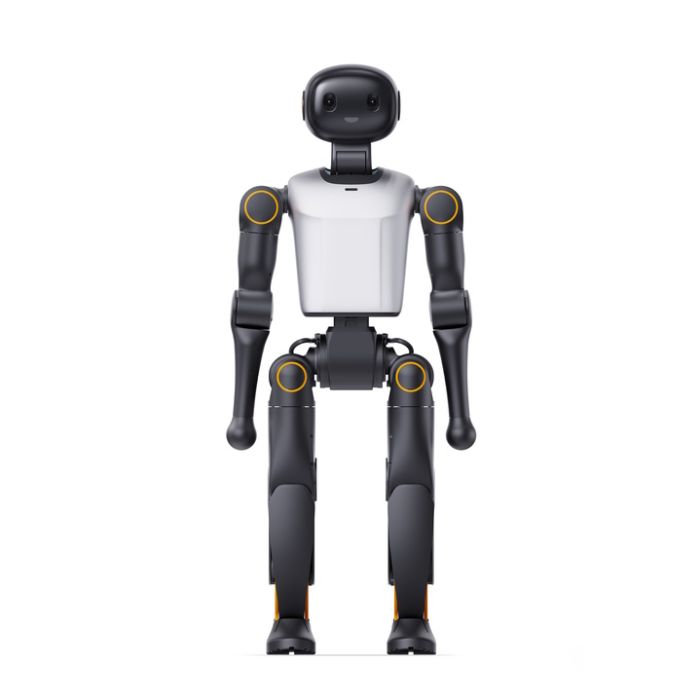
In stock
- BRAND:
- BOOSTER ROBOTICS
- MODEL:
- BOOSTER K1
- ORIGIN:
- China
- Warranty:
- 12 MONTHS
- AVAILABILITY:
- SUBJECT TO AVAILABILITY
- SKU:
- Booster-K1
Booster K1 EDU Humanoid Robot
Most teaching robots fall into two camps: toys that cannot be pushed further than a demo, and laboratory machines that students are afraid to touch. The Booster K1 EDU Humanoid Robot belongs to neither. It is a bipedal platform that finished as both champion and runner-up in the RoboCup 2025 KidSize competition, and it comes with the compute, sensors and software access that a classroom or a research group needs to start real embodied-AI work.
The Booster K1 EDU Humanoid Robot is available through this page, by quotation.
Background
Booster Robotics and the K1 lineage
BOOSTER ROBOTICS builds humanoid robots for developers, researchers and educators. The K1 is its introductory model, and it is offered in three versions: Geek, Education and Professional. This page describes the Education version, the one known as the K1 EDU.
The K1 has been tested in public. At RoboCup 2025 in the KidSize class, K1 robots took both the champion and the runner-up positions. Robot soccer is hard on hardware, with falls, collisions and constant recovery, so this result tells a school or a lab something practical: the body is built to be used, not just displayed.
Positioning: an introductory embodied development platform
The manufacturer describes the K1 as an introductory embodied development platform. In plain terms, it is meant to be the first humanoid a team buys, the one on which students learn how perception, balance, motion and language models fit together. It is small and light enough to be handled by one person, and the package includes a carrying case for moving it between rooms, campuses or events.
Its key technology is the combination of a well-articulated body and an open software path. The joints use dual encoders, the robot supports secondary development, and it works with ROS and with simulation environments such as Isaac Sim. That means a team can rehearse an idea in simulation and then try it on the real machine.
Technical Specifications
| Specification | Value |
|---|---|
| Positioning | Introductory Embodied Development Platform |
| RoboCup 2025 result | KidSize champion and runner-up |
| Height | ~95cm |
| Weight | ~19.5kg |
| Total degrees of freedom | 22 |
| Degrees of freedom per leg | 6 |
| Degrees of freedom per arm | 4 |
| Head degrees of freedom | 2 |
| Knee movement range | 0°~127° |
| Ankle movement range | P-50°~20°, R±20° |
| Max peak joint torque | 60N·m |
| Joint encoder | Dual Encoder |
| AI performance (Education) | 117 TOPS |
| Onboard compute module (Education) | NVIDIA Jetson Orin NX with 8 GB RAM |
| Camera | Stereo Depth Camera |
| IMU | 9-axis IMU |
| Audio | Circular 3-Mic Array + speaker |
| Battery (Education) | 5Ah |
| Battery life (Education) | 80min (walking 0.4m/s) |
| Wi-Fi 6 (Education) | Supported |
| Bluetooth 5.2 | Supported |
| Expansion port | Gigabit Ethernet |
| Buttons | Power×1, Interaction×3 |
| Language model | Doubao LLM included, free for 6 months |
| Secondary development | Supported |
| Firmware upgrade | Supported |
| Software compatibility (Education) | ROS-compatible; compatible with simulation environments such as Isaac Sim |
| In the box (Education) | Documentation, hardware manual, ROS drivers, sample projects, charger, power supply, 5 Ah battery, remote control, carrying case |
Specifications as published by the manufacturer; confirmed against the datasheet at quotation.
The manufacturer has not published the payload, the IP rating, the charging time, the operating temperature, the dimensions with width and depth, or the power consumption; they are confirmed at quotation.
What makes the K1 EDU different from the other K1 versions?
The K1 comes in Geek, Education and Professional versions, and the figures in the table above belong to the Education version wherever they are marked as such. The AI performance, the Jetson Orin NX module, the battery, the battery life and the software compatibility are all stated for this version, so they should not be assumed for the others.
What defines the EDU is its balance. It carries a compute module that runs AI, perception and control on the robot itself, it ships with ROS drivers and sample projects, and it includes the accessories needed to start on day one: charger, power supply, battery, remote control and carrying case. A team does not have to assemble a toolchain from scratch before the first lesson.
If your work leans toward hobby-level tinkering, the Booster K1 GEEK Edition Humanoid Robot may be worth comparing. If your project calls for a more demanding configuration, look at the Booster K1 Professional Humanoid Robot. Ask for both configurations in the same quotation request and compare them line by line.
How does the K1 EDU support AI and software development?
The Education version has a NVIDIA Jetson Orin NX with 8 GB RAM, rated at 117 TOPS of AI performance. That is enough to keep perception and control on the robot, which suits students who want to see a vision model or a control loop run on real hardware rather than on a remote server.
The sensors give that computer something to work with. A stereo depth camera supplies images with depth, a 9-axis IMU reports the body's motion and orientation, and a circular 3-microphone array with a speaker lets the robot hear and speak. A Doubao language model is included, free for 6 months, so voice interaction projects can begin without a separate service plan.
On the software side, secondary development is supported, firmware can be upgraded, and the robot is ROS-compatible, with ROS drivers and sample projects in the box. Compatibility with simulation environments such as Isaac Sim means a lab can test behavior virtually first. A Gigabit Ethernet expansion port, Wi-Fi 6 and Bluetooth 5.2 cover wired and wireless connections.
On the body, 22 degrees of freedom are split into six per leg, four per arm and two in the head. Joints use dual encoders, and the maximum peak joint torque is 60N·m. The knee moves from 0° to 127°, which gives the legs room to crouch and recover.
Who is the Booster K1 EDU for?
Universities and technical colleges are the clearest fit. A robotics course can use one K1 EDU as a shared platform for locomotion, perception and human-robot interaction, and students can move from simulation to hardware without changing tools.
Research groups starting in embodied AI will find it a practical entry point. It allows quick experiments with onboard AI, and it leaves the choice of a larger or more specialized humanoid until the group knows what it needs. Teams that outgrow it can look at the Booster T1 Basic Humanoid Robot from the same maker.
Competition teams and school robotics clubs also benefit, given the RoboCup 2025 record. Technology centers and makerspaces that want a humanoid for demonstrations and workshops can use it as well, since it is portable and ships in its own case. Buyers who mainly want a lower-commitment starting point can compare the Geek version through the link above.
What is the Booster K1 EDU used for?
- University teaching. A hands-on platform for courses in robotics, control and artificial intelligence.
- Embodied-AI research. Running perception, planning and control models on the robot's onboard compute.
- Simulation to hardware work. Developing in a simulation environment such as Isaac Sim and then testing on the physical robot.
- Robot competitions. Preparing a team for humanoid soccer and similar events.
- Voice and interaction projects. Building conversational behavior with the microphone array, speaker and included language model.
- Demonstrations and outreach. Showing students, visitors and sponsors what a walking humanoid can do, using the carrying case to move it.
Pricing and Availability
Prices are not listed on this page. Quotation is the way to buy: send us your request, tell us how many units you need and which version, and we will respond with an offer. Delivery, customs and support are arranged together with the quotation, so the Caribbean destination is handled from the start. The Booster K1 EDU Humanoid Robot is available on this page.
Frequently Asked Questions
How tall and heavy is the Booster K1 EDU?
The manufacturer states a height of about 95cm and a weight of about 19.5kg.
How many degrees of freedom does it have?
It has 22 in total: six in each leg, four in each arm and two in the head. The knee moves from 0° to 127°.
What computer does the EDU version use?
The Education version uses an NVIDIA Jetson Orin NX with 8 GB RAM, with AI performance of 117 TOPS. It supports local AI, perception and control applications.
How long does the battery last?
The Education version has a 5Ah battery, and the stated battery life is 80min while walking at 0.4m/s.
Can I develop my own software for it?
Yes. Secondary development is supported, firmware can be upgraded, and the robot is ROS-compatible. ROS drivers and sample projects are in the box, and simulation environments such as Isaac Sim are supported.
What is included in the box?
The Education version comes with documentation, a hardware manual, ROS drivers, sample projects, a charger, a power supply, a 5 Ah battery, a remote control and a carrying case.
Where can I buy the Booster K1 EDU Humanoid Robot and what does it cost?
You can buy it through this page by requesting a quotation. No price is shown here; the offer, including delivery, customs and support, is prepared for your project.
Summary
The Booster K1 EDU Humanoid Robot is a robot that has been tested in competition and then equipped for teaching: 22 degrees of freedom, dual-encoder joints, an onboard Jetson Orin NX, a stereo depth camera, ROS drivers and a carrying case. That combination lets a classroom or a lab move from a first lesson to serious experiments on the same machine. If it fits your program, this page is the starting point.


