
BMR Intelligent Follow-up Concrete Placing Pump
In stock
- BRAND:
- BMR
- ORIGIN:
- China
- Warranty:
- 12 MONTHS
- AVAILABILITY:
- SUBJECT TO AVAILABILITY
- SKU:
- BMR-Intelligent-Follow-up-Concrete-Placing-Pump
BMR Intelligent Follow-up Concrete Placing Pump
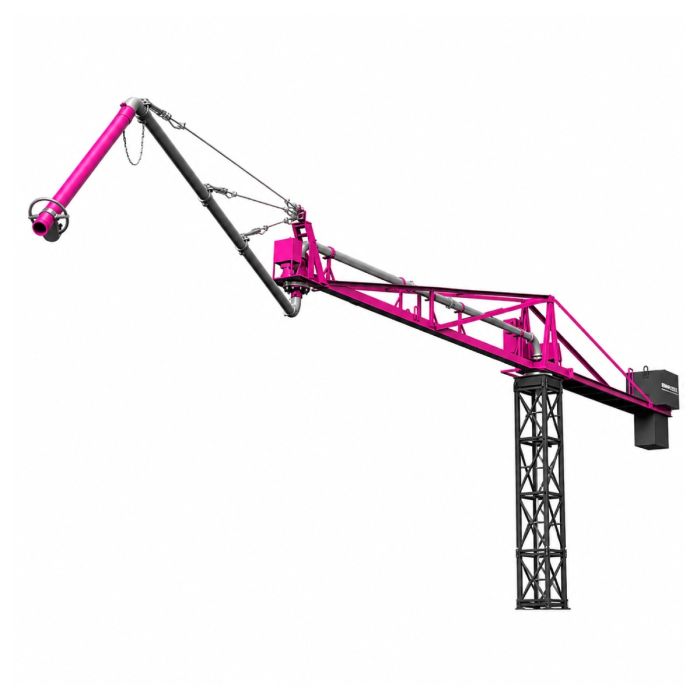
Picture a pour crew on a rebar mat: one person guiding the hose, others hauling it, all of them working around a line heavy with concrete. Now picture the same slab with one operator holding a joystick while a boom does the hauling. That is the idea behind the BMR Intelligent Follow-up Concrete Placing Pump, a placing boom that moves the discharge point by algorithm instead of by muscle.
The product is available through this page, by quotation.
Background
The company behind the boom
The BMR Intelligent Follow-up Concrete Placing Pump is made by Shenzhen BrightMaster Robotics Co., Ltd., the maker of the BMR line of construction robots. The line is built around the stages of concrete work: placing, leveling, finishing, grinding and coating. This placing pump sits at the start of that sequence, where wet concrete leaves the pipeline and has to be put where it belongs.
Placing is a good candidate for automation because the work is repetitive, physically demanding and sensitive to timing. Concrete will not wait for a crew to rest. A machine that carries the heavy part of the job lets a site keep its pace and keep its people out of the most strenuous tasks.
Positioning and key technology
The pump is offered in four models, HG12, HG15, HG18 and HG20, named for placing radii of 12 m, 15 m, 18 m and 20 m. They suit concrete placing on different floors and basements. The central technology is algorithm control of the boom and arm movement. That control supports four working modes: automatic, follow-up, remote and manual.
In automatic mode the machine places concrete according to a preset path. In follow-up mode a single person operates it by joystick. In remote mode the boom and arm are operated from a distance. In manual mode the work is done the traditional way, by manual pulling. A site is never left without a way to keep working, whatever the conditions of the day.
Technical Specifications
| Specification | HG12 | HG15 | HG18 | HG20 |
|---|---|---|---|---|
| Max. placing radius | 12 m | 15 m | 18 m | 20 m |
| Total weight (excl. counterweight) | 1.6 T | 1.7 T | 3.1 T | 3.3 T |
| Min. weight for transfer between floors | 1.6 (2.2) T | 1.7 (2.2) T | 2.2 T | 2.5 T |
| Installation | Outrigger span 3.6×3.6 | Outrigger span 4.2×4.2 | — | Preformed hole: 1.2×1.2~1.5×1.5; Elevator shaft installation: 2.1×2.1~2.3×2.3 |
| Operating voltage | AC380V (±40V) Three-phase five-wire | AC380V (±40V) Three-phase five-wire | AC380V (±40V) Three-phase five-wire | AC380V (±40V) Three-phase five-wire |
| Max. wind resistance | 13.8 m/s (force 6 wind) | 13.8 m/s (force 6 wind) | 13.8 m/s (force 6 wind) | 13.8 m/s (force 6 wind) |
Specifications as published by the manufacturer; confirmed against the datasheet at quotation.
The manufacturer has not published the boom and arm construction, the concrete output rate, the pipe diameter, the power rating, the control and sensing hardware, the contents of the box, the dimensions when folded or the noise level; they are confirmed at quotation.
What makes follow-up placing different from pulling the hose by hand?
Hand placing depends on a crew. Several people move the discharge hose across the deck, and the quality of the pour depends on how well they coordinate and how long they can keep going. The follow-up function replaces that effort. By controlling the movement of the boom and arm through algorithms, only 30% of the manpower is needed to complete the placing work.
The second difference is consistency. The automatic placing function takes advantage of the high uniformity of automatic placing. The leveling workload is reduced by 13%, which helps to achieve high-precision ground. A more even pour leaves less to correct afterward, and the crews that follow can start from a better surface.
The third difference is flexibility. The four working modes mean the machine does not force one way of working. A crew can run a preset path where the layout allows it. It can switch to a single operator with a joystick where the pour needs judgment, or take the boom and arm under remote operation. It can also fall back to traditional manual pulling. That range makes the machine easier to adopt on a site that is used to hand placing, because the old method stays available.
Which model fits which floor: HG12, HG15, HG18 or HG20?
The answer begins with reach. The HG12 covers a 12 m placing radius and the HG15 covers 15 m. The HG18 reaches 18 m and the HG20 reaches 20 m. A larger radius lets one setup cover more of the slab before the boom has to be moved.
Weight and installation vary as well. The HG12 weighs 1.6 T excluding counterweight and stands on an outrigger span of 3.6×3.6. The HG15 weighs 1.7 T and uses an outrigger span of 4.2×4.2. For transfer between floors, the HG12 is listed at 1.6 (2.2) T and the HG15 at 1.7 (2.2) T.
The HG18 weighs 3.1 T excluding counterweight, with a minimum transfer weight of 2.2 T. The HG20 weighs 3.3 T, with a minimum transfer weight of 2.5 T. The HG20 has two installation routes: a preformed hole of 1.2×1.2~1.5×1.5, or elevator shaft installation of 2.1×2.1~2.3×2.3. No installation figure is listed for the HG18.
Wind limits are the same across the range: maximum wind resistance is 13.8 m/s (force 6 wind). All four models run on AC380V (±40V) three-phase five-wire power, so a site needs that supply in place before the machine arrives.
Who is the BMR Intelligent Follow-up Concrete Placing Pump for?
General contractors on multi-story buildings are the clearest fit. Their pours repeat floor after floor, and the combination of a boom that can be moved between levels and a smaller placing crew speaks directly to their schedule. The HG20, with its preformed-hole and elevator shaft installation options, is the model to ask about for taller work. The HG12 and HG15, with their outrigger spans, suit slabs and basements where the reach needed is shorter.
Concrete subcontractors will value the reduced manpower. When the placing function needs only 30% of the labor, crews can be assigned to other work, and fewer people stand in the most demanding position on the pour.
Site managers focused on floor quality will look at automatic placing. The reduced leveling workload helps toward a high-precision ground, which matters for floors that must meet tight flatness requirements. After placing, the same site may use BMR 2.5 Meter Concrete Leveling Robot and BMR Concrete Finishing Robot. Other machines for the later stages are in the Concrete Robots category.
What is the BMR Intelligent Follow-up Concrete Placing Pump used for?
- Floor slab placing: concrete is placed on different floors of a building, with the boom covering the radius of the chosen model.
- Basement pours: basements are among the intended placing locations.
- Single-operator placing: in follow-up mode one person steers the boom and arm by joystick.
- Preset-path placing: in automatic mode the machine places concrete along a path set in advance.
- Remote placing: in remote mode the boom and arm are operated from a distance.
- Preparation for leveling: uniform automatic placing reduces the leveling workload by 13% and supports a high-precision ground.
Pricing and Availability
We do not list prices on this page. Each machine is quoted for the model and the site it is meant for. Delivery, customs and support are arranged with the quotation. Send us the model you have in mind, the floor or basement it will work on and your power supply, and we will return a quotation. The BMR Intelligent Follow-up Concrete Placing Pump is available on this page.
Frequently Asked Questions
How many models are there?
There are four: HG12, HG15, HG18 and HG20. They are named for placing radii of 12 m, 15 m, 18 m and 20 m.
How much manpower does it save?
By controlling the movement of the boom and arm through algorithms, only 30% of the manpower is needed to complete the placing work.
What working modes are available?
Automatic mode places concrete along a preset path. Follow-up mode is single-person joystick operation. Remote mode operates the boom and arm from a distance. Manual mode is traditional manual pulling.
What power supply does it need?
The operating voltage is AC380V (±40V), three-phase five-wire, on all four models.
How much wind can it work in?
The maximum wind resistance is 13.8 m/s, which is force 6 wind.
How is the machine installed?
The HG12 uses an outrigger span of 3.6×3.6 and the HG15 uses 4.2×4.2. The HG20 can be installed in a preformed hole of 1.2×1.2~1.5×1.5 or in an elevator shaft of 2.1×2.1~2.3×2.3.
Where can I buy the BMR Intelligent Follow-up Concrete Placing Pump and what does it cost?
You can buy it through this page by requesting a quotation. The cost depends on the model and your site, so it is given in the quotation and not as a listed figure.
Summary
The hard part of a pour is hauling the hose across the deck while the concrete keeps arriving. The BMR Intelligent Follow-up Concrete Placing Pump gives that job to a boom guided by algorithms. Only 30% of the manpower is needed, and automatic placing reduces the leveling workload by 13%. Four models from 12 m to 20 m, four working modes and wind resistance of 13.8 m/s let a site choose the machine and the way of working that suit it. To size the right model for your floors or basement, this page is the starting point.


