
Unitree H2-D Standard Fixed Base Dual-Arm Humanoid Robot
In stock
- BRAND:
- UNITREE ROBOTICS
- MODEL:
- H2-D Standard
- PART #:
- H2-D Standard
- ORIGIN:
- China
- Warranty:
- 12 MONTHS
- AVAILABILITY:
- SUBJECT TO AVAILABILITY
- SKU:
- Unitree-H2-D-Standard
Unitree H2-D Standard Fixed Base Dual-Arm Humanoid Robot
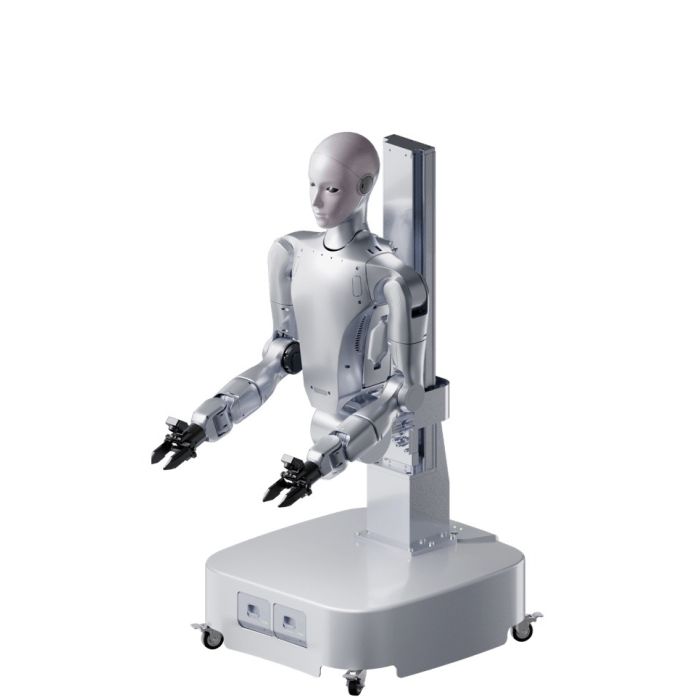
A skilled bench worker does not get the job done with fast feet. The work depends on the shoulders, the waist and the height of the bench. The Unitree H2-D Standard Fixed Base Dual-Arm Humanoid Robot is built around that idea: a two-armed upper body on a vertical column that bends at the waist, lifts and turns to meet the work instead of walking to it.
The product is available through this page, by quotation.
Background
Unitree and the H2 family
UNITREE ROBOTICS is a manufacturer of robots and robot components. The sources for this page name three versions in the H2 line: the H2-A Standard (Fixed Base), the H2-D Standard and the H2-D Flagship (Mobile Chassis). This page describes the H2-D Standard, and every figure below belongs to that version only. The Flagship adds a mobile chassis; the Standard stays in place on a fixed base.
Teams that want to compare the wider family can browse the category pages for H2-D Standard and Unitree H2-D.
Positioning and key technology
The H2-D Standard is a stationary dual-arm humanoid platform. Its reach comes from three things: waist pitch, a two-degree-of-freedom column that lifts vertically and yaws, and a choice of end-effectors at the hands. Because it does not need to carry its own power around, it can run from a direct power supply for continuous operation, while a quick-release base battery is also part of the specification.
The joints use a low-inertia, high-speed inner-rotor permanent magnet synchronous motor. The structure is made of aerospace-grade aluminum, titanium alloy and high-strength engineering plastics, and the robot is cooled by air. For development work it comes with comprehensive SDKs and APIs, together with a mature navigation software stack, and it includes a handheld controller.
Technical Specifications
| Specification | Value |
|---|---|
| Version | H2-D Standard |
| Waist joint range of motion | Pitch: 0°-115° |
| Column degrees of freedom | Vertical Lift, Yaw |
| Overall dimensions at minimum column height | 1200x560x605mm |
| Overall dimensions at maximum column height | 1700x560x605mm |
| Total weight (with battery) | Approx. 148Kg |
| Lift speed | Up to 200 mm/s |
| Battery | Quick-Release Base Battery: 48V/18Ah (864Wh) |
| Battery life | Direct Power Supply: 7*24H |
| Joint motor | Low-Inertia High-Speed Inner-Rotor Permanent Magnet Synchronous Motor |
| Cooling system | Air Cooling |
| Material composition | Aerospace-Grade Aluminum, Titanium Alloy, and High-Strength Engineering Plastics |
| End-effector options | Optional 2-Finger Gripper / 3-Finger Dexterous Hand / 5-Finger Dexterous Hand |
| Connectivity | WiFi 6 and Bluetooth 5.2 |
| Voice interaction | Microphone Array and High-Power Speaker for Natural Voice Interaction |
| Software and development | Comprehensive SDKs and APIs, together with a mature navigation software stack |
| Handheld controller | Yes |
Specifications as published by the manufacturer; confirmed against the datasheet at quotation.
The manufacturer has not published the IP rating, the operating temperature range, the noise level, the power consumption or the certifications; they are confirmed at quotation.
What makes the fixed base different from a mobile humanoid?
A mobile humanoid solves the question of where the work is. A fixed-base robot solves the question of how well the work is done once the robot is there. The H2-D Standard is aimed at the second question. Its column raises the whole upper body from an overall height of 1200 mm to 1700 mm, with a footprint that stays at 560x605mm in both positions. The lift runs at up to 200 mm/s, so the robot can change its working height between tasks or adjust to different bench and shelf levels.
The waist adds a second way to reach. Pitch from 0° to 115° lets the torso lean toward a work surface, and the column can yaw to turn the upper body. Together these give the two arms a wide working area without any travel. That is helpful when the cell, the bench or the test stand is fixed and the robot must be part of the layout instead of moving through it.
The fixed base also changes the power question. With a direct power supply, the battery life is 7*24H, which suits stations that run around the clock. The quick-release base battery, rated 48V/18Ah (864Wh), is there for setups where a cable is not practical. The weight with battery is approximately 148Kg, so planning the floor position and the mounting is part of the project.
Which hands can the H2-D Standard use?
The robot does not come with a single fixed hand. The end-effector options are a 2-finger gripper, a 3-finger dexterous hand and a 5-finger dexterous hand, each offered as an option. A simple gripper suits repeatable pick-and-place work, while the dexterous hands suit research into more human-like manipulation. Choose the hand together with the object and the task, and name it in your quotation request.
Who is the Unitree H2-D Standard for?
University and research laboratories. Teams studying bimanual manipulation and embodied AI get a stable platform with SDKs and APIs, WiFi 6 and Bluetooth 5.2, and a handheld controller for direct operation.
Industrial engineering teams. Groups planning a stationary cell, such as assembly, inspection or sorting at a fixed bench, can use the adjustable column and waist pitch to fit the robot to the workstation.
Training and education centers. A humanoid upper body with voice interaction and a choice of hands is a practical way to teach robotics, and a fixed base makes the classroom setup simpler to manage.
Service and demonstration venues. The microphone array and high-power speaker support natural voice interaction at a counter, exhibit or showroom where the robot does not need to travel.
Buyers who need the robot to move between locations should look at the H2-D Flagship (Mobile Chassis), which the sources describe as the mobile version. Those who want to compare other listings in the family can start from the Unitree H2-D category.
What is the Unitree H2-D Standard used for?
- Bimanual manipulation research: two arms and a choice of hands for studying coordinated handling of objects.
- Embodied AI development: SDKs, APIs and a navigation software stack give developers a base to build on.
- Workstation assembly and handling: the column and waist let the robot work at different heights on a fixed bench.
- Continuous stationary operation: direct power supply supports 7*24H running for stations that never stop.
- Teaching and demonstrations: a humanoid upper body with voice interaction makes lessons and exhibits easy to follow.
- Remote or hands-on control trials: the handheld controller and WiFi 6 and Bluetooth 5.2 connectivity support direct operation and testing.
Pricing and Availability
Every configuration is quoted individually, including the choice of end-effector. Request a quotation and the team will respond with the details for your project. Delivery, customs and support are arranged together with the quotation. The Unitree H2-D Standard Fixed Base Dual-Arm Humanoid Robot is available on this page.
Frequently Asked Questions
Does the H2-D Standard move around on its own?
No. It is a fixed-base version. It reaches with waist pitch and a column that lifts and yaws. The H2-D Flagship (Mobile Chassis) is the version with a mobile chassis.
How tall is the robot?
The overall dimensions are 1200x560x605mm at minimum column height and 1700x560x605mm at maximum column height.
How is it powered?
It can run from a direct power supply, with a battery life of 7*24H. It also has a quick-release base battery rated 48V/18Ah (864Wh).
Which end-effectors are available?
The options are a 2-finger gripper, a 3-finger dexterous hand and a 5-finger dexterous hand.
Can I develop my own software for it?
Yes. It comes with comprehensive SDKs and APIs, together with a mature navigation software stack. It also has a handheld controller.
What connectivity and voice features does it have?
It has WiFi 6 and Bluetooth 5.2. A microphone array and a high-power speaker provide natural voice interaction.
Where can I buy the Unitree H2-D Standard and what does it cost?
It is available through this page, by quotation. No price is listed; send a quotation request and the offer will be prepared for your configuration.
Summary
The Unitree H2-D Standard shows that a humanoid does not have to walk to be useful. A column that lifts, a waist that pitches, two arms and a choice of hands put the reach where the work is, and a direct power supply keeps it running 7*24H. For a stationary workspace in research, teaching or industry, this page is the starting point.


