
OrionStar LuckiBot Pro
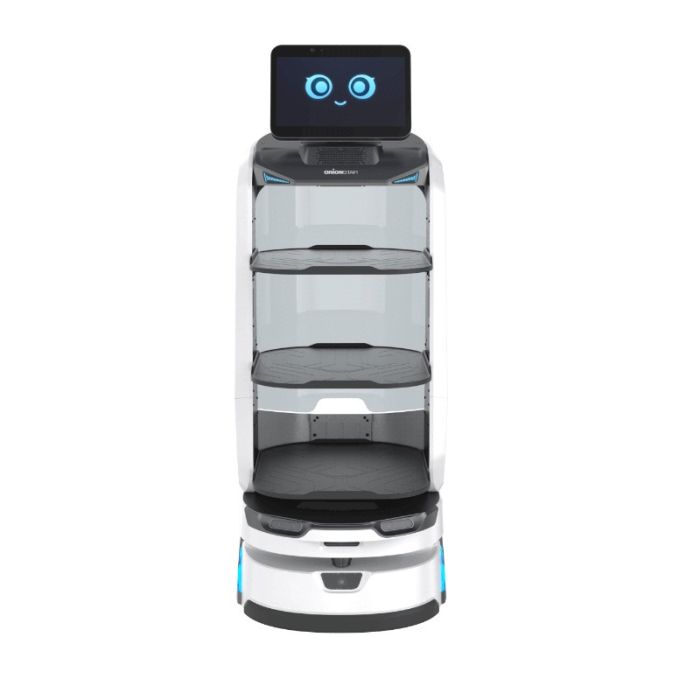
In stock
- BRAND:
- ORIONSTAR
- AVAILABILITY:
- SUBJECT TO AVAILABILITY
- SKU:
- OrionStar-LuckiBot-Pro
OrionStar LuckiBot Pro
A busy dining room asks a lot of a robot: narrow gaps between chairs, guests who step back without looking, and trays that must arrive upright. The OrionStar LuckiBot Pro is built for exactly that kind of floor, pairing visual SLAM navigation and smart dish detection with a screen that talks to guests while it works.
The product is available through this page, by quotation.
Background
The company behind the robot
The LuckiBot Pro is made by Beijing OrionStar technology co., Ltd., a company that describes its mission as building truly useful robots. That phrase explains the design of this machine. It is not a showpiece for a lobby; it is a working delivery robot meant to carry food and drinks, return dishes and keep going through a long service day.
The LuckiBot Pro belongs to a small family. The sources name three versions: the LuckiBot, the LuckiBot Pro and the LuckiBot Pro Autodoor. This page covers the LuckiBot Pro only, and every figure below belongs to that version. You can browse the wider range in the OrionStar category.
Visual SLAM and an open software platform
Navigation on the LuckiBot Pro is powered by visual SLAM. The robot integrates one LiDAR sensor, three RGBD depth vision sensors, a fisheye camera and an infrared camera. On top of that, it offers 240-degree 3D all-around recognition of obstacles with a depth camera, along with ground perception positioning, which lets it adapt to more scenarios.
The software side is just as deliberate. The OrionStar RobotOS platform comes with an SDK containing hundreds of API interfaces, and the hardware follows a modular design with universal data and power interfaces. For an integrator or a developer, that means the robot can be customized rather than used only as it ships.
Technical Specifications
| Specification | LuckiBot Pro |
|---|---|
| Overall size | 558 mm × 525 mm × 1375 mm |
| Color | Pearl white + Elegant black |
| Screen | 14-inch; 1080 FHD |
| Loading space | 3 trays / 4 trays; tray dimension 500 mm x 420 mm |
| Single tray load | Max 15 Kg |
| Total load | Max 60 Kg |
| Cruising speed | 0.5 ~ 1.2 m/s (adjustable) |
| Cruising time | 12 H (typical cruising scene) |
| Charging time | 4.5 H (charge when turned off) |
| Charging mode | Two modes: Automatic Charging Dock + Cable |
| Obstacle recognition | 240-Degree 3D all-around recognition of obstacles & Depth Camera |
| Sensors | One LiDAR sensor, three RGBD depth vision sensors, a fisheye camera, an infrared camera |
| Chassis and suspension | Quasi-circular chassis; Torsion Bar Suspension |
| Connectivity | 4G (TDD-LTE, FDD-LTE); dual-band Wi-Fi (2.4 GHz / 5 GHz) |
| Software platform | OrionStar RobotOS with an SDK of hundreds of API interfaces |
Specifications as published by the manufacturer; confirmed against the datasheet at quotation.
The manufacturer has not published the IP rating, the battery capacity, the noise level, the operating temperature, the maximum climbable slope or the package contents; they are confirmed at quotation.
How does the LuckiBot Pro find its way around a crowded room?
Most delivery robots depend on one main sensor. The LuckiBot Pro combines several: a LiDAR sensor, three RGBD depth vision sensors, a fisheye camera and an infrared camera, all feeding its visual SLAM. The 240-degree 3D all-around recognition of obstacles and the depth camera give it a wide view of what is ahead and to the sides, which matters when a child runs across its path or a chair is pulled out.
The body helps as well. The quasi-circular chassis design gives the robot high passability, so it can turn and slip through tight spots more easily than a boxy frame would. A torsion bar suspension is listed for the chassis. Cruising speed is adjustable from 0.5 to 1.2 m/s, so an operator can set a gentle pace for a crowded dining room and a faster one for a quiet corridor.
What can the LuckiBot Pro carry, and how long does it work?
The loading space is arranged in trays measuring 500 mm x 420 mm each. The layer set is adjustable and supports up to 4 layers, so you can match the layout to plates, bowls, drinks or packaged items. A single tray takes a maximum of 15 Kg, and the total load is a maximum of 60 Kg.
Endurance is stated as 12 hours in a typical cruising scene, and charging takes 4.5 hours when the robot is turned off. Two charging modes are supported: an automatic charging dock and a cable. The dock suits a fixed station in a restaurant, while the cable is a simple fallback.
Connectivity covers 4G (TDD-LTE, FDD-LTE) and dual-band Wi-Fi at 2.4 GHz and 5 GHz. According to the manufacturer, this suite enables cloud-based operational data reports, fleet monitoring and over-the-air (OTA) updates, which is useful for anyone running more than one unit.
Who is the OrionStar LuckiBot Pro for?
Restaurant operators are the obvious buyers. A robot that can carry several trays and return used dishes frees servers to talk with guests instead of walking back and forth. The smart dish detection and the large tray area suit venues with steady, repeated runs between kitchen and tables.
Hotels and resorts can use it for food and beverage service in dining areas. Operators who want a robot that also promotes their offers will like the 14-inch display, which broadcasts ads, videos and pictures to catch guests' attention.
Developers and system integrators form a third group. With RobotOS, an SDK of hundreds of API interfaces and universal data and power interfaces, the LuckiBot Pro is a platform for custom applications. If you are still comparing models, the OrionStar category lists the other robots in the range, and the sources also name the LuckiBot and the LuckiBot Pro Autodoor as versions of this line.
What is the OrionStar LuckiBot Pro used for?
- Food delivery to tables. Carries dishes from the kitchen to the guest on adjustable trays.
- Dish return. Smart dish detection supports collecting used dishes and bringing them back.
- Guest promotion. The 14-inch screen shows ads, videos and pictures while the robot moves through the venue.
- Interactive guest contact. The display gives guests something to engage with, adding to the marketing potential of each trip.
- Fleet-managed service. 4G and Wi-Fi support operational data reports, fleet monitoring and OTA updates.
- Custom development. The RobotOS SDK and modular interfaces let developers build their own applications.
Pricing and Availability
We do not publish prices for the LuckiBot Pro. Quotation is the next step: tell us your venue, the number of units and your intended use, and we will prepare an offer. Delivery, customs and support are arranged with the quotation. The OrionStar LuckiBot Pro is available on this page.
Frequently Asked Questions
How much can the LuckiBot Pro carry?
A single tray takes a maximum of 15 Kg, and the total load is a maximum of 60 Kg.
How long does it run on a charge?
The cruising time is 12 hours in a typical cruising scene. Charging takes 4.5 hours when the robot is turned off.
How does it charge?
It supports two modes: an automatic charging dock and a cable.
What sensors does it use to avoid obstacles?
It integrates one LiDAR sensor, three RGBD depth vision sensors, a fisheye camera and an infrared camera, with 240-degree 3D all-around recognition of obstacles.
Can it be customized?
Yes. The OrionStar RobotOS platform includes an SDK with hundreds of API interfaces, and the modular design supports universal data and power interfaces.
Which accessories are listed for it?
The listed accessories are the Lucki-Button, cup holders, a Sealed Food Protector and a Cute Head Cover.
Where can I buy the OrionStar LuckiBot Pro and what does it cost?
You can request it through this page. The cost is given in a quotation prepared for your project, and we do not list prices here.
Summary
The LuckiBot Pro answers the crowded-floor problem with a sensor set built for it: LiDAR, three depth sensors, fisheye and infrared cameras, a rounded chassis and adjustable speed. It carries up to 60 Kg across adjustable trays, runs for 12 hours in a typical cruising scene, and its 14-inch screen speaks to guests along the way. For a quotation on the OrionStar LuckiBot Pro, this page is the starting point.


