
OrionStar CarryBot
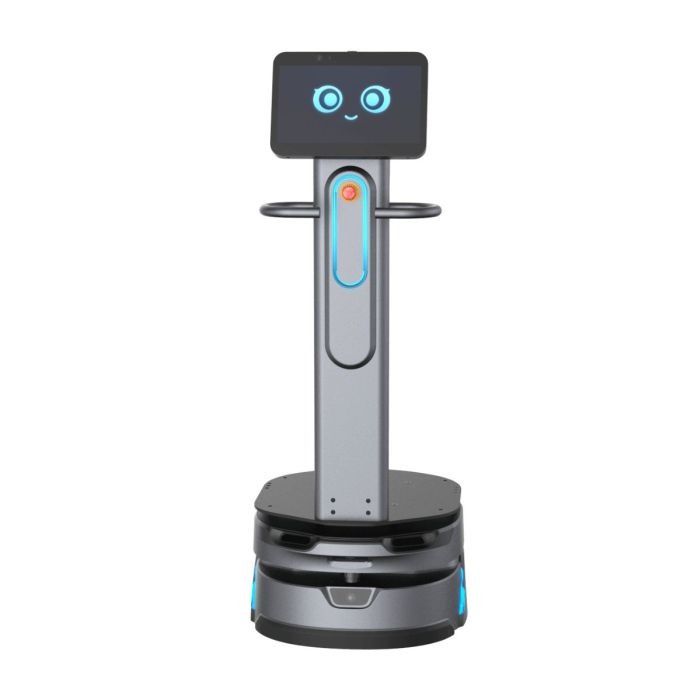
In stock
- BRAND:
- ORIONSTAR
- MODEL:
- CARRYBOT
- ORIGIN:
- Canada
- AVAILABILITY:
- SUBJECT TO AVAILABILITY
- SKU:
- OrionStar-CarryBot
OrionStar CarryBot
Most factory floors were never drawn with robots in mind, and the aisles show it: narrow passages, door thresholds, floor grooves, people crossing at every corner. The OrionStar CarryBot is an Autonomous Mobile Robot (AMR) built for exactly that kind of crowded, imperfect space, where a large machine on fixed tracks would simply not fit.
The product is available through this page, by quotation.
Background
The company behind the robot
The CarryBot is made by Beijing OrionStar technology co., Ltd. The manufacturer designed this AMR for discrete manufacturing enterprises, with consumer electronics, warehousing and logistics named as typical domains, and the range is not limited to those. Discrete manufacturing means products assembled from distinct parts in batches or single units, so material moves between many small stations rather than along one continuous line. Carrying parts, totes and shelves between those stations is the daily work this robot is meant to take over.
The sources name several versions: CarryBot D150, CarryBot D100, and the labels CarryBot 1, CarryBot 2 and CarryBot 3. In this article every figure stays with the version the source gives it to. You can find related robots from the same maker in the OrionStar category.
How it finds its way
The CarryBot integrates LiDAR, three depth cameras and V-SLAM 2.0 technology. LiDAR measures the surroundings with laser light, the depth cameras add a view of obstacles at different heights, and V-SLAM is the method by which a robot builds a map and locates itself on it using vision. Together they let the robot move around without being tied to a guide line on the floor.
The robot achieves a positioning accuracy of up to 1 cm under optimal conditions. It can operate in constrained passages with a minimum physical clearance of 65 cm, depending on dynamic traffic. That clearance is why it is described as an ideal solution for the tight spaces often found in micro-fulfillment centers.
It also deals with the floor itself. The CarryBot overcomes 10 mm thresholds and 30 mm grooves, the small steps and gaps that stop many wheeled carriers at doorways and between floor sections.
Technical Specifications
| Specification | Value | Applies to |
|---|---|---|
| Product type | Autonomous Mobile Robot (AMR) | CarryBot |
| Navigation sensors | LiDAR, three depth cameras, V-SLAM 2.0 | CarryBot |
| Minimum clearance | 65 cm | CarryBot |
| Obstacle crossing | 10 mm thresholds, 30 mm grooves | CarryBot |
| Positioning accuracy | Up to 1 cm under optimal conditions | D150 |
| Overall size | 600 mm x 525 mm x 1377 mm | CarryBot 1 (D150) |
| Net weight | 60 kg (robot 48 kg + shelf 12 kg) | CarryBot 3 (D150) |
| Load capacity | Max load: 150 kg (including shelf) | CarryBot 3 (D150) |
| Payload | 100 kg | D100 |
| Runtime | 9 hours | D100 |
| Moving speed | 0.5 to 1.0 m/s | D150 |
| Screen | 14-inch, 1080 FHD | D150 |
| Working time | Up to 12 hours on a single charge (100 kg loads) | D150 |
| Charging time | Full charge within 4.5 hours | D150 |
| Charging mode | Automatic charging dock, cable | D150 |
| Battery | 34Ah, 25.2V | D150 |
| Operating system | Customized RobotOS based on Android 9.0 | D100 and D150 |
| Connectivity | 4G and dual-band Wi-Fi | D100 and D150 |
| Open APIs | 500+ free APIs | CarryBot |
Specifications as published by the manufacturer; confirmed against the datasheet at quotation.
The manufacturer has not published the IP rating, the certifications, the operating temperature range, the noise level, the maximum slope, the lithium battery chemistry or the package contents; they are confirmed at quotation.
What makes the CarryBot different from a traditional AGV?
A traditional automated guided vehicle follows a fixed route, and installing that route takes time. Deployment time is reduced from several weeks with traditional AGVs to less than one day. For a plant that reorganizes its lines often, that gap decides whether automation is practical at all.
The second difference is how the robots share space. When several CarryBots work in the same scenario and meet at a fork in the road, they avoid each other autonomously, without human intervention, by following the priority of the robot number. A supervisor does not need to untangle a standoff in a narrow aisle, and a fleet can grow one unit at a time.
The third is the software. The robots run a deeply customized RobotOS based on Android 9.0, with 4G and dual-band Wi-Fi connectivity, and 500+ free APIs are available. Your integrators therefore get an open interface to work with rather than a closed box.
How do the D100 and D150 differ?
The CarryBot D100 is the classic model for standard delivery needs, with a 100kg payload and a 9-hour runtime. The D150 is the version for which the sources give the heavier figures: a maximum load of 150 kg including the shelf, a working time of up to 12 hours on a single charge with 100 kg loads, a 14-inch 1080 FHD screen and a moving speed of 0.5 to 1.0 m/s.
Treat the two runtime figures with care: the D100 number is its runtime, while the D150 number is given for a 100 kg load. Your quotation request should state the load you carry every day so we can recommend the right version.
Who is the OrionStar CarryBot for?
Electronics and other discrete manufacturers are the first group. They move parts and finished goods over short distances between stations, often through aisles that were never widened for machines. The 65 cm minimum clearance and the ability to cross thresholds and grooves suit those floors.
Warehouse and logistics operators are the second. Micro-fulfillment centers in particular are compact, and a robot that works in tight passages lets you use space that a larger carrier would waste.
Integrators and system builders are the third. The 500+ free APIs and the Android-based RobotOS give them a platform to connect the robot to their own workflows.
If your loads are standard and moderate, the D100 is the version to consider. If you carry heavier shelves or run long shifts, the D150 figures are the ones to discuss. Browse the wider OrionStar range if you are comparing robot types.
What is the OrionStar CarryBot used for?
- Shelf transport. The robot carries a shelf, which is counted within the 150 kg maximum load for the D150.
- Line-side material supply. Parts move from storage to assembly stations without a person pushing a cart.
- Micro-fulfillment handling. The small footprint and 65 cm minimum clearance fit compact fulfillment layouts.
- Intralogistics between zones. The robot crosses 10 mm thresholds and 30 mm grooves between areas of a building.
- Multi-robot fleets. Several units share the same scenario and yield to each other by robot-number priority.
- Custom workflows. With 500+ free APIs, developers can tie the robot to their own software; attachments are sold separately.
Pricing and Availability
We do not print prices on this page. Quotation is the way to buy: tell us the version, the load and the site, and we respond with a proposal. Delivery, customs and support are arranged together with the quotation. Attachments are sold separately, so please mention them when you ask. The OrionStar CarryBot is available on this page.
Frequently Asked Questions
What kind of robot is the OrionStar CarryBot?
It is an Autonomous Mobile Robot (AMR) designed for discrete manufacturing enterprises, including consumer electronics, warehousing and logistics.
How does it navigate?
It integrates LiDAR, three depth cameras and V-SLAM 2.0 technology. Its positioning accuracy is up to 1 cm under optimal conditions.
Can it work in narrow spaces?
Yes. It navigates through a minimum clearance of 65 cm, depending on dynamic traffic, and overcomes 10 mm thresholds and 30 mm grooves.
How long does it run and how fast does it charge?
The D150 works up to 12 hours on a single charge with 100 kg loads and reaches a full charge within 4.5 hours. The D100 has a 9-hour runtime.
What payload can it carry?
The D150 has a maximum load of 150 kg including the shelf, and the D100 a 100kg payload.
Is an IP rating or certification published?
No. The manufacturer has not published the IP rating or the certifications.
Where can I buy the OrionStar CarryBot and what does it cost?
You can buy it through this page by requesting a quotation. The cost depends on the version, the attachments and the delivery, and it is given in the quotation itself.
Summary
The CarryBot answers a plain problem: factory and warehouse floors are tight, uneven and busy, and most carriers were designed for neither. With LiDAR, three depth cameras and V-SLAM 2.0, a 65 cm minimum clearance, a deployment time of under one day, and fleets that sort out their own right of way, it is built for the floor as it really is. If you are ready to size the right version for your site, this page is the starting point.


