
Geek+ M200C Intralogistics AMR
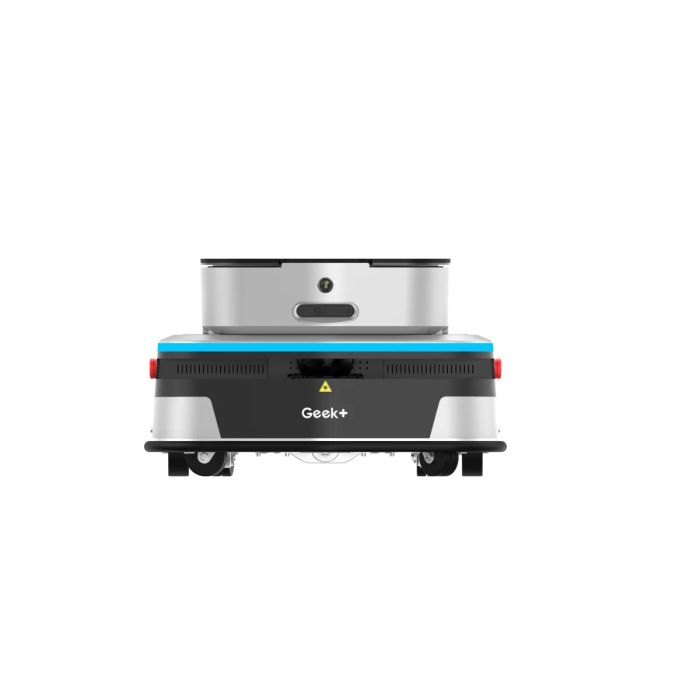
In stock
- BRAND:
- GEEK+
- MODEL:
- M200C
- PART #:
- M200C
- ORIGIN:
- China
- Warranty:
- 12 MONTHS
- AVAILABILITY:
- SUBJECT TO AVAILABILITY
- SKU:
- GeekPlus-M200C
Geek+ M200C Intralogistics AMR
Most warehouse robots are judged by what they can lift. The Geek+ M200C Intralogistics AMR is better judged by what it can slip under, line up with and hand over. It stands 319mm high, glides at up to 1.5m/s and is built around the point where a tote or pallet meets a shelf.
The product is available through this page, by quotation.
Background
Geek+ and its lineage
Geek+ is a Beijing-based technology company, established in 2015, and it has gained global recognition in warehouse robotics since then. Its work centers on autonomous mobile robots that move goods inside warehouses and logistics centers, so that people spend less time walking and carrying and more time on tasks that need judgment.
The M200C belongs to the family of intralogistics AMRs that Geek+ offers for material handling and transportation. Other models in the range are sized for different loads and layouts, and you can compare them on their own pages, such as the Geek+ M2000C Intralogistics AMR and the Geek+ M3000C Intralogistics AMR.
Positioning and key technology
The M200C is an autonomous mobile robot designed for material handling and transportation tasks in warehouses and logistics centers. It uses a combination of sensors, cameras and navigation algorithms to move around the facility and locate the items it is sent to carry.
For localization, the M200C maintains accurate position using 3D SLAM, inertial localization, markers and reflectors, and QR codes on the floor. It can also pivot in place, which matters in narrow aisles and crowded handover areas where there is no room for a wide turning circle.
For safety, the M200C has 2D obstacle detection, 3D obstacle detection at the front, and autonomous obstacle avoidance. In a site where people, carts and robots share the same floor, these layers of sensing are what let the robot keep moving without constant supervision.
On the software side, the M200C offers ERP, WMS and MES integration, open APIs and multi-language support. A robot that cannot take its orders from your existing systems becomes an island, and this integration is what lets it work as part of the wider operation.
Technical Specifications
This page covers two versions, the M200C and the M200C with lift. Their figures are set side by side below, and each figure belongs to its own version.
| Specification | M200C | M200C with lift |
|---|---|---|
| Payload | 200kg | 200kg |
| Top speed | 1.5m/s | 1.5m/s |
| Dimensions (LxWxH) | 760x520x319mm | 760x520x313mm |
| Weight | 90kg | 106kg |
Specifications as published by the manufacturer; confirmed against the datasheet at quotation.
The manufacturer has not published the battery capacity, the battery life, the charging time, the IP rating, the operating temperature, the stopping accuracy, the lift height, the certifications or the contents of the box; they are confirmed at quotation.
What makes the M200C different from a fixed conveyor?
A conveyor is fixed in place. Once it is built, the route is the route, and changing it means engineering work. An AMR such as the M200C finds its way with sensors, cameras and navigation algorithms, so the route is a matter of software and floor markings rather than steel.
That is the practical difference for a site that expects its layout to change. When a picking zone moves or a new packing station opens, the robot can be directed to the new points without rebuilding anything. With 3D SLAM, inertial localization, reflectors and floor QR codes available as localization methods, a planner can choose the approach that suits the building.
The load handling design also deserves attention. The M200C uses a pallet design to handle totes from ground support, and a pins design to match the shelf better and to lift. In plain terms, the robot is shaped for the way totes and shelves are actually presented, rather than expecting the site to adapt to a generic carrier.
What does the lift version add?
The M200C with lift carries the same 200kg payload and the same 1.5m/s top speed as the standard M200C. The differences are in the body: it measures 760x520x313mm and weighs 106kg, against 760x520x319mm and 90kg for the M200C.
The extra 16kg is the visible cost of the lifting capability, and the buyer should weigh it against how often loads must be raised to or lowered from a shelf. If your plan depends on reaching a particular shelf level, mention it when you request your quotation.
Who is the Geek+ M200C Intralogistics AMR for?
The M200C suits operators who want to automate the movement of totes and similar loads without rebuilding the building. Typical buyers fall into a few groups.
Distribution and fulfillment managers with long walking routes between storage and packing will see the most direct benefit, because transport is the part of the job the robot can take over. Manufacturers who feed lines from a stock area have a similar need, moving parts and containers on a steady cycle.
Systems integrators building automation projects can use the open APIs and the ERP, WMS and MES integration to connect the robot to a customer's existing software. Teams that expect to grow in steps will value a robot that is added to a fleet rather than built into the structure.
If your loads or your layout call for something different, look at the wider range under AMRs or the Warehouse Robots category. Choose the M200C with lift where shelf handling and lifting are part of the job, and the standard M200C where ground-level tote transport is enough.
What is the Geek+ M200C Intralogistics AMR used for?
- Tote transport from ground support: the pallet design handles totes picked up from the floor and carries them to their destination.
- Shelf-matched handling: the pins design is made to match the shelf better and to lift, which suits shelf-to-station transfers.
- Warehouse material transfer: it moves goods between storage, packing and dispatch areas without a driver.
- Production feeding: it carries parts and containers to work areas in a logistics or manufacturing site.
- Mixed-traffic aisles: 2D and 3D obstacle detection and autonomous avoidance let it work where people also move.
- System-driven tasking: ERP, WMS and MES integration with open APIs lets existing software assign the transport jobs.
Pricing and Availability
This product is sold by quotation, and no price is shown on the page. Tell us your site, the loads you move and the number of robots you expect to need, and we will prepare a quotation around them. Delivery, customs and support are arranged with the quotation. The Geek+ M200C Intralogistics AMR is available on this page.
Frequently Asked Questions
What payload does the M200C carry?
Both the M200C and the M200C with lift carry 200kg.
How fast does the M200C travel?
The top speed is 1.5m/s for both versions.
What are the dimensions and weight?
The M200C measures 760x520x319mm and weighs 90kg. The M200C with lift measures 760x520x313mm and weighs 106kg.
How does the robot find its way?
It combines sensors, cameras and navigation algorithms. Localization uses 3D SLAM, inertial localization, markers and reflectors, and QR codes on the floor, and the robot can pivot in place.
Does it connect to our warehouse software?
Yes. The M200C offers ERP, WMS and MES integration, open APIs and multi-language support.
Where do I find the battery, IP rating and lift height?
Those items are listed with the open points under the specification table. Ask for them when you request your quotation.
Where can I buy the Geek+ M200C Intralogistics AMR and what does it cost?
You can request it through this page. The cost is given in a quotation prepared for your project, as no price is listed here.
Summary
The M200C earns its place not by size but by fit: a low body, a design made for totes and shelves, several ways of knowing where it is, and software links that let it take instructions from the systems you already run. The lift version adds shelf handling at the cost of extra weight. If that sounds like the transport partner your floor needs, this page is the starting point.


