
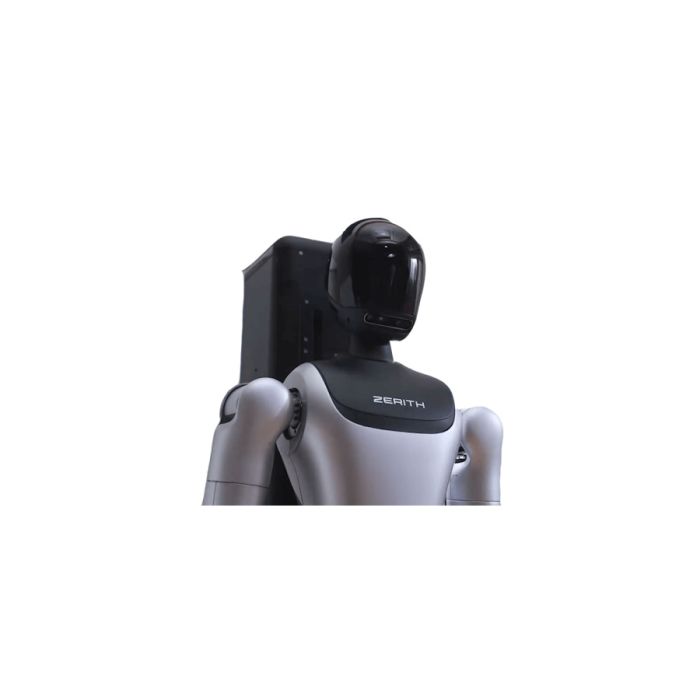
Zerith Z1 Humanoid Robot (Z1)
In stock
- BRAND:
- ZERITH
- PART #:
- Z1
- ORIGIN:
- China
- AVAILABILITY:
- SUBJECT TO AVAILABILITY
- SKU:
- Zerith-Z1
Zerith Z1 Humanoid Robot (Z1)
Why build a robot on two legs when wheels are simpler to keep upright? Because stairs, thresholds, slopes and cluttered floors were all designed around human feet. The Zerith Z1 Humanoid Robot (Z1) is Zerith Technology's answer to that problem: a bipedal machine that stands upright, holds its balance on uneven surfaces and is meant to walk and interact in spaces that people built for themselves.
The product is available through this page, by quotation.
Background
Zerith Technology and its humanoid lineage
Zerith Technology mainly provides humanoid robots. On October 24, 2024, the company launched its first bipedal humanoid robot, the Z1. Its range today includes two products: the humanoid robot ZERITH Z1 and the dual-arm robot F1. The first walks on two legs; the second concentrates on manipulation with two arms.
That focus tells you something about the company's direction. Rather than spreading across many robot types, Zerith has put its effort into machines that resemble the human body in form and in the way they move. The Z1 is the walking, balancing member of that family, and it is the product on which the company's engineering choices are easiest to see.
Positioning and key technology
The Z1 is built to walk and interact in human-designed spaces, and it maintains balance even on uneven surfaces. Three technical choices support that purpose. The first is a set of joint motors that reach a peak torque of 150Nm. The second is an EtherCAT communication module developed in-house by Zerith Technology, which offers low-latency, high-bandwidth communication. The third is an AI-driven design optimization of the structural parameters, which reduces the robot's energy consumption (COT) and enhances its dynamic motion performance.
Zerith presents this last point as unique among its peers. For a buyer, the practical meaning is that the frame itself was tuned by computation for motion and efficiency, not simply assembled from standard parts.
The Z1 sits in the store's Bipedal Humanoids category, and more broadly among Humanoids.
Technical Specifications
| Specification | Value |
|---|---|
| Product | Zerith Z1 Humanoid Robot (Z1) |
| Manufacturer | Zerith Technology |
| Launch date | October 24, 2024 |
| Form | Bipedal humanoid, stands upright on two legs |
| Peak joint torque | 150Nm |
| Degrees of freedom | 27 |
| Load-bearing limit | Up to 20 kg |
| Load-to-weight ratio | Exceeding 70% |
| Communication | In-house EtherCAT module, low latency, high bandwidth |
| Structural design | AI-driven design optimization of structural parameters |
| Terrain capability | Stable navigation of irregular surfaces and complex terrain for extended periods |
Specifications as published by the manufacturer; confirmed against the datasheet at quotation.
The manufacturer has not published the official weight, the official height, the maximum walking speed, the charging time, the battery capacity, the IP rating, the onboard compute, the contents of the box, the operating system or the hand and finger configuration; they are confirmed at quotation.
What makes the Z1 different from a wheeled humanoid?
A wheeled platform is at its best on a smooth, prepared floor. The Z1 is designed for the opposite situation. It stands on two legs, keeps its balance on uneven surfaces, and has anti-interference capabilities that let it navigate irregular surfaces and complex terrain stably for extended periods. If your site has ground that changes underfoot, that difference is the reason to look at a bipedal machine.
The store also lists the Zerith H1 Wheeled Humanoid Robot, which is the natural comparison for a buyer whose floors are flat and whose priority is not walking. The Z1 is the choice when walking itself is part of the requirement or part of the research.
Why do the joint figures matter?
Three figures describe what the Z1 can do physically: a peak joint torque of 150Nm, 27 degrees of freedom, and a load-bearing limit of up to 20 kg. Torque determines how forcefully the joints can act. Degrees of freedom describe how many independent ways the body can move, which matters for whole-body coordination and for the range of motions a developer can teach it. The load limit tells you what the robot can carry.
Together they produce a load-to-weight ratio exceeding 70%. A high ratio means the robot can carry a large load relative to its own mass, which is a sign of an efficient structure. This is consistent with the AI-driven structural optimization and its stated goal of lowering energy consumption (COT).
The EtherCAT communication module completes the picture. Humanoid control depends on many joints exchanging data quickly and on time, so low latency and high bandwidth are not decorative features. Because Zerith developed the module in-house, the communication layer was made together with the rest of the robot.
Who is the Z1 for?
The Z1 suits university laboratories and research institutes that study humanoid balance, imitation learning and embodied AI. Developers use it to study these subjects within real-world settings, which is difficult to do with a machine that cannot stand and walk on its own.
It also suits companies building an in-house robotics capability, system integrators evaluating legged platforms for human-designed spaces, and technical training centers that want students to work with a real bipedal machine. Organizations with flat floors and no need for walking may prefer the Zerith H1 Wheeled Humanoid Robot. Those whose main task is manipulation with two arms may want to ask us about Zerith's dual-arm robot F1, which belongs to the same company range.
What is the Z1 used for?
- Humanoid balance research: studying how a two-legged machine stays upright, including on uneven surfaces.
- Imitation learning: teaching the robot behaviors through demonstration and studying the results.
- Embodied AI development: testing AI software on a physical body in real-world settings.
- Terrain trials: evaluating stable movement across irregular surfaces and complex terrain for extended periods.
- Load-carrying tests: exploring what a humanoid can handle within a load-bearing limit of up to 20 kg.
- Teaching and demonstration: showing students and visitors what a bipedal humanoid does in spaces made for people.
Pricing and Availability
We do not print prices on this page. Every Zerith Z1 Humanoid Robot (Z1) is supplied by quotation, so that the configuration and your requirements can be matched. Send us your project details and we will respond with a quotation. Delivery, customs and support are arranged together with the quotation, so you know the full picture before you commit. The Zerith Z1 Humanoid Robot (Z1) is available on this page.
Frequently Asked Questions
When was the Z1 launched?
Zerith Technology launched the Z1, its first bipedal humanoid robot, on October 24, 2024.
How many degrees of freedom does the Z1 have?
The Z1 has 27 degrees of freedom. Its joint motors reach a peak torque of 150Nm.
How much can the Z1 carry?
The load-bearing limit is up to 20 kg, which gives a load-to-weight ratio exceeding 70%.
What communication system does the Z1 use?
It uses an EtherCAT communication module developed in-house by Zerith Technology. The module offers low-latency, high-bandwidth communication.
Can the Z1 walk on uneven ground?
Yes. The Z1 maintains balance on uneven surfaces and can stably navigate irregular surfaces and complex terrain for extended periods.
Are the battery life, weight and height available?
Those details, along with the walking speed, the charging time and the IP rating, are given to you together with your quotation.
Where can I buy the Z1 and what does it cost?
You can buy it through this page by requesting a quotation. The cost is given in the quotation after we confirm your requirements, and no price is printed here.
Summary
The question at the start was why a robot should stand on two legs. For the Zerith Z1 the answer is the environment: human spaces are uneven, stepped and unpredictable, and a machine that balances on two legs can meet them on their own terms. With a peak joint torque of 150Nm, 27 degrees of freedom, a load-bearing limit of up to 20 kg, an in-house EtherCAT module and an AI-optimized structure, it gives developers and researchers a physical platform for balance, imitation learning and embodied AI. If you want to evaluate it for your laboratory or project, this page is the starting point.


