
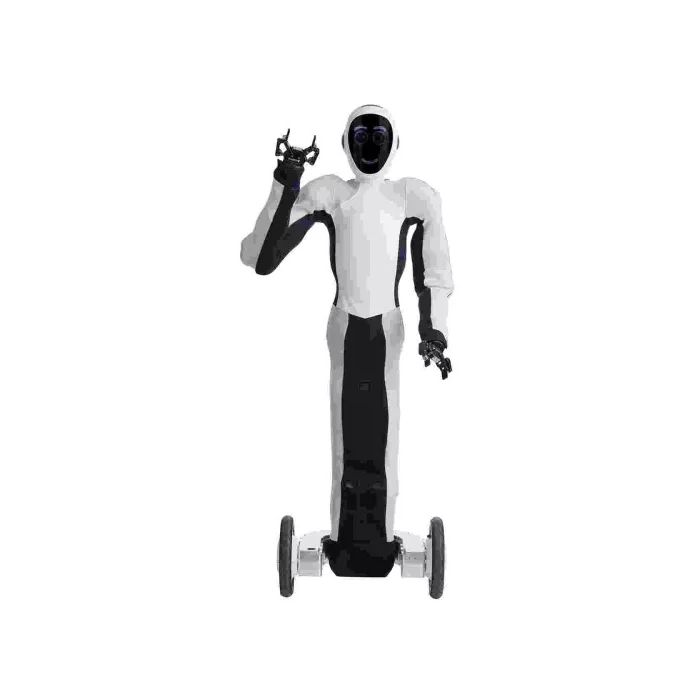
X1 Eve Wheeled Humanoid Robot
In stock
- BRAND:
- X1
- MODEL:
- EVE
- AVAILABILITY:
- SUBJECT TO AVAILABILITY
- SKU:
- X1-Eve
X1 Eve Wheeled Humanoid Robot
A robot that finishes its shift knowing more than when it started is a different kind of purchase from a machine that simply repeats a program. The X1 Eve Wheeled Humanoid Robot is built around that idea: it works among people, watches through its cameras, and gets better at ordinary tasks with every corridor and every lift ride.
The product is available through this page, by quotation.
Background
The company behind EVE
EVE comes from 1X, a company formerly known as Halodi Robotics. It was founded in 2014 by Bernt Øivind Børnich. The change of name marks a shift from a research-minded start-up to a maker of working humanoids, and EVE is the machine that carries that shift into everyday workplaces.
The company's approach is easy to read from the robot itself. EVE uses soft, organically inspired mechanics and a human-inspired musculature, which makes it durable enough for work yet safe enough to operate with trained teams. Each unit is tested by 1X in real-world scenarios before it is deployed, so a buyer receives a machine that has already met the kinds of situations it will face.
Positioning and key technology
EVE is described by its maker as the smarter working humanoid collecting data from the real world. That phrase explains the positioning. The robot is not sold only as a pair of arms on a base; it is sold as a worker that learns. Advanced embodied learning models let its multi-terrain wheels navigate around corners and take elevators, and the robot becomes more efficient at everyday tasks over time.
The hardware supports that goal. The joints use 1X Technologies Revo1 quasi direct-drive technology. Compute is split between an Intel i7 for real-time control and an Nvidia Xavier for AI inference. Two front cameras and one rear camera, together with further sensors, let the robot perceive and interact with its surroundings. If you are comparing platforms in this class, you can browse the Wheeled Humanoids category or the wider Humanoids category.
Technical Specifications
| Specification | Value |
|---|---|
| Height | 6 foot 2 inches |
| Weight | 192 pounds |
| Top speed | 9 miles/hour |
| Carry capacity | 33 pound |
| Run time | 6-hour run time, up to 6 hours on a 1-hour charge |
| Battery | 1.05-kWh lithium-ion battery pack |
| Degrees of freedom | 25 (Neck: 1 DoF; Arm: 7 DoF x 2; Leg: 6 DoF x 1; Hand: 1 DoF x 2; Wheels 1 DoF x 2) |
| Actuators | 1X Technologies Revo1 quasi direct-drive technology |
| Compute | Intel i7 for real-time control; Nvidia Xavier for AI inference |
| Cameras | Two front cameras and one rear camera |
| Mobility | Multi-terrain wheels; navigates around corners and takes elevators |
| Materials | Plastic, aluminum, fabric |
Specifications as published by the manufacturer; confirmed against the datasheet at quotation.
The manufacturer has not published the dimensions, the IP rating, the connectivity, the operating temperature, the hand and gripper type, the package contents or the power consumption; they are confirmed at quotation.
What makes EVE different from a robot that walks?
The first difference is how EVE gets around. Its multi-terrain wheels carry it around corners and into elevators, which is what a building with several floors and narrow passages demands. The fact sheet lists the wheels as two degrees of freedom, and the single leg structure as six, so the machine pairs a stable rolling base with a humanoid upper body.
The upper body is where the work is done. Each arm has seven degrees of freedom, the neck has one, and each hand has one, for 25 degrees of freedom in total. Seven degrees of freedom per arm is a familiar figure in manipulation, because it gives the arm room to reach around obstacles rather than only straight ahead. Revo1 quasi direct-drive actuation underlies that motion and fits the maker's emphasis on safety near people.
The second difference is that EVE learns. The maker describes embodied learning models that make the robot more efficient at everyday tasks over time, and it presents EVE as collecting data from the real world. For a buyer, that means the value of the robot is not frozen on the day of delivery.
How does EVE operate day to day?
EVE operates autonomously by default, using artificial intelligence to navigate your workspace. A person does not need to steer it from moment to moment. When a human is wanted, though, the option exists: a single operator can control a fleet of EVEs, tap into their cameras and control their movement to take action from a distance. That gives a site a sensible split between routine autonomy and remote judgment.
On the energy side, the manufacturer states a 6-hour run time and up to 6 hours on a 1-hour charge. The battery pack is a 1.05-kWh lithium-ion unit. A short charge and a long working period suit a schedule built around shifts, where a robot can recharge during a break and return to work.
The speed and the load are stated plainly: a top speed of 9 miles/hour and a carry capacity of 33 pound. Those figures place EVE among the machines meant for moving light items and covering ground within a building, not for heavy lifting.
Who is X1 Eve for?
Facilities teams in large indoor sites are the clearest fit: places with long corridors, lifts and shared spaces where people and machines meet. The ability to take elevators and turn corners, plus a design intended to work safely alongside trained teams, speaks directly to those settings.
Operations managers who run several sites will care about fleet control. One operator can reach the cameras of many units and act at a distance, which suits organizations that want a small central team supporting several locations.
Research groups and innovation labs are a third segment. Because EVE is built around embodied learning and collects data from real surroundings, it gives teams a platform for studying how a working humanoid behaves outside the lab. Buyers who still need to compare machine types can start with the Wheeled Humanoids category before asking for a quotation.
What is X1 Eve used for?
- Moving light items: the 33 pound carry capacity suits carrying objects between rooms or floors.
- Navigating multi-floor buildings: the wheels handle corners and the robot can take elevators.
- Working beside trained teams: the soft, organically inspired mechanics are designed for safe shared operation.
- Remote assistance: an operator can look through the cameras and control movement from a distance.
- Fleet supervision: one person can oversee a group of EVEs from a single position.
- Real-world data collection: the robot gathers experience that improves its handling of everyday tasks over time.
Pricing and Availability
We do not print prices on this page. Quotation is the way to proceed: tell us your site, your tasks and the number of units, and we prepare an offer for the X1 Eve Wheeled Humanoid Robot. Delivery, customs and support are arranged together with the quotation, so you see the whole picture in one document. The X1 Eve Wheeled Humanoid Robot is available on this page.
Frequently Asked Questions
How tall and heavy is EVE?
EVE stands 6 foot 2 inches tall and weighs 192 pounds, as the manufacturer states.
How long does EVE run on a charge?
The manufacturer states a 6-hour run time, and up to 6 hours on a 1-hour charge. The battery pack is a 1.05-kWh lithium-ion unit.
Can EVE work without a person controlling it?
Yes. EVE operates autonomously by default, using artificial intelligence to navigate your workspace. A human operator can still take over remotely through its cameras.
What can EVE carry and how fast does it move?
The carry capacity is 33 pound and the top speed is 9 miles/hour.
What sensors and computing does EVE use?
EVE has two front cameras and one rear camera, plus further sensors. An Intel i7 handles real-time control and an Nvidia Xavier handles AI inference.
Is EVE safe to use near people?
It is designed with soft, organically inspired mechanics and a human-inspired musculature, and 1X tests every EVE in real-world scenarios before deployment. It is built to operate with trained teams.
Where can I buy X1 Eve and what does it cost?
You can request a quotation on this page. We do not publish a price; the offer is prepared for your site and quantity, with delivery, customs and support arranged alongside it.
Summary
EVE is a working humanoid that is meant to improve with use. It moves on multi-terrain wheels, rides elevators, perceives its surroundings through cameras and sensors, and runs autonomously unless an operator steps in. Its stated figures are a height of 6 foot 2 inches, a 33 pound carry capacity, a 9 miles/hour top speed and up to 6 hours on a 1-hour charge. For a team that wants a robot that learns on the job, this page is the starting point.


