
Unitree Tendon-Driven Dexterous Hand
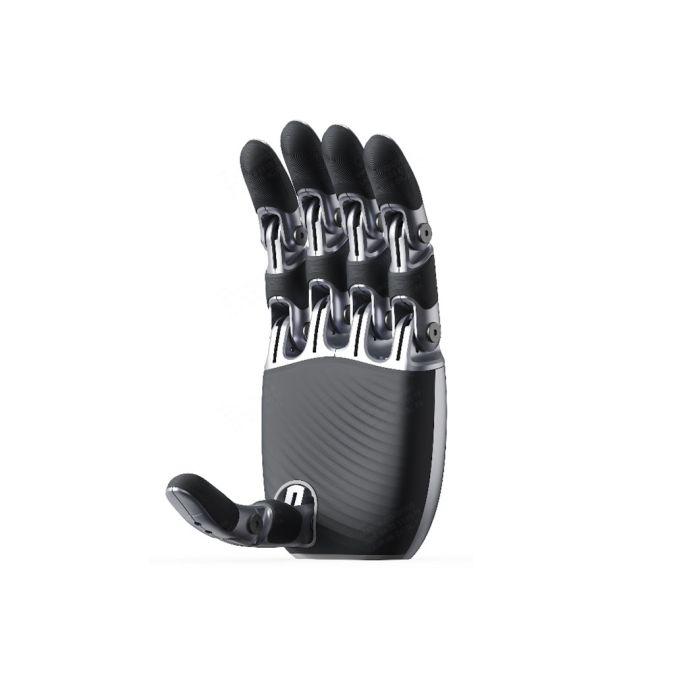
In stock
- BRAND:
- UNITREE ROBOTICS
- MODEL:
- Tendon-driven-dexterous-hand
- PART #:
- Tendon-driven-dexterous-hand
- ORIGIN:
- China
- Warranty:
- 12 MONTHS
- AVAILABILITY:
- SUBJECT TO AVAILABILITY
- SKU:
- Unitree-Tendon-driven-dexterous-hand
Unitree Tendon-Driven Dexterous Hand
Most dexterous hands spend their complexity on the fingers. The Unitree Tendon-Driven Dexterous Hand spends it in the rope. Five fingers, ten degrees of freedom, yet only two of those joints are actuated: the work is carried from the drive to the fingertips by a gear-tendon rope transmission. For a team that wants a humanoid to grasp real objects without carrying the weight and wiring of a motor at every knuckle, that trade is the whole point.
This product is available through this page, by quotation.
Background
Unitree and its hand lineage
Unitree Robotics is known for legged and humanoid robots, and its range has grown to include the parts that let those robots touch the world: arms, grippers and a family of dexterous hands. Each hand in that family takes a different position between simplicity and finger-level control. Some use more actuators and tactile surfaces; others, like this one, keep the mechanism lean. You can compare the whole family on the Unitree Hands page, and the wider range of parts for humanoids sits in Humanoid Accessories.
The version covered here is Dex2/5. It is a five-finger hand described as a 10-DOF (2 actuated) tendon-driven design, and it is compatible with G1/R1 models.
Positioning and key technology
The key technology is the gear-tendon rope drive. Instead of putting a motor in each joint, the hand routes motion through tendons, in the way a human hand moves its fingers from muscles that sit further up the arm. The thumb has one actuated degree of freedom. The index, middle, ring and little fingers share a single degree of freedom, so they close together as one group.
That coupling is a deliberate choice. The hand is not built for playing individual fingers independently; it is built for reliable, repeatable grasping with a small, light mechanism. The hand weighs 365g and measures 151mm x 70mm x 63mm in the flat state, a footprint that suits mounting on a humanoid wrist.
Technical Specifications
| Specification | Value |
|---|---|
| Type | 10-DOF (2 actuated) 5-finger tendon-driven dexterous hand |
| Weight | 365g |
| Size (hand in flat state) | 151mm x 70mm x 63mm |
| Degrees of freedom | Thumb: one DOF; index, middle, ring and little fingers share one DOF |
| Transmission mechanism | Gear-tendon rope drive |
| Thumb Joint 0 | 0~42° |
| Thumb Joint 1 | 0~105° |
| Four-Finger Joint 0 | 0~88° |
| Four-Finger Joint 1 | 0~105° |
| Minimum fist clench time | 0.5 s |
| Minimum grip diameter | 8mm |
| Fingertip strength | Thumb: 15N; index, middle, ring and little fingers: total 15 N |
| Load (palm facing down, room temperature, grasping a 5cm round hard object) | Maximum weight 1.5kg |
| Working voltage | 24V-60V |
| Static current | [email protected] |
| Maximum current | [email protected] |
| Communication interface | RS485 |
| Communication rate | 1000Hz |
| Perceptual feedback | Joint mode, joint position, joint velocity, joint torque, joint temperature, voltage and current |
| Control feedback | Joint mode, joint position, joint velocity, joint torque, joint stiffness coefficient, joint damping coefficient |
| Working temperature range | -20℃ ~ 60℃ |
| Fatigue life | The entire hand has passed over 100000 fatigue cycles |
| Impact resistance | Completed over 100 drop tests |
| Compatible robots | G1/R1 models |
Specifications as published by the manufacturer; confirmed against the datasheet at quotation.
The manufacturer has not published the contents of the box, the tactile sensing, the IP rating, the connector type or the software SDK details; they are confirmed at quotation.
How does a tendon-driven hand differ from one with a motor in every joint?
A hand with an actuator at every joint gives you independent control of each finger, but it pays for that in weight, wiring, heat and cost of maintenance. A tendon-driven hand moves the actuation away from the fingers and carries the force through ropes. The fingers themselves stay light, and the mechanism has fewer parts that can fail at the fingertips.
In this hand the result is two actuated degrees of freedom driving ten joints. The thumb moves on its own, and the four long fingers move as one group. You give up the ability to point with the index finger while the others curl. In return you get a hand that closes into a fist in a minimum of 0.5 s, grips objects as small as 8mm in diameter, and holds up to 1.5kg when grasping a 5cm round hard object with the palm facing down at room temperature.
The durability figures point the same way. The entire hand has passed over 100000 fatigue cycles and has completed over 100 drop tests, which matters when a hand is mounted on a robot that will be handled, moved and occasionally knocked.
What control and feedback does the hand offer?
Fewer actuators do not mean less data. The hand communicates over RS485 at 1000Hz. It reports joint mode, position, velocity, torque, temperature, voltage and current, and it accepts control of joint mode, position, velocity, torque, stiffness coefficient and damping coefficient. The stiffness and damping controls are the useful part for manipulation work: they let a controller make a grasp firm or compliant depending on the object.
The working voltage runs from 24V to 60V. The static current is [email protected] and the maximum current is [email protected], which helps with planning the power supply on a host robot. The working temperature range is -20℃ to 60℃.
Who is the Unitree Tendon-Driven Dexterous Hand for?
Research groups working on humanoid grasping will find a hand that is compatible with G1/R1 models and light enough that it does not unbalance an arm. Universities and training programs get a mechanism that can be studied: the gear-tendon rope drive and the coupled finger motion are good teaching material for how a real hand trades freedom for simplicity.
Integrators building demonstration cells will value the repeatable grip and the durability record. Teams evaluating end-effectors before a larger purchase can use it as a practical baseline for what a coupled five-finger hand can do.
If your work needs independent control of each finger, or touch sensing at the fingertips, look at the siblings instead. The Unitree Dex5-S Pro 22-DOF Tactile Dexterous Hand is named for its higher degree-of-freedom count and tactile function, and the Unitree G1 Dex3-1 Force-Controlled 3-Finger Tactile Dexterous Hand is a three-finger, force-controlled option.
What is the Unitree Tendon-Driven Dexterous Hand used for?
- Humanoid grasping research: gives a G1/R1 robot a five-finger hand for studying how it picks up and holds everyday objects.
- Teleoperation trials: lets an operator close the thumb and the finger group to handle objects remotely.
- Teaching and lab work: shows students how a tendon drive turns two actuated joints into a ten-joint hand.
- Small-object handling: takes hold of items down to 8mm in diameter in bench demonstrations.
- Compliance experiments: uses the stiffness and damping coefficients to test firm and soft grasps.
- Durability and integration testing: puts a hand with proven fatigue and drop-test results onto a robot for extended trials.
Pricing and Availability
No prices are listed on this page, because the configuration, the host robot and the destination all shape the quotation. Send a request with the robot you intend to use and the work you have in mind, and you will receive a quotation. Delivery, customs and support are arranged with the quotation. The Unitree Tendon-Driven Dexterous Hand is available on this page.
Frequently Asked Questions
How many joints does the hand have, and how many are motorized?
It is a 10-DOF hand with 2 actuated degrees of freedom. One drives the thumb and one drives the four long fingers together.
How strong is the grip?
Fingertip strength is 15N for the thumb and a total of 15 N for the index, middle, ring and little fingers. With the palm facing down at room temperature, the hand holds a maximum weight of 1.5kg when grasping a 5cm round hard object.
Which robots is it compatible with?
It is compatible with G1/R1 models.
How is it connected and controlled?
The communication interface is RS485 with a communication rate of 1000Hz. For connector and SDK details, see the note under the specification table.
Does it have touch feedback?
If touch feedback is a requirement, compare the tactile models in the Unitree Hands range, or raise it when you request your quotation.
What temperature and power conditions does it work in?
The working temperature range is -20℃ ~ 60℃ and the working voltage is 24V-60V.
Where can I buy the Unitree Tendon-Driven Dexterous Hand and what does it cost?
You can buy it through this page by requesting a quotation. The cost is given in the quotation, not listed here, and depends on your configuration and destination.
Summary
The Unitree Tendon-Driven Dexterous Hand puts its intelligence in the rope rather than in the knuckles. Ten joints are moved by two actuated degrees of freedom, in a hand that weighs 365g, closes in 0.5 s at best, and has passed over 100000 fatigue cycles. It suits teams that value a light, durable, repeatable grasp over individual finger control. For a quotation tailored to your robot and your project, this page is the starting point.


