
Unitree R1-A7-D Smart G Humanoid Robot
In stock
- BRAND:
- UNITREE ROBOTICS
- MODEL:
- R1-A7-D-Smart-G
- PART #:
- R1-A7-D-Smart-G
- ORIGIN:
- China
- Warranty:
- 12 MONTHS
- AVAILABILITY:
- SUBJECT TO AVAILABILITY
- SKU:
- Unitree-R1-A7-D-Smart-G
Unitree R1-A7-D Smart G Humanoid Robot
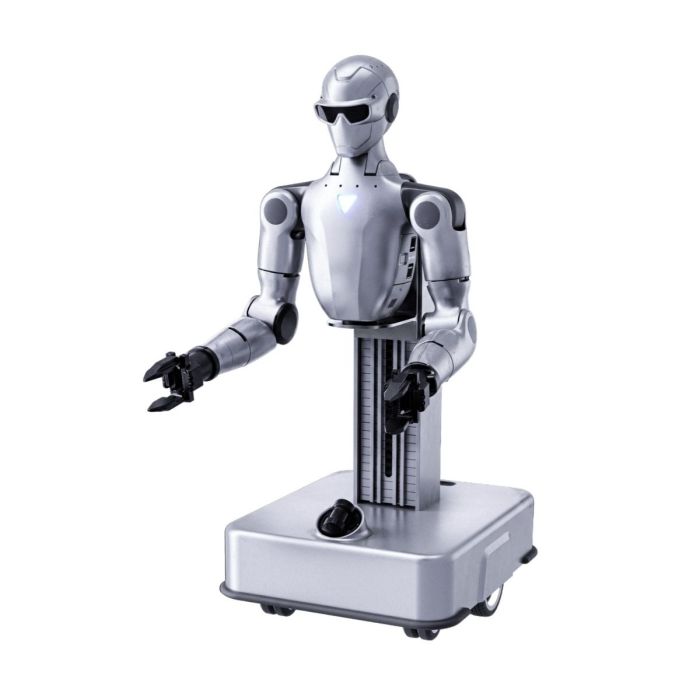
Walking is the hardest thing a humanoid does and, for most bench, shelf and cart work, the least useful. The Unitree R1-A7-D Smart G Humanoid Robot leaves it out on purpose: it is a torso with two arms and tactile hands, mounted on a wheeled base with a powered lifting column. It does not walk. It rolls to the job, rises to the right height and gets on with the work.
The product is available through this page, by quotation.
Background
Unitree and the R1 lineage
Unitree Robotics is known for compact, developer-friendly robots, and the R1 family carries that approach into upper-body manipulation. The family includes the desk-mount R1-A7, the wheeled R1-A7-D, the Smart and Ultimate configurations of the R1-A7-D (lettered A to H), and the R1-A5 and R1-A5-D. The choice is made along two lines. The first is how the torso is carried: on a desk, or on a wheeled mobile base with a powered lifting column and a chassis LiDAR for mobile manipulation. The second is what the torso is equipped with: which hands, and how much onboard compute.
This page covers the R1-A7-D in the Smart G configuration. Every figure below belongs to that version, or to the R1-A7-D where the figure is given for the base alone. Nothing here is borrowed from the desk-mount R1-A7, which is lighter at about 13 kg and has no mobile base.
Positioning and key technology
The R1-A7-D sits between a fixed manipulator and a full walking humanoid. Its mobile base combines a telescopic pillar for height adjustment with a wheeled base for omnidirectional navigation, so one machine can work at a low shelf, a bench or a counter. A chassis LiDAR supports navigation, and a binocular head camera gives the robot its view of the work.
The Smart G configuration adds the LinkerBot O6 Tactile (RGB) hand, a 6-DOF hand with tactile sensors and a wrist RGB camera. Smart configurations also add a 40 TOPS Orin Nano for onboard AI. The arm joints use crossed-roller and deep-groove ball bearings, hollow internal wiring, dual encoders and local air cooling. Together, these choices point to a platform built for teams who write their own software, and full secondary development support is available.
Technical Specifications
| Specification | Unitree R1-A7-D Smart G |
|---|---|
| Hands | LinkerBot O6 Tactile (RGB): 6-DOF hand with tactile sensors and wrist RGB camera |
| Onboard AI compute (Smart configurations) | 40 TOPS Orin Nano |
| Compute | 8-core CPU (body) plus 8-core CPU with 10 TOPS (head) |
| Dimensions (R1-A7-D) | 683 x 520 x 440 mm (26.9 x 20.5 x 17.3 in) collapsed, raised to 1,600 mm (63 in) |
| Weight (R1-A7-D) | About 32 kg (71 lb) |
| Degrees of freedom (R1-A7-D) | 20 (adds a 3-DoF wheeled chassis), or 22 counting the grippers |
| Mobile base | Telescopic pillar for height adjustment; wheeled base for omnidirectional navigation |
| Arm length (forearm + upper arm) | 555 mm (21.9 in) |
| End-clamp accuracy | ±0.1 mm (±0.004 in) |
| Head camera | Binocular; 1280 x 720 RGB at 30 Hz; 544 x 448 depth at 10 Hz; 146° by 124° field of view |
| Chassis sensing | Chassis LiDAR |
| Power (R1-A7-D) | Removable chassis battery standard (about 1.5 h) plus external supply |
| Audio | 4-array microphone and dual 3 W speakers |
| Wireless | Wi-Fi 6 and Bluetooth 5.2 |
| Joint design | Crossed-roller and deep-groove ball bearings, hollow internal wiring, dual encoders on the arm joints, local air cooling |
| Software / SDK | Full secondary development support |
Specifications as published by the manufacturer; confirmed against the datasheet at quotation.
The manufacturer has not published the IP rating, the operating temperature range, the top speed, the shoulder torque, the waist range or the package contents for Smart G; they are confirmed at quotation.
What makes the R1-A7-D different from the desk-mount R1-A7?
The difference is mobility. The desk-mount R1-A7 stays where it is bolted, and its reach is the reach of its arms. The R1-A7-D carries the same kind of torso on a wheeled base, so the work no longer has to come to the robot. The powered lifting column adds the second advantage: the torso is 440 mm tall when collapsed on a footprint of 683 x 520 mm, and it can be raised to 1,600 mm, so the arms can work at very different heights from one parking spot.
There is a cost to this. The R1-A7-D weighs about 32 kg against about 13 kg for the desk-mount version, and it depends on a removable chassis battery that runs about 1.5 h as standard, with an external supply for longer sessions. A team that works at a single station will find the desk-mount version simpler. A team that must serve several stations, or study navigation and manipulation together, will find the wheeled base worth the weight.
What does the Smart G configuration add?
Smart configurations add a 40 TOPS Orin Nano on top of the 8-core body CPU and the 8-core head CPU with 10 TOPS. That leaves room to run perception and learning workloads on the robot itself, rather than on a separate computer.
The G in the name refers to the hands. Smart G uses the LinkerBot O6 Tactile (RGB), a 6-DOF hand with tactile sensors and a wrist RGB camera. Touch and a close-up view from the wrist are valuable when a grasp depends on contact: a soft item, a slippery one, a part that must be seated. The head camera supplies the wide view, with 1280 x 720 RGB at 30 Hz and 544 x 448 depth at 10 Hz over a 146° by 124° field of view, and the wrist camera supplies the close one. The other lettered configurations each have their own page.
Who is the Unitree R1-A7-D Smart G for?
University and corporate research groups are the clearest fit. They study manipulation, tactile learning, or mobile manipulation, and they need an arm-and-hand platform that their own code can drive. The secondary development support and the onboard 40 TOPS module serve them directly.
Educators and training labs can use it to teach perception, motion planning and human-robot interaction on a machine that is safe to place on a bench, since it does not walk. System integrators can use it as a test bed before they commit to a production design for light assembly, sorting or service tasks.
Buyers who do not need a tactile wrist-camera hand may prefer another Smart configuration. The sibling versions, such as Unitree R1-A7-D Smart A Humanoid Robot and Unitree R1-A7-D Smart B Humanoid Robot, are listed on their own pages, and the whole group can be browsed in the R1-A7-D Smart category. Those who need a robot that walks should look elsewhere, because this one is a torso on wheels.
What is the Unitree R1-A7-D Smart G used for?
- Tactile manipulation research. The hand's touch sensors and wrist camera give researchers contact data alongside vision.
- Mobile manipulation studies. The wheeled base, lifting column and chassis LiDAR let a team work on moving and handling in one system.
- Teaching robotics. Students can program perception, planning and control on a platform that stays at bench height.
- Precision handling trials. An end-clamp accuracy of ±0.1 mm (±0.004 in) suits small-part and fixture experiments.
- Human-robot interaction. The 4-array microphone and dual 3 W speakers support voice-based work with people.
- Software development. Full secondary development support lets integrators build and test their own applications.
Pricing and Availability
No price is printed on this page, because the configuration, the accessories and the destination all shape the offer. Please ask for a quotation and tell us how you plan to use the robot. Delivery, customs and support are arranged with the quotation. The Unitree R1-A7-D Smart G Humanoid Robot is available on this page.
Frequently Asked Questions
Does the Unitree R1-A7-D Smart G walk?
No. It is a torso, not a humanoid in the walking sense. It moves on a wheeled base with omnidirectional navigation.
How tall can it reach?
It measures 683 x 520 x 440 mm (26.9 x 20.5 x 17.3 in) collapsed, and the lifting column raises it to 1,600 mm (63 in).
What hands does Smart G use?
It uses the LinkerBot O6 Tactile (RGB), a 6-DOF hand with tactile sensors and a wrist RGB camera.
How long does the battery last?
The removable chassis battery is standard and runs about 1.5 h. An external supply can also be used.
Can I write my own software for it?
Yes. The robot comes with full secondary development support, and Smart configurations add a 40 TOPS Orin Nano for onboard AI.
What does the head camera see?
The binocular head camera delivers 1280 x 720 RGB at 30 Hz and 544 x 448 depth at 10 Hz, over a 146° by 124° field of view.
Where can I buy the Unitree R1-A7-D Smart G Humanoid Robot and what does it cost?
You can buy it through this page, by quotation. The cost depends on the configuration and destination, so send us your requirements and we will prepare the offer.
Summary
The Unitree R1-A7-D Smart G Humanoid Robot gives up walking and gains what most manipulation work needs: a stable torso, a lifting column, tactile hands with a wrist camera and an open platform for your own software. Its figures, from the 1,600 mm raised height to the ±0.1 mm end-clamp accuracy, describe a tool for research, teaching and integration. To discuss the configuration and the delivery, this page is the starting point.