
Unitree Go2 X Robot Dog
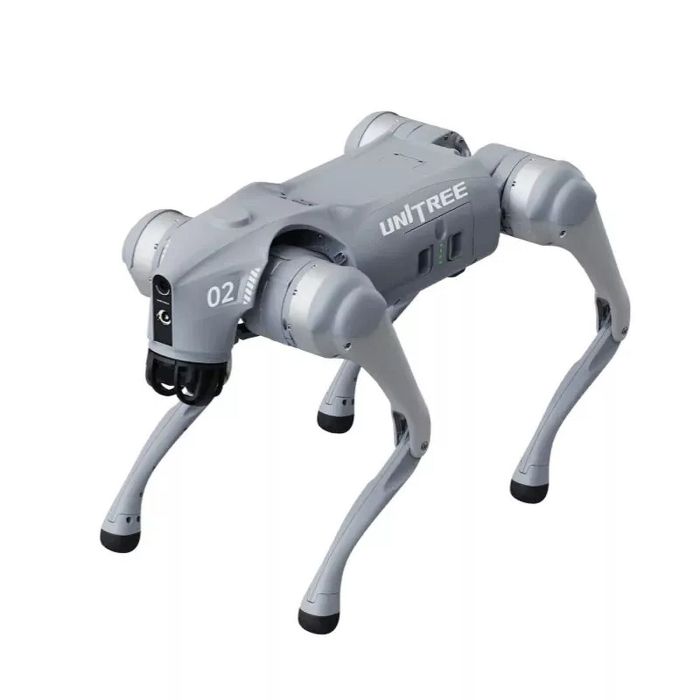
In stock
- BRAND:
- UNITREE ROBOTICS
- MODEL:
- GO2-X
- PART #:
- GO2-X
- ORIGIN:
- China
- Warranty:
- 12 MONTHS
- AVAILABILITY:
- SUBJECT TO AVAILABILITY
- SKU:
- Unitree-GO2-X
Unitree Go2 X Robot Dog
Most robot dogs are judged by how they look in a video. The Unitree Go2 X Robot Dog is better judged by what happens after the video ends: when a controller is already in the box, when the body has to carry a load across a yard, and when a team wants to write its own code without being locked out. That is the middle ground this quadruped occupies, and it is worth understanding before you request a quotation.
The Unitree Go2 X Robot Dog is available through this page, by quotation.
Background
Unitree and the Go2 family
Unitree Robotics is a Chinese maker of legged robots, and its quadrupeds are among the most widely seen in universities, research labs and demonstration programs. The company built its reputation on compact, actuator-driven machines that bring walking robots within reach of teams that once needed a large engineering budget to attempt it.
The Go2 is the family this product belongs to. It comes in four versions: Air, Pro, X and EDU. They share the same basic idea of a four-legged robot with a body of aluminium alloy and high strength engineering plastic, but they differ in speed, payload, sensing and how far a developer can reach into the software. The X sits third in that line, above the Air and the Pro on speed and payload, and below the EDU in openness.
Where the X fits in the range
The Go2 X is positioned for buyers who want a capable platform with a manual controller supplied and some room to develop their own functions, without stepping up to the full development version. Secondary development is partial on the X, which means part of the platform is open to your own work and part is not.
Its key hardware is a set of 12 aluminum knee joint motors, a maximum joint torque of about 45N·m, and an 8-core high-performance CPU for basic computing. Those three items explain most of what the robot can do: the motors and torque drive the gait and the climbing, and the processor handles the onboard computing that keeps it balanced and responsive. You can see the whole family on the Unitree Go2 category page.
Technical Specifications
| Specification | Value |
|---|---|
| Standing dimensions | 70cm x 31cm x 40cm |
| Crouching dimensions | 76cm x 31cm x 20cm |
| Weight (with battery) | About 15kg |
| Material | Aluminium alloy + High strength engineering plastic |
| Voltage | 28V~33.6V |
| Working maximum power | About 3000W |
| Payload | ≈8kg (MAX ~ 12kg) |
| Speed | 0 ~ 3.7m/s (MAX ~ 5m/s) |
| Max climb drop height | About 16cm |
| Max climb angle | 40° |
| Basic computing power | 8-core High-performance CPU |
| Max joint torque | About 45N·m |
| Knee joint motors | 12 set (aluminum) |
| Battery | Standard (8000mAh) |
| Battery life | About 1-2h |
| Foot-end force sensor | Not included |
| Secondary development | Partial |
| Manual controller | Included |
| Wireless module | Wi-Fi6/Bluetooth/4G |
| Remote control distance (ISS 2.0) | Over 30m |
Specifications as published by the manufacturer; confirmed against the datasheet at quotation.
The manufacturer has not published the IP rating, the operating temperature range, the camera resolution for the X, the package weight and dimensions, or the noise level; they are confirmed at quotation.
What makes the Go2 X different from the Air and the Pro?
The first difference is in what ships with the robot. For the X, the manual controller is included, while it is an optional extra on the Go2 Air and the Go2 Pro. For a team that wants to switch on the robot and walk it the same day, that matters. There is no separate accessory to source and no wait for a part that was left out of the original order.
The second difference is in performance. The X runs at 0 ~ 3.7m/s with a maximum of about 5m/s, carries about 8kg with a maximum of about 12kg, and manages a climb drop height of about 16cm and a climb angle of 40°. The Air and the Pro have lower speed figures, and the Air also has a lower climbing angle, so the X is the version to look at when speed and carrying capacity are part of the job.
The third difference is in openness. Secondary development is partial on the X, so you can build on the platform, but not with the freedom of the fully open version. If your plan is to write a lot of custom software, read the next section before you decide.
What does the EDU version add?
The EDU is the version for developers. Secondary development is fully available on the EDU, where the X offers it in part. The foot-end force sensor is also present on the EDU and absent on the X, and the EDU comes with a long endurance battery option in place of the standard one on the X.
That makes the choice fairly clear. If you need foot-contact sensing, full access for your own code, or longer running time, the Go2 Edu Standard or the Go2 Edu Plus are the places to start. If you want the faster, stronger platform with a controller in the box and are comfortable with partial development access, the X is the more direct answer.
Who is the Go2 X for?
Universities and training centers are a natural fit. Students can learn how a legged robot moves, using the supplied manual controller, and teachers can introduce some programming through the partial development access without the cost and complexity of a fully open research platform.
Integrators and demonstration teams are another. The payload and speed figures suit a robot that needs to carry a small sensor or accessory across uneven ground, and the Wi-Fi6, Bluetooth and 4G wireless module gives several ways to stay connected. A remote control distance of over 30m on ISS 2.0 keeps the operator at a comfortable range.
Organizations in the Caribbean that are weighing inspection or site-survey work can use the X to evaluate legged mobility on real terrain: steps, slopes, gravel and grass. Anyone planning outdoor work in heat, rain or salt air should raise weather protection and temperature limits when asking for the quotation.
Developers who need foot-end force sensing or full access to the software should look to the EDU versions instead.
What is the Go2 X used for?
- Education and training: students learn legged locomotion and robot control on a platform that arrives with its manual controller.
- Research prototyping: teams test ideas in walking, balance and navigation using the 8-core CPU and partial secondary development.
- Payload carrying: the robot carries a load of about 8kg, up to about 12kg at maximum, across ground that would stop a wheeled vehicle.
- Terrain evaluation: climbs of up to 40° and drops of about 16cm show how a legged robot copes with steps and slopes.
- Demonstrations and exhibitions: a moving quadruped draws attention at trade shows, schools and public events.
- Remote operation trials: Wi-Fi6, Bluetooth and 4G links, with a remote control distance of over 30m, support tests of controlled operation from a distance.
Pricing and Availability
We do not publish prices on this page. Quotation is the way to buy: tell us the quantity, the intended use and your location, and we will prepare an offer for the Unitree Go2 X Robot Dog. Delivery, customs and support are arranged with the quotation. The Unitree Go2 X Robot Dog is available on this page.
Frequently Asked Questions
How fast is the Unitree Go2 X Robot Dog?
Its speed is 0 ~ 3.7m/s, with a maximum of about 5m/s.
How much can it carry?
The payload is about 8kg, with a maximum of about 12kg.
How long does the battery last?
Battery life is about 1-2h on the standard 8000mAh smart battery.
Does it come with a controller?
Yes. The manual controller is included with the X. The remote control distance on ISS 2.0 is over 30m.
Can I write my own software for it?
Partly. Secondary development is partial on the X. The EDU versions offer full secondary development.
Is it waterproof?
Ask about weather protection when you request your quotation, and we will answer it for the X specifically.
Where can I buy the Unitree Go2 X Robot Dog and what does it cost?
You can buy it through this page by requesting a quotation. The cost depends on your quantity, delivery location and support needs, and it is given in the quotation.
Summary
The Go2 X is the version for people who want more than a demonstration but do not need the full development package. It stands 70cm x 31cm x 40cm, weighs about 15kg with its battery, moves at up to 3.7m/s in normal use, carries about 8kg, and arrives with its manual controller. Its limits are as clear as its strengths: partial secondary development, no foot-end force sensor and a battery life of about 1-2h. If that balance matches your project, this page is the starting point.


