
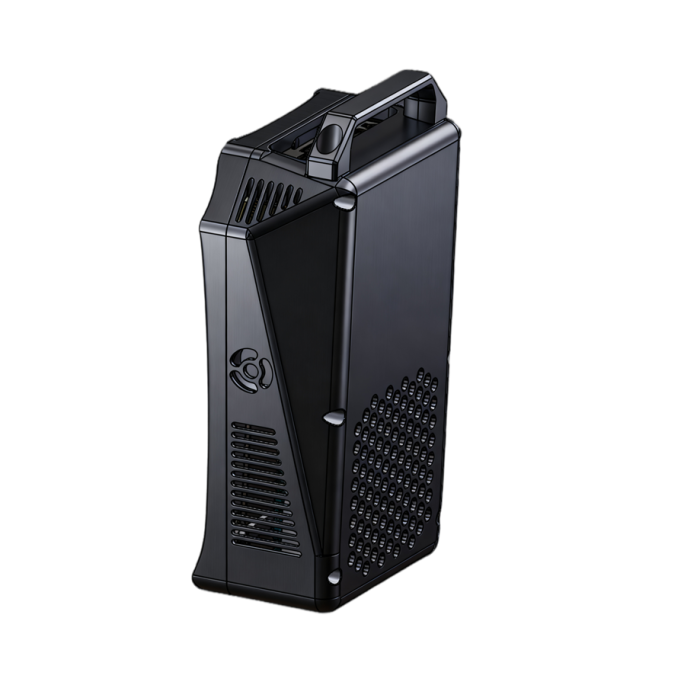
NVIDIA AGX Thor Backplane Expansion Dock for Unitree G1
In stock
- BRAND:
- UNITREE ROBOTICS
- MODEL:
- G1-AGX-THOR-DOCK
- PART #:
- G1-AGX-THOR-DOCK
- ORIGIN:
- China
- Warranty:
- 12 MONTHS
- AVAILABILITY:
- SUBJECT TO AVAILABILITY
- SKU:
- Unitree-G1-AGX-THOR-DOCK
NVIDIA AGX Thor Backplane Expansion Dock for Unitree G1
Most upgrades to a humanoid robot change how it looks or moves. The NVIDIA AGX Thor Backplane Expansion Dock for Unitree G1 changes how much the robot can work out for itself. A body that walks well but has to lean on a distant computer for every hard decision is only half independent. This dock is aimed at closing that gap by placing the NVIDIA Jetson AGX Thor platform on the G1 or G1-D itself.
This product is available through this page, by quotation.
Background
Unitree Robotics and the G1 line
Unitree Robotics was founded in 2016 in China and has built its reputation as a pioneer in robotics technology. Its humanoid line has become a common sight in university laboratories and development teams, because it brings a capable walking platform within reach of groups that want to experiment rather than only watch demonstrations. The G1 and its G1-D counterpart belong to that line, and this dock is an expansion accessory made for both of them.
An accessory like this exists because research needs change faster than a robot's body does. A team may be content with the mechanics of its humanoid and still outgrow the onboard computing. Rather than replace the whole platform, the team adds a dock that carries a stronger computer. Related add-ons for the family are gathered under Humanoid Accessories.
The NVIDIA Jetson AGX Thor platform
At the heart of the dock is the NVIDIA Jetson AGX Thor platform, built on the Blackwell GPU architecture. The platform delivers up to 2070 TFLOPS (FP4) of AI performance, with up to 128 GB of memory at 273 GB/s of bandwidth and a 14-core Neoverse V3AE CPU. Those three elements matter together: the GPU runs the neural networks, the memory holds the models and the data flowing through them, and the CPU handles the surrounding software that keeps a robot running.
For a humanoid, this is a different class of computing from a modest embedded board. Large models for vision, language and action need room in memory and fast access to it. A backplane dock that brings this capacity onto the robot's frame lets those models run where the sensors and motors are, instead of across a wireless link.
Technical Specifications
| Specification | Value |
|---|---|
| Compatible robots | Unitree G1 and G1-D |
| Platform | NVIDIA Jetson AGX Thor |
| GPU architecture | Blackwell |
| AI performance (FP4) | Up to 2070 TFLOPS |
| Memory | Up to 128 GB |
| Memory bandwidth | 273 GB/s |
| CPU | 14-core Neoverse V3AE |
| Scope of delivery | 1× NVIDIA AGX Thor Backplane Expansion Dock for G1/G1-D |
Specifications as published by the manufacturer; confirmed against the datasheet at quotation.
The manufacturer has not published the dimensions, the weight, the power consumption, the port types and counts, the operating system, the storage, the wireless connectivity, the IP rating or the operating temperature; they are confirmed at quotation.
What makes the AGX Thor dock different from the AGX Orin dock?
Unitree also offers a sibling accessory for the same robot, the NVIDIA AGX Orin Backplane Expansion Dock for Unitree G1. The two share a purpose, which is to give the G1 a stronger onboard computer, but they are built around different NVIDIA platforms. The Thor dock uses the Jetson AGX Thor platform with the Blackwell GPU architecture, while the sibling is built around NVIDIA AGX Orin.
For a buyer, the practical question is how demanding the intended software is. The Thor figures, up to 2070 TFLOPS (FP4), up to 128 GB of memory and 273 GB/s of bandwidth, are aimed at heavy workloads such as running large action models directly on the robot. If your project is lighter, or if you are still deciding how far to go with onboard compute, it is worth comparing the two pages side by side. We will gladly set out the differences when you request a quotation.
Why does onboard compute matter for a humanoid?
A robot that depends on an external computer is tied to the quality of its connection. Latency, dropouts and the need to carry a tether or stay near a wireless access point all limit where and how the robot can work. Moving the intelligence onto the robot removes much of that dependence, so experiments can leave the bench and continue in a corridor, a workshop or an outdoor test area.
There is also a matter of workflow. Collecting demonstrations, training a policy and deploying it are steps that go more smoothly when the same computer is present at each stage. Because the dock is made for imitation learning, VLA deployment, data collection and onboard inference, it covers that loop rather than a single step of it. The result is a platform where the model you trained can run on the very body that learned from the demonstrations.
Who is the NVIDIA AGX Thor Backplane Expansion Dock for?
The dock suits university and institute laboratories that already own a G1 or G1-D and want to run modern learning-based control on it. Imitation learning in particular benefits from a robot that can record, process and replay behavior without leaning on a remote server.
It also suits companies developing embodied AI products. These teams often need to show that a vision-language-action model can work on real hardware under real constraints, and onboard compute is central to that claim. Integrators who prepare robots for demonstrations or pilot projects will find the same value, since a self-contained robot is easier to transport and set up.
Teams with lighter software needs, or those exploring a first deployment, may be better served by the AGX Orin dock. For anyone unsure, a short conversation about the planned workloads is the quickest way to choose.
What is the NVIDIA AGX Thor Backplane Expansion Dock used for?
- Imitation learning. Record human demonstrations and train behaviors that the G1 or G1-D can then reproduce.
- VLA deployment. Run vision-language-action models on the robot itself instead of on a remote machine.
- Data collection. Gather sensor and motion data during real tasks for later training and analysis.
- Onboard inference. Execute trained neural networks directly on the robot, so decisions do not wait on a network link.
- Research prototyping. Test new perception and control ideas on a humanoid with substantial computing at hand.
- Teaching and demonstration. Show students and visitors an autonomous humanoid whose intelligence travels with it.
Pricing and Availability
We do not publish prices on this page. The call to action is a quotation: tell us which robot you use, whether a G1 or a G1-D, and what you plan to run on it, and we will respond with an offer. Delivery, customs and support are arranged with the quotation. The dock is available on this page.
Frequently Asked Questions
Which robots is the dock made for?
It is made for the Unitree G1 and the G1-D. The scope of delivery is one NVIDIA AGX Thor Backplane Expansion Dock for G1/G1-D.
What AI performance does it offer?
The platform provides up to 2070 TFLOPS (FP4) of AI performance. It is built on the NVIDIA Jetson AGX Thor platform with the Blackwell GPU architecture.
How much memory does it have?
It offers up to 128 GB of memory with 273 GB/s of bandwidth. This is the capacity available for models and data on the robot.
What processor does it use?
It uses a 14-core Neoverse V3AE CPU alongside the Blackwell GPU. The CPU handles the general software that surrounds the AI workloads.
What is it meant for?
It is intended for imitation learning, VLA deployment, data collection and onboard inference. In short, it is for running intelligence on the robot itself.
What about power draw, ports and weight?
Those details are not among the figures available for this dock. Ask for them when you request a quotation.
Where can I buy the NVIDIA AGX Thor Backplane Expansion Dock for Unitree G1 and what does it cost?
You can buy it through this page by requesting a quotation. We do not list prices here; the offer is prepared once we know your robot and your requirements.
Summary
A humanoid is only as independent as the computer it carries. The NVIDIA AGX Thor Backplane Expansion Dock for Unitree G1 answers that by bringing the Jetson AGX Thor platform, with up to 2070 TFLOPS (FP4), up to 128 GB of memory and a 14-core Neoverse V3AE CPU, onto the G1 or G1-D. It serves the whole loop from imitation learning and data collection to VLA deployment and onboard inference. If you want your robot to think for itself, this page is the starting point.


