
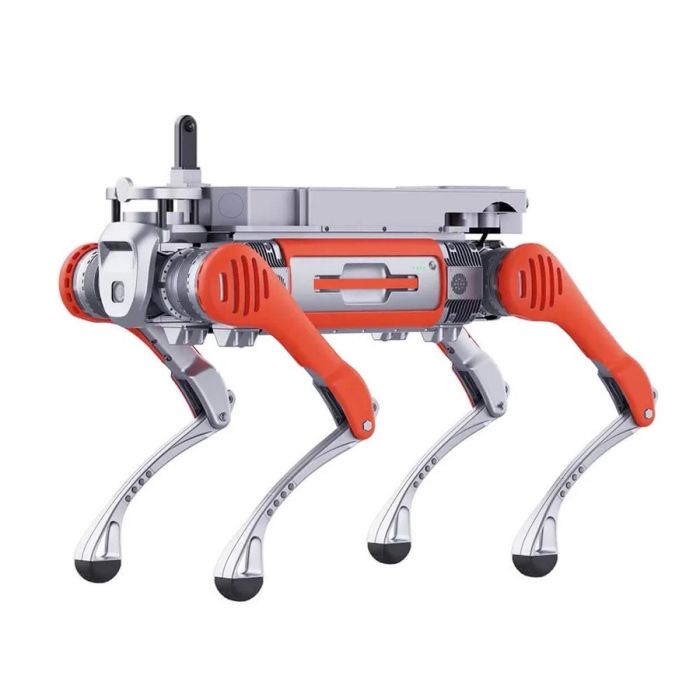
Unitree B2 Fire Rescue Quadruped Robot Dog (B2-XF2-C)
In stock
- BRAND:
- UNITREE ROBOTICS
- PART #:
- B2-XF2-C
- ORIGIN:
- China
- AVAILABILITY:
- SUBJECT TO AVAILABILITY
- SKU:
- Unitree-B2-XF2-C
Unitree B2 Fire Rescue Quadruped Robot Dog (B2-XF2-C)
Some of the hardest fires on an island are not in the open: they burn in a hotel service stair, a fuel-depot pump room or a ship's hold, where the first question is who goes in. The Unitree B2 Fire Rescue Quadruped Robot Dog (B2-XF2-C) is a four-legged machine built so that, in many cases, a robot can go in first and the crew can decide with live pictures in front of them.
This product is available through this page, by quotation.
Background
Unitree Robotics and the B2 lineage
Unitree Robotics is known for quadruped robots that range from compact education platforms to heavier industrial machines. The B2 family sits at the industrial end of that range, designed for work outside the laboratory: uneven ground, long shifts and sites where a wheeled vehicle would stall. The Fire Rescue series takes that foundation and adapts it to one demanding profession.
The series is organized around several named configurations: an inspection robot dog, a water cannon robot dog and an air blower robot dog. Each takes the same legged body and gives it a different job. The model code in the name of this page, B2-XF2-C, places it in the XF2 line of the series.
Positioning and key technology
The series is deeply integrated into fire rescue applications and supports modular functions and replacements. In practice this means the platform is not a single-purpose tool: the equipment it carries can be changed to suit the incident, whether the task is reconnaissance, firefighting with water or foam, or airflow against a vegetation fire.
The body uses a composite metal material that is wear-resistant, has high mechanical strength, and is dust-proof and waterproof. Joint performance has increased by 170%, a gain that matters most when a legged robot has to climb, balance and recover on broken surfaces. A drencher system lets the robot keep operating in high-temperature environments without being affected by heat, which improves fire-extinguishing efficiency.
Technical Specifications
| Specification | Value |
|---|---|
| Series | Unitree B2 Fire Rescue |
| Maximum step height (facing front) | 40cm |
| Joint performance (Fire Rescue series) | Increased by 170% |
| Body material | Composite metal; wear-resistant, high mechanical strength, dust-proof and waterproof |
| Modularity | Supports modular functions and replacements |
| Heat protection | Drencher system for operation in high-temperature environments |
| Battery | Quick replacement while maintaining water-tightness |
| Navigation (XF2 / F2D designation) | Laser SLAM kit for autonomous navigation included |
| Navigation (XF1 / F2 designation) | Delivered without SLAM navigation |
| Water cannon version: pitching range | 5 - 85° (with body-compensated angle) |
| Water cannon version: water flow rate | 40L/s, for both water and foam |
| Water cannon version: firing range | 60m |
| Air blower version: function | Extinguishes forest fires through high-speed airflow |
| Visualization platform | Long-distance video stream transmission and visualized information for rescue decision-making |
Specifications as published by the manufacturer; confirmed against the datasheet at quotation. The manufacturer has not published the exact weight, the payload, the maximum speed, the IP rating, the gas sensor model or the remote controller specifications of the fire rescue version; they are confirmed at quotation.
What makes the Fire Rescue series different from a standard quadruped?
A general-purpose quadruped is tuned for walking, carrying sensors and being easy to integrate. The Fire Rescue series is tuned for the opposite of comfort. The composite metal body is chosen for wear resistance and mechanical strength, and it is dust-proof and waterproof, so smoke residue, spray and debris are part of the design brief rather than an afterthought.
The second difference is how the robot thinks about heat. The drencher system keeps the machine working in high-temperature environments without being affected by heat. For a robot that may be asked to approach a fire rather than avoid it, that is the feature that separates a firefighting platform from an inspection platform with a different paint job.
The third difference is endurance in the field. Quick battery replacement while maintaining water-tightness matters because a rescue robot that needs a long pause to swap power is a robot that is not helping. Being able to change the battery without giving up the sealing improves both rescue efficiency and safety.
How does the robot handle stairs and rough ground?
Fire stairs, loading ramps and rubble are the daily terrain for this class of machine. The Fire Rescue series ascends and descends steps facing front with a maximum height of 40cm, with excellent stability and balance when climbing fire stairs. The 170% increase in joint performance supports this: stronger joints give the legs more authority when the footing is poor.
Navigation depends on the designation. Models marked XF2 or F2D include the Laser SLAM kit for autonomous navigation, while models marked XF1 or F2, without the D, are delivered without SLAM navigation. B2-XF2-C carries the XF2 designation, so the autonomous navigation kit is part of the model line it belongs to. Teams that plan repeated patrols of the same building will value that, while teams that drive the robot manually in every case can weigh whether they need it.
Who is the Unitree B2 Fire Rescue Quadruped Robot Dog (B2-XF2-C) for?
Municipal and volunteer fire services are the obvious first group. A robot that can enter a smoke-filled stairwell and send back a clear video stream lets the incident commander see conditions before committing a crew. The visualization platform recreates the onsite environment for commanding and provides visualized information for rescue decision-making.
Industrial sites are the second group: fuel terminals, power stations, ports and large hotel or resort complexes, where a small fire in a confined or hazardous area can escalate quickly. Safety managers at such sites often want a machine that can carry out a first response or a close inspection while people stay at a distance.
Emergency planners, training academies and system integrators form the third group. They may be building a response concept around a modular platform, testing how a legged robot fits into drills, or adding mission equipment of their own.
The same series offers sibling versions under other model codes. If you are comparing configurations, you can look at B2-XF2-A, B2-XF2-B or B2-XF2-D, and the wider Unitree B2 category shows the rest of the family. Ask for the differences between versions when you request a quotation.
What is the Unitree B2 Fire Rescue Quadruped Robot Dog (B2-XF2-C) used for?
- Reconnaissance before entry. The robot goes ahead into stairwells, corridors and collapsed structures and sends back video so that crews know what is waiting.
- Command support. Long-distance video transmission and visualized information help commanders recreate the scene and decide on a rescue plan.
- Water and foam delivery. In the water cannon configuration, the robot can fire water or foam at a flow rate of 40L/s over a range of 60m.
- Forest and brush fire response. In the air blower configuration, high-speed airflow is used to extinguish forest fires.
- Work in high heat. The drencher system lets the robot keep operating where heat would stop an unprotected machine.
- Autonomous patrols. With the Laser SLAM kit of the XF2 designation, the robot supports autonomous navigation of known sites.
Pricing and Availability
No price is printed on this page, because the right configuration depends on the equipment, the site and the number of units. A quotation is the way forward: tell us the application and we will reply with a tailored offer. Delivery, customs and support are arranged together with the quotation. The Unitree B2 Fire Rescue Quadruped Robot Dog (B2-XF2-C) is available on this page.
Frequently Asked Questions
Does this robot include autonomous navigation?
Models designated XF2 or F2D include the Laser SLAM kit for autonomous navigation. Models designated XF1 or F2 are delivered without SLAM navigation.
How high a step can it climb?
Facing front, the maximum step height is 40cm, with excellent stability and balance on fire stairs.
Can it work in high temperatures?
Yes. The drencher system lets the robot continue to operate in high-temperature environments without being affected by heat.
Is the body protected against dust and water?
The body is made of a composite metal material that is wear-resistant, has high mechanical strength, and is dust-proof and waterproof.
Can the equipment be changed?
The series supports modular functions and replacements. Water cannon and air blower configurations exist alongside the inspection robot dog.
How quickly can the battery be changed?
The series offers quick battery replacement while maintaining water-tightness, which improves rescue efficiency and safety.
Where can I buy the Unitree B2 Fire Rescue Quadruped Robot Dog (B2-XF2-C) and what does it cost?
You can request it through this page. The cost depends on the configuration and scope, so it is given in a written quotation rather than printed here.
Summary
The question at the start was who goes in first. The Unitree B2 Fire Rescue Quadruped Robot Dog (B2-XF2-C) answers it with a sealed, heat-protected, step-climbing machine that can see, report and, in the right configuration, fight the fire with water, foam or airflow. Its modular design lets the mission change without replacing the robot, and the XF2 designation brings the Laser SLAM kit for autonomous navigation. For a Caribbean fire service, port or industrial site that wants to keep people out of the worst spaces, this page is the starting point.


