
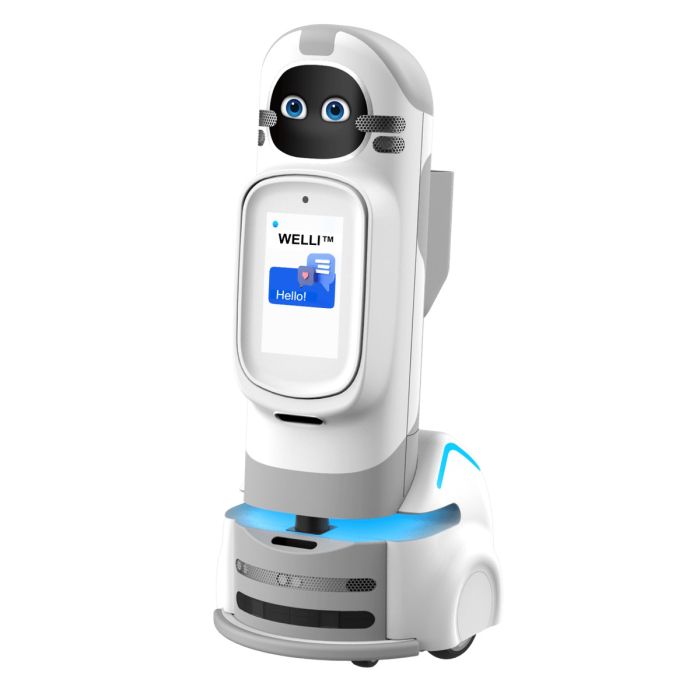
UBTECH Smart Companion Robot WELLI
In stock
- BRAND:
- UBTECH
- PART #:
- WELLI
- ORIGIN:
- China
- AVAILABILITY:
- SUBJECT TO AVAILABILITY
- SKU:
- UBTECH-WELLI
UBTECH Smart Companion Robot WELLI
A good companion remembers who you are, notices when something has changed and still has time to chat. That is the standard set for the UBTECH Smart Companion Robot WELLI, a mobile robot made for care settings where staff are stretched thin and residents value a familiar face, even one on a screen. It greets people by name, keeps them company, nudges their thinking with daily training and, when a visitor arrives, walks them to the right door.
The product is available through this page, by quotation.
Background
The company behind WELLI
WELLI comes from UBTECH, the brand behind a wide family of service and humanoid robots. Ubtech Robotics Corp Ltd was incorporated in 2012 and is headquartered in Shenzhen, China. Over the years the company has built a catalog that reaches from reception humanoids to delivery robots and smart mobility products, and several of those sit in the same Healthcare robots category as WELLI.
That lineage matters to a buyer. A companion robot is not a toy and not a warehouse machine. It has to share corridors with walkers, wheelchairs and visitors, and it has to speak to people who may not be comfortable with technology. WELLI is the product in the range most clearly aimed at that human side of care.
How WELLI is positioned
WELLI meets daily psychological needs by providing proactive care as a companion. Three ideas sit behind that role. The first is recognition: WELLI uses facial recognition to confirm the intended user and greet them with a customized menu or voice command. The second is care management: it understands the cognitive status of its owner through hospital admission information and regular evaluations, and it intervenes positively against the decline of cognitive ability through daily training. The third is connection: it helps seniors communicate more easily with their family members, which strengthens family ties.
On top of those three ideas sits a practical skill set. WELLI can guide visitors to their destination with autonomous navigation and obstacle avoidance, and it answers questions based on a preset Q&A base. In other words, it is a companion for the resident and a front-of-house helper for the building at the same time.
Technical Specifications
WELLI comes in two versions, distinguished by the size of the main screen. Each figure below stays with the version it belongs to; a dash marks a figure not given for that version.
| Specification | Spec set with 10.1" main screen | Spec set with 13.3" main screen |
|---|---|---|
| Dimensions | 47.5 x 44 x 102 cm | 48.3 x 43 x 100 cm |
| Weight | 31 kg | 25kg |
| Display | Dual-screen display; the 10.1" main screen shows service content and the 5.5" sub-screen shows expressions | Dual-screen display; the 13.3" main screen shows service content and the 5.5" sub-screen shows expressions |
| Speaker | 5 W hi-fi speaker x 2 | — |
| Battery | 20 Ah lithium battery, compliant with UL1642, UN38.3, IEC62133, UL2054 | — |
| Speed | Up to 1 m/s | — |
| Network | 802.11 B/G/N/AC + BT4.2 | — |
| Obstacle crossing | 2 cm high obstacle; 3.5 cm gap | — |
| Lidar | Small-sized measuring Lidar with a 270° scanning angle, 0.33° angle resolution and scanning frequency of 15 Hz | — |
| Camera | 1080p; output format: JPEG/YUV | — |
Specifications as published by the manufacturer; confirmed against the datasheet at quotation.
The manufacturer has not published the IP rating, the battery runtime, the charging time, what is in the box, the operating software, the payload or the operating temperature; they are confirmed at quotation.
What makes WELLI different from a simple service robot?
Many service robots are built around a task: carry this, show that, answer the phone. WELLI is built around a person. Its care functions begin with who the user is. Facial recognition confirms the intended user, and the greeting that follows is a customized menu or voice command rather than the same script for everyone. For someone living in a care residence, being recognized is a small thing that changes how a machine feels.
The second difference is that WELLI takes part in care, not only sits beside it. It understands the cognitive status of its owner through hospital admission information and regular evaluations, and daily training is used to intervene in the degradation of cognition capability. That gives staff and families a routine they can rely on every day, instead of a one-off demonstration.
The third difference is the dual-screen design. The main screen carries the service content, while the 5.5" sub-screen shows expressions. Splitting the two means the robot can present a menu or a lesson and still look attentive, which is useful with residents who respond to faces more than to text.
How does WELLI move and see its surroundings?
A companion that cannot cross a threshold is not much of a companion. The 10.1" version reaches speeds up to 1 m/s and crosses a 2 cm high obstacle and a 3.5 cm gap, which covers the door sills and floor joints common in care buildings. A small-sized measuring Lidar with a 270° scanning angle, 0.33° angle resolution and 15 Hz scanning frequency supports autonomous navigation and obstacle avoidance, and a 1080p camera with JPEG/YUV output handles imaging.
For connectivity, the 10.1" version carries 802.11 B/G/N/AC and BT4.2. Audio comes from two 5 W hi-fi speakers, so the robot can be heard in a busy common room. The battery is a 20 Ah lithium unit compliant with UL1642, UN38.3, IEC62133 and UL2054.
Who is WELLI for?
The clearest buyers are operators of senior living and care residences who want a consistent presence in common areas and hallways. A resident gets a recognizable greeting and daily cognitive training, and the staff get a helper that does not replace their judgment but fills the gaps between their visits.
Hospitals and clinics are a second group. WELLI uses hospital admission information and regular evaluations to understand cognitive status, which points to settings where that information already exists. Reception areas in such buildings also benefit from the guiding function, since visitors can be taken to their destination without pulling a nurse away from a ward.
Families are the third audience, even if they are not the purchasers. WELLI helps seniors communicate more easily with family members, which is often the feature that persuades a relative that a robot belongs in a loved one's daily life.
The choice between the two versions comes down to the screen and the body. The 13.3" version has a larger main screen and a lower weight, which suits spaces where content is viewed from a distance. The 10.1" version has the fuller specification. Buyers whose main task is carrying items rather than companionship may want to look at the UBTECH VERCARI Cabinet Delivery Robot instead, which is a separate product.
What is WELLI used for?
- Daily companionship. It provides proactive care and meets daily psychological needs of the person it looks after.
- Cognitive training. Daily training is used to intervene in the degradation of cognition capability.
- Personal greetings. Facial recognition confirms the intended user and greets them with a customized menu or voice command.
- Family contact. It helps seniors communicate with their family members and so strengthens family ties.
- Guiding visitors. Autonomous navigation and obstacle avoidance take visitors to their destination.
- Answering questions. It responds to questions based on the preset Q&A base.
Pricing and Availability
No price is listed on this page, because each deployment differs in version, quantity and site. Quotation is the next step: tell us the setting, the number of units and the version you prefer, and we respond with a proposal. Delivery, customs and support are arranged with the quotation. The UBTECH Smart Companion Robot WELLI is available on this page.
Frequently Asked Questions
What is WELLI?
WELLI is a smart companion robot from UBTECH that provides proactive care, supports daily cognitive training and guides visitors. It is meant for care settings.
How does WELLI recognize the person it serves?
It uses facial recognition to confirm the intended user. It then greets that person with a customized menu or voice command.
Can WELLI guide visitors around a building?
Yes. It guides visitors to their destination using autonomous navigation and obstacle avoidance features.
What screens does WELLI have?
It has a dual-screen display. The main screen shows service content and comes in 10.1" and 13.3" versions, while the 5.5" sub-screen shows expressions.
What battery does the 10.1" version use?
It uses a 20 Ah lithium battery compliant with UL1642, UN38.3, IEC62133 and UL2054.
Does WELLI help families stay in touch?
Yes. It strengthens family ties by helping seniors communicate more easily with their family members.
Where can I buy WELLI and what does it cost?
You can request WELLI through this page. The cost depends on the version and the project, so it is given in a quotation rather than listed here.
Summary
WELLI starts from the idea that a good companion remembers you. It recognizes the user, greets them in a personal way, supports daily cognitive training, helps them reach their family and walks visitors to where they need to go. Two versions with different main screens let a buyer match the robot to the room. For quotation on either one, this page is the starting point.


