
UBTECH Cruzr Y1 Wheeled Industrial Humanoid Robot
In stock
- BRAND:
- UBTECH
- MODEL:
- CRUZR Y1
- ORIGIN:
- China
- Warranty:
- 12 MONTHS
- AVAILABILITY:
- SUBJECT TO AVAILABILITY
- SKU:
- UBTECH-Cruzr-Y1
UBTECH Cruzr Y1 Wheeled Industrial Humanoid Robot
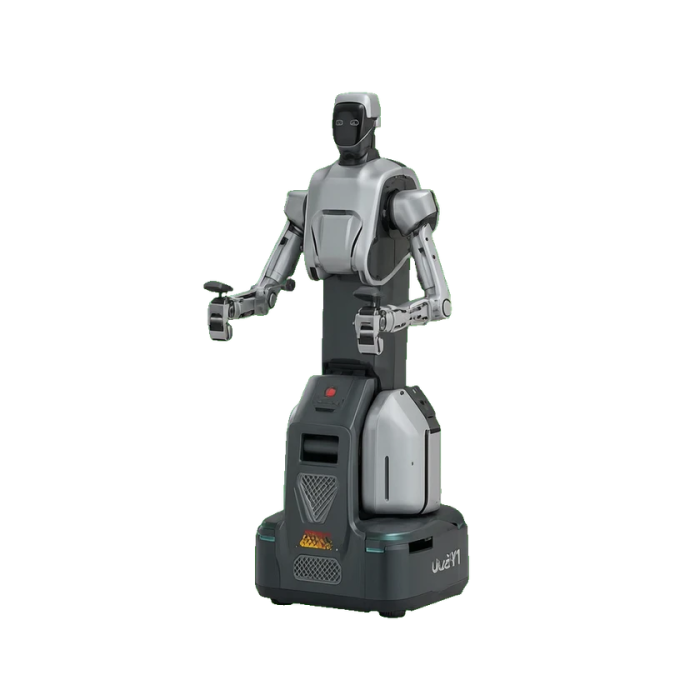
A robot that waits behind a fence for work to arrive is only half useful when the work keeps moving. The UBTECH Cruzr Y1 Wheeled Industrial Humanoid Robot is built around the opposite idea: it carries two arms, a lifting column and a ring of sensors to the shelf, the conveyor or the pallet, and it handles cartons, bins and awkward parts where they sit.
The product is available through this page, by quotation.
Background
UBTECH and the Cruzr family
UBTECH builds humanoid and service robots, and the Cruzr name has long belonged to its wheeled platforms. Some of them are made for reception and customer-facing work, such as the UBTECH Cruzr 1S Intelligent Commercial Service Wheeled Humanoid Robot. The Cruzr Y1 turns the same wheeled-humanoid idea toward the factory floor and the warehouse, where the job is to connect warehousing, manufacturing and logistics. You can see other machines of this type in our Wheeled Humanoids category.
Where the Cruzr Y1 differs from a service robot is in what it is asked to do. It does not greet people or answer questions. It grasps, lifts, positions and releases, and it does so with two anthropomorphic arms that work together on the same load.
Key technology: mobility, arms and intelligence
The base combines 360° omnidirectional wheels with a vertical lifting module, which lets the robot move through tight workshop spaces with agility and rotate 360° on the spot. The lifting module gives the arms a vertical reach of 0–1.8 m, so one machine can serve a low bin and a higher shelf without being reconfigured.
The arms use integrated harmonic joint modules with torque sensors, a design that balances precision with payload capacity. Each arm has 7 degrees of freedom and a 750 mm reach. Perception comes from LiDAR, ToF, RGB and force sensors, which help the robot interpret space, locate objects and guide handling.
Behind this sits a proprietary hardware architecture and the ROSA software system, which integrates a Vision-Language-Action (VLA) algorithm. The robot runs on domestic Digua S100P and S600 series computing chips. UBTECH Co-Agent supports industrial task coordination, and the company provides SDKs, vision recognition and motion control development interfaces, plus a multi-machine scheduling platform for running more than one unit.
Technical Specifications
| Specification | Value |
|---|---|
| Product type | Industrial wheeled humanoid |
| Arms | Two anthropomorphic arms |
| Degrees of freedom per arm | 7 |
| Reach per arm | 750 mm |
| Payload | 10 kg, both arms combined |
| Vertical reach | 0–1.8 m |
| Handling repeatability | ±0.5 mm |
| Base rotation | 360° on the spot |
| Aisle navigation | 0.8 m aisles |
| Battery runtime | Over 4 hours |
| Fast charging | Under 1.5 hours |
| Energy management | Quick battery swapping and automatic charging |
| Tooling | Modular quick-change system for cartons, bins and irregular parts |
| End effector mounting | Standard ISO 9409-1 mounting flange |
| Sensors | LiDAR, ToF, RGB and force sensors |
| Computing chips | Digua S100P and S600 series |
| Software | ROSA system, VLA algorithm, UBTECH Co-Agent, SDKs and multi-machine scheduling platform |
Specifications as published by the manufacturer; confirmed against the datasheet at quotation.
The manufacturer has not published the dimensions, the weight, the top speed, the battery capacity, the IP rating, the connectivity, the operating temperature range, the certifications or the contents of the box; they are confirmed at quotation.
What makes the Cruzr Y1 different from a fixed robot cell?
A fixed cell is excellent at one repeated task, but it is tied to one spot. When a line changes, the cell often needs rework. The Cruzr Y1 changes the question. Because the base is omnidirectional and rotates 360° on the spot, it can approach a workstation from the direction that suits the task, and it can travel through 0.8 m aisles. Actual clearance depends on the route, the posture and the materials carried, so a site walk-through is part of any serious assessment.
The second difference is the tooling. The modular quick-change system supports tools for cartons, bins and irregular parts, and the standard ISO 9409-1 mounting flange gives engineers a familiar interface for end effectors. One platform can therefore take on several handling jobs by changing the tool rather than the robot.
The third is continuity. Quick battery swapping and automatic charging support a continuous-operation strategy. With over 4 hours of battery runtime and fast charging under 1.5 hours, a shift plan can be built around swaps and top-ups instead of long idle periods.
How does the Cruzr Y1 compare with a legged industrial humanoid?
Legged humanoids such as the UBTECH Walker S2 Industrial Humanoid Robot aim to move through spaces designed for people, including steps. The Cruzr Y1 makes a different trade. It uses wheels and a lifting column, which suit smooth workshop and warehouse floors where positioning at the workstation matters more than walking. For buyers whose routes are flat and structured, the wheeled design is a direct fit; for sites with stairs or uneven ground, a different platform deserves a look.
The arms also matter. Seven degrees of freedom per arm, with torque-sensing joints and a ±0.5 mm handling repeatability, speak to careful, repeatable placement. The 10 kg payload is for both arms combined, so planners should size loads accordingly.
Who is the Cruzr Y1 for?
Manufacturers with changing lines will find the most value, especially where parts move between stations by hand today. Logistics and warehouse operators can use it for cartons and bins at the interface between storage and dispatch. Palletizing is a clear application: the robot auto-matches box sizes and integrates seamlessly with the line.
System integrators and research teams are a third group. The SDKs, the vision recognition and motion control interfaces and the multi-machine scheduling platform allow them to build task-specific solutions. If your need is reception, guidance or customer service rather than handling, the Cruzr Y1 is not the right match, and the Commercial category is the better place to look.
What is the Cruzr Y1 used for?
- Palletizing. The robot auto-matches box sizes and integrates with the line.
- Carton handling. Quick-change tools grasp cartons at workstations and on shelves.
- Bin handling. The lifting module adjusts working height across the 0–1.8 m vertical reach.
- Irregular parts. Tools for irregular parts widen the range beyond boxes.
- Moving between workstations. The omnidirectional base carries the robot through workshop aisles of 0.8 m.
- Continuous shifts. Battery swapping and automatic charging keep the robot working through long operating periods.
Pricing and Availability
We do not print prices on this page. A quotation is the way forward, and it is tailored to your application and site. Delivery, customs and support are arranged together with the quotation. The UBTECH Cruzr Y1 Wheeled Industrial Humanoid Robot is available on this page.
Frequently Asked Questions
How much can the Cruzr Y1 lift?
The payload is 10 kg for both arms combined. Each arm has 7 degrees of freedom and a 750 mm reach.
How long does the battery last?
Battery runtime is over 4 hours, and fast charging takes under 1.5 hours. Quick battery swapping and automatic charging are also supported.
Can it work in narrow aisles?
It navigates through 0.8 m aisles. Actual clearance depends on the route, the posture and the materials carried.
What tools can it use?
A modular quick-change system supports tools for cartons, bins and irregular parts. The mounting interface is a standard ISO 9409-1 flange.
What sensors does it carry?
It uses LiDAR, ToF, RGB and force sensors to interpret space, locate objects and guide handling.
Can we develop our own applications?
Yes. UBTECH provides SDKs, vision recognition and motion control development interfaces, and a multi-machine scheduling platform. UBTECH Co-Agent supports industrial task coordination.
Where can I buy the Cruzr Y1 and what does it cost?
You can request a quotation through this page. The cost depends on your configuration and site, and we quote it directly rather than printing a figure.
Summary
The Cruzr Y1 answers the problem of work that moves by bringing the manipulation to it. Two 7-DOF arms, a 0–1.8 m vertical reach, an omnidirectional base and a tool system built around an ISO 9409-1 flange make it a flexible handler for cartons, bins and palletizing. If your work will not stand still, ask for a quotation, and this page is the starting point.


