
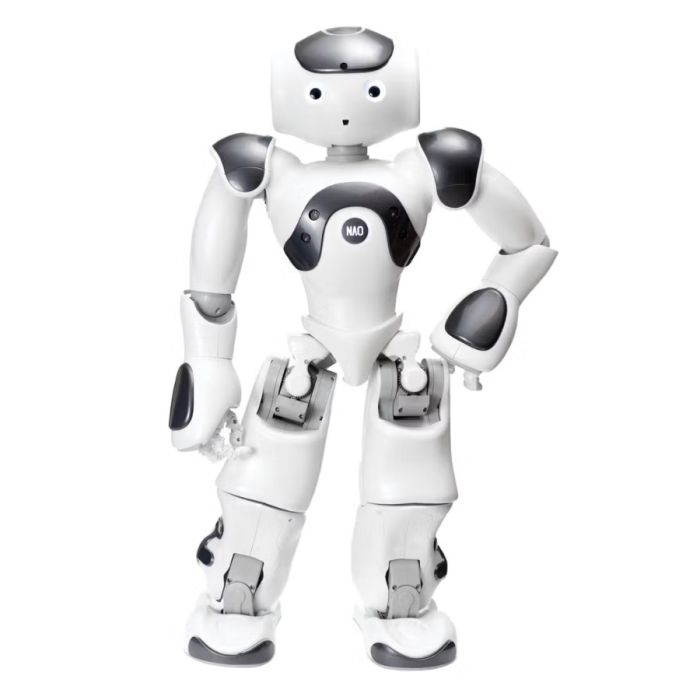
Softbank Robotics NAO V6 Humanoid Robot
In stock
- BRAND:
- SOFTBANK
- MODEL:
- NAO
- AVAILABILITY:
- SUBJECT TO AVAILABILITY
- SKU:
- SoftBank-NAO
Softbank Robotics NAO V6 Humanoid Robot
Most robots are built to be kept at a distance from people. The Softbank Robotics NAO V6 Humanoid Robot was built to be spoken to, watched and taught. It is a humanoid designed to interact naturally with people in education, research, healthcare and elderly environments, and that purpose shapes everything from its cameras and microphones to the way it is programmed.
The product is available through this page, by quotation.
Background
From Aldebaran to Softbank Robotics
NAO began life at Aldebaran, a company that set out to make a humanoid robot approachable enough for ordinary rooms and capable enough for serious work. Aldebaran was later acquired by Softbank Robotics, and the NAO line continued under that name. The V6 generation described on this page is the one the manufacturer positions as a proven platform for working with people.
That history matters to a buyer for a simple reason. A humanoid that has been used in classrooms, laboratories and care settings has been tested by many kinds of users, and the software and teaching material around it reflect that experience.
Positioning and key technology
NAO V6 stands 574 mm tall and has 25 degrees of freedom, which is what lets it gesture, turn its head and move in ways people read as natural. It senses the room through two front cameras, four microphones and a sonar, and it talks through two speakers. It connects by Ethernet, Wi-Fi or Bluetooth, so it fits into a school network or a laboratory bench setup without special equipment.
The software side is just as important. NAO is programmed in Python or C++ through its SDK, and scenarios can be designed visually in Choregraphe. A complete software suite is supplied, made up of Choregraphe, Monitor and the SDK. Beginners can start with the visual tool, while advanced users move to code on the same robot.
Technical Specifications
| Specification | Value |
|---|---|
| Height | 574 mm |
| Dimensions | 574mm x 275mm x 311mm |
| Weight | About 5.48 kg |
| Degrees of freedom | 25 |
| Processor | Intel Atom E3845 (1.91 GHz) |
| Memory | 4 GB DDR3 |
| Storage | 32 GB eMMC |
| Cameras | 2 front cameras (OV5640 sensor, 5 MP) |
| Camera resolution and frame rate | Up to 2560*1920 at 1 fps or 640*480 at 30 fps |
| Audio | 4 microphones; 2 speakers (2 W input) |
| Sonar frequency | 40kHz |
| Sonar detection range | 0.20 m - 0.80 m |
| Connectivity | Ethernet (RJ45), Wi-Fi (802.11a/b/g/n), Bluetooth 4.0 (LE) |
| Battery | Li-ion 21.6 V / 2.9 Ah (62.5 Wh) |
| Battery runtime | ~60 min (active use) / ~90 min (standard use) |
| Programming | Python, C++ (via SDK); scenario design via Choregraphe |
| Software supplied | Complete software suite (Choregraphe, Monitor & SDK) |
Specifications as published by the manufacturer; confirmed against the datasheet at quotation.
The manufacturer has not published the payload, the IP rating, the walking speed, the charging time or the operating noise level.
What makes NAO V6 suitable for teaching and research?
The first reason is scale. At 574 mm tall, NAO fits on a table or a workbench, so a class or a research group can work around it without clearing a room. Its body has 25 degrees of freedom, which gives students visible results: a few lines of code become a wave, a nod or a change of posture.
The second reason is the range of ways in. Choregraphe lets a newcomer build a scenario by arranging behaviors visually, and the SDK lets a more experienced programmer write Python or C++ for the same robot. Monitor completes the suite. One robot can therefore serve a first-year course and a graduate project, which makes it easier to justify for a school or a university department.
The third reason is that NAO was designed for contact with people. Its cameras, microphones and speakers allow it to see, listen and answer, so studies of human-robot interaction can be run on a real humanoid rather than on a simulation. That is the strength of the platform in education, research, healthcare and elderly environments alike.
What sensing and connectivity does NAO V6 offer?
Vision comes from two identical front cameras with an OV5640 sensor of 5 MP. They deliver up to 2560*1920 at 1 fps, or 640*480 at 30 fps when motion matters more than detail. Four microphones capture speech, and two speakers, each with a 2 W input, let the robot reply aloud.
For distance, the sonar works at 40kHz with a detection range of 0.20 m to 0.80 m. That suits close-range awareness of a person or an obstacle in front of the robot, not mapping a large space.
Behind the sensors sits an Intel Atom E3845 at 1.91 GHz, with 4 GB DDR3 memory and 32 GB eMMC storage. Connectivity covers Ethernet (RJ45), Wi-Fi (802.11a/b/g/n) and Bluetooth 4.0 (LE), so the robot can join a wired or wireless network in a classroom or a laboratory.
Who is NAO V6 for?
Schools and universities are the clearest group. A teacher who wants programming to feel physical, or a lecturer who needs a humanoid for robotics and artificial intelligence courses, will find the Choregraphe and SDK combination a practical start.
Research groups form the second segment. Teams studying how people respond to a humanoid in conversation or in guided activities can use the cameras, microphones and Python or C++ programming to build their own experiments.
Healthcare and elderly-care programs are the third. The manufacturer designed NAO to interact naturally with people in those environments, so organizations testing companionship, guided exercise or therapy sessions can consider it for pilot work.
The sources also name two versions, the NAO V6 Standard Edition and the NAO AI Edition. They do not tie the specifications above to either one, so tell us which you need when you request a quotation. Buyers still comparing wider options can browse the Shop category.
What is NAO V6 used for?
- Teaching programming. Students write Python or C++ code, or build scenarios in Choregraphe, and watch the robot carry them out.
- Robotics courses. The 25 degrees of freedom and the onboard sensors give a hands-on subject for lessons on movement and perception.
- Human-robot interaction research. Cameras, microphones and speakers let researchers study conversation and gesture with a real humanoid.
- Healthcare activities. Care teams can try structured sessions where the robot engages patients in a friendly way.
- Elderly environments. The robot can act as a conversational presence in settings where company and gentle stimulation matter.
- Demonstrations and outreach. A humanoid that speaks and moves holds the attention of visitors at open days and exhibitions.
Pricing and Availability
We do not print prices on this page. Please request a quotation, stating the version you need and the quantity, and we will respond with the details. Delivery, customs and support are arranged with the quotation. The Softbank Robotics NAO V6 Humanoid Robot is available on this page.
Frequently Asked Questions
How tall is NAO V6 and how much does it weigh?
NAO V6 stands 574 mm tall and weighs about 5.48 kg. Its dimensions are 574mm x 275mm x 311mm.
What can I program it with?
You can program it in Python or C++ through the SDK, and design scenarios in Choregraphe. A complete software suite of Choregraphe, Monitor and the SDK is supplied.
How long does the battery last?
The Li-ion battery is rated 21.6 V / 2.9 Ah (62.5 Wh). Runtime is about 60 minutes in active use and about 90 minutes in standard use.
How does NAO V6 connect to a network?
It offers Ethernet (RJ45), Wi-Fi (802.11a/b/g/n) and Bluetooth 4.0 (LE). That covers wired and wireless setups.
What cameras and audio does it have?
It has two front cameras with an OV5640 sensor of 5 MP, four microphones and two speakers with a 2 W input. Video runs up to 2560*1920 at 1 fps or 640*480 at 30 fps.
What is the sonar range?
The sonar works at 40kHz with a detection range of 0.20 m - 0.80 m.
Where can I buy NAO V6 and what does it cost?
You can buy it through this page by requesting a quotation. We give no price here; the cost is provided with the quotation, together with delivery, customs and support arrangements.
Summary
NAO V6 is a robot made for people rather than for fences. Its 574 mm body with 25 degrees of freedom, its cameras, microphones and sonar, and its Python, C++ and Choregraphe tools make it a practical humanoid for classrooms, laboratories and care settings. The figures are listed in the table above. If NAO V6 fits your program, this page is the starting point.


