
Senad iLoabot-M Autonomous Loading and Unloading Robot
In stock
- BRAND:
- SENAD
- PART #:
- iLoabot-M
- ORIGIN:
- China
- AVAILABILITY:
- SUBJECT TO AVAILABILITY
- SKU:
- Senad-iLoabot-M
Senad iLoabot-M Autonomous Loading and Unloading Robot
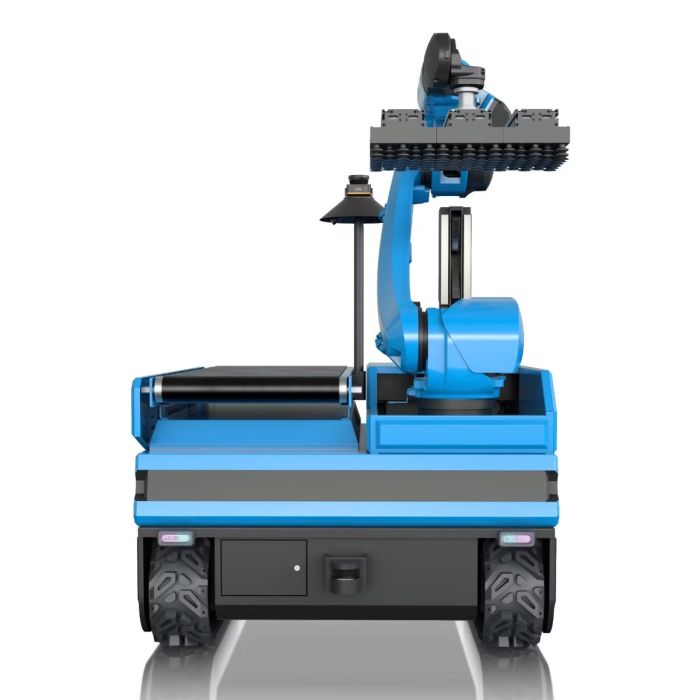
Every logistics chain has a place where the machines stop and people take over. For many operators that place is the open door of a trailer, where cartons still come out one at a time. The Senad iLoabot-M Autonomous Loading and Unloading Robot is built for that threshold. It brings a mobile robot, a vision system and a robotic arm to the spot where automation has traditionally given out.
This product is available through this page, by quotation.
Background
The company and its lineage
The iLoabot-M is made by Senad Robot (Shanghai) Co., Ltd., a robotics manufacturer based in Shanghai, China. Senad sells its machines under the SENAD brand, and the iLoabot name covers a series of embodied intelligent solutions for logistics. Several members of that series are listed in this store, among them the Senad iLoabot Ultra Autonomous Bulk Unloading Robot and the Senad Iloabot-P (iLoabot-P).
The series is still developing. At WRC2026, Senad showed its iLoabot series and released the iLoabot-M 2.0 iteration together with the iLoabot-X 2.0 heavy-load de-palletizing solution. For a buyer, that means the iLoabot-M is not a one-off. It belongs to a product family that the manufacturer keeps improving and presents at major robotics events.
Positioning and key technology
Senad describes the iLoabot-M as designed to address the “last 20 meters” challenge in logistics unloading operations. That phrase explains the whole product. Long-haul transport, sorting hubs and conveyor lines are largely mechanized. The final stretch between the vehicle or container and the rest of the facility is where manual handling has stayed in place.
Two technologies carry the idea. The first is autonomous navigation: the robot drives to the designated position based on a signal, so it does not need a person to steer it into place. The second is 3D vision detection: the robot finds the position of the package and guides its robotic arm to perform the grasping. Together they let one machine move to the work and then pick the goods, which is the sequence a human unloader follows.
Technical Specifications
| Specification | Value |
|---|---|
| Product | Senad iLoabot-M Autonomous Loading and Unloading Robot |
| Manufacturer | Senad Robot (Shanghai) Co., Ltd., Shanghai, China |
| Design purpose | The “last 20 meters” challenge in logistics unloading operations |
| Navigation | Autonomous navigation to the designated position based on a signal |
| Package detection | 3D vision detection of the package position |
| Handling | Robotic arm performs the grasping, guided by the vision system |
| Newer iteration | iLoabot-M 2.0, released at WRC2026 |
Specifications as published by the manufacturer; confirmed against the datasheet at quotation.
The manufacturer has not published the dimensions, the weight, the payload, the battery capacity, the power supply, the operating speed, the throughput per hour, the sensor list, the connectivity, the IP rating, the contents of the box, the software or control system, or the operating temperature; they are confirmed at quotation.
What makes the iLoabot-M different from a conveyor-based unloading setup?
A conveyor extends a fixed line into a vehicle, and a worker still has to put each carton on it. The iLoabot-M works the other way around. It carries its own mobility and its own picking intelligence, and it goes to the position it is told to go to. The robot, not the person, does the reaching and grasping.
The difference matters for how a facility is organized. A system that depends on a person at the face of the load keeps that person in the most physically demanding spot on the dock. A robot that navigates on its own and finds packages with 3D vision removes the need for someone to stand there. The conveyor and the rest of the facility can stay as they are, and the robot covers the gap in front of them.
Senad names the design purpose plainly: the iLoabot-M is meant for the last 20 meters of unloading. That is a narrow and honest claim. It does not promise to automate a whole warehouse. It targets the one stretch that stays manual in many operations.
What does the iLoabot-M 2.0 change?
Senad released the iLoabot-M 2.0 iteration at WRC2026, alongside the iLoabot-X 2.0 heavy-load de-palletizing solution. Beyond that release, no figures or feature differences are given for the 2.0 version, so this page assigns none to it or to the original iLoabot-M.
If you are choosing between the two, ask for both to be covered in your quotation. Request the datasheet for each, and compare payload, throughput and software side by side. Because the two units may differ in ways this page does not describe, the datasheet is the right basis for the decision.
Who is the iLoabot-M for?
The first group is operators of distribution centers and logistics hubs where inbound vehicles are unloaded by hand. If dock labor is hard to find, tiring to sustain or a bottleneck at peak times, a robot designed for the last 20 meters speaks to that problem directly.
The second group is integrators and automation planners. They are building or upgrading a logistics flow and need a unit that fits the vehicle-to-facility handover. Autonomous navigation and vision-guided grasping give them a machine that can be placed into a workflow on a signal rather than on manual steering.
The third group is businesses in the Caribbean and neighboring markets that move goods through ports, free zones and regional distribution points. Containers and trucks arrive in volume there, and the final handover is often manual. These buyers should tell us about their site conditions, power and support needs when they request a quotation.
Not every handling job is the same. If your work is heavy-load de-palletizing, look at the Senad iLoabot-X Heavy-Duty Wheeled Humanoid Logistics Robot. If you need a fixed station for pallets, the Senad 3D Vision Depalletising Workstation is a different kind of solution. You can also browse the wider Logistics Robots category.
What is the iLoabot-M used for?
- Unloading at the dock. The robot covers the final stretch between the vehicle and the facility, which Senad calls the last 20 meters.
- Autonomous positioning. It navigates by itself to the designated position once it receives a signal.
- Package location. 3D vision detection finds where each package sits.
- Vision-guided grasping. The robotic arm performs the grasping, guided by what the vision system sees.
- Reducing manual handling. Work that people do at the face of the load can move to the machine.
- Fitting a wider logistics flow. It can sit alongside other Senad solutions in a broader logistics automation setup.
Pricing and Availability
This page shows no price. Every iLoabot-M is quoted for the buyer's site, volumes and requirements, and a quotation is the way to start. Send us your application, and we will return a written offer for the robot, including whether the original iLoabot-M or the 2.0 iteration suits you. Delivery, customs and support are arranged with the quotation. The Senad iLoabot-M Autonomous Loading and Unloading Robot is available on this page.
Frequently Asked Questions
What problem does the iLoabot-M solve?
It addresses the “last 20 meters” challenge in logistics unloading operations, the final stretch where goods are still often handled manually.
How does the robot find its working position?
It navigates autonomously to the designated position based on a signal. No one needs to steer it to the spot.
How does it pick up packages?
It uses 3D vision detection to locate the package and guides its robotic arm to perform the grasping.
Is there a newer version?
Yes. Senad released the iLoabot-M 2.0 iteration at WRC2026. Ask for it in your quotation if you want to compare it with the original.
Who manufactures the iLoabot-M?
It is made by Senad Robot (Shanghai) Co., Ltd., based in Shanghai, China, and sold under the SENAD brand.
What are the payload, battery life and IP rating?
Those values come with the quotation, so please include your working conditions in your request.
Where can I buy the iLoabot-M and what does it cost?
You can request it through this page. The cost depends on your application and is given in a written quotation, not as a listed price.
Summary
The dock door is where fast freight meets slow hands, and the iLoabot-M is Senad's answer to that mismatch. It drives itself to its position, sees the package in three dimensions and picks it with a robotic arm. Its payload, speed and size come with the quotation. What is clear is the purpose: to take on the last 20 meters of unloading. If that stretch is your bottleneck, this page is the starting point.


