
SIASUN SA10A-10/0.80 (SA10A-10/0.80)
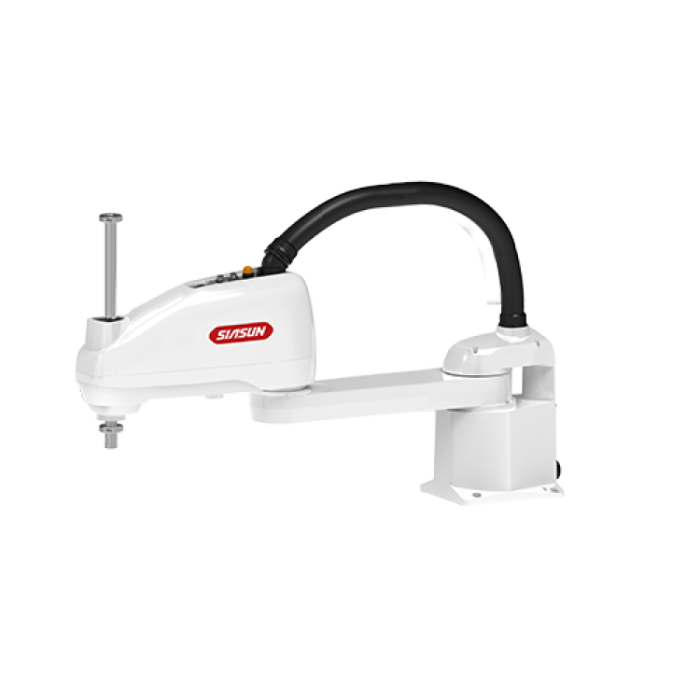
In stock
- BRAND:
- SIASUN
- MODEL:
- SA10A-10/0.80
- PART #:
- SA10A-10/0.80
- ORIGIN:
- China
- Warranty:
- 12 MONTHS
- AVAILABILITY:
- SUBJECT TO AVAILABILITY
- SKU:
- SIASUN-SA10A-10-0-80
SIASUN SA10A-10/0.80 (SA10A-10/0.80)
A SCARA arm earns its place on a line by repeating one motion thousands of times without drifting, and by doing it in a footprint the cell designer can afford. That is the job the SIASUN SA10A-10/0.80 (SA10A-10/0.80) is built for: a 10 kg (22 lbs) payload, an 800mm reach and a compact, lower-height body that leaves room around it for tooling, feeders and people.
The SIASUN SA10A-10/0.80 is available through this page, by quotation.
Background
Siasun and the SA10A generation
Siasun is a Chinese industrial robot maker whose catalog covers several robot families, and SCARA arms form one of its product lines. The SA10A series is described by the manufacturer as a brand-new generation of SCARA robots. Two sibling versions share the series: the SIASUN SA10A-10/0.60 and the SIASUN SA10A-10/0.70.
For buyers in the Caribbean, this lineage matters in a practical way. Electronics assembly, battery handling and similar light-industrial work is increasingly planned around compact, repeatable robots rather than large articulated arms. A SCARA family with several reach options lets a plant standardize on one design language, one control platform and one training path, while choosing the arm length that suits each station.
Dual-support structure and modular design
The key technology of the SA10A series is its dual-support structure. The manufacturer states that it delivers larger load capacity, high rigidity and low vibration. Rigidity is the quiet virtue of a SCARA arm: when the arm stops, a stiff structure settles quickly, and a settled arm can place a part sooner and with more confidence.
The second pillar is the modular design. The manufacturer says it meets the needs of more automation scenarios while reducing maintenance costs. In practice a modular robot is easier to service by section, and easier to adapt as a line changes from one product to the next. The main unit also carries abundant user cables, so grippers, sensors and other end-of-arm devices can be wired without improvised cable runs. It is paired with a new generation of S series control cabinet, and supports multiple programming and teaching methods.
Technical Specifications
| Specification | SA10A-10/0.80 |
|---|---|
| Payload | 10 kg (22 lbs) |
| Reach | 800mm |
| Repeatability | J1+J2/±0.02mm, J3/±0.01mm, J4/±0.01° |
| Protection | IP20 |
Specifications as published by the manufacturer; confirmed against the datasheet at quotation.
The manufacturer has not published the weight, the rated power supply, the cycle time, the joint speed and range, the communication interfaces, the mounting method, the controller model or the contents of the box; they are confirmed at quotation.
What makes the SA10A-10/0.80 different from the shorter versions?
The difference that the manufacturer publishes is reach. The SA10A-10/0.60 reaches 600mm, while the SA10A-10/0.80 reaches 800mm. The choice is therefore about how much working area one arm can serve. We do not state a reach figure for the SA10A-10/0.70 here, and its details are confirmed at quotation.
A longer reach changes how a cell can be laid out. One arm can serve more positions around it: a feeder on one side, a fixture in the middle, an output tray on the other. That can mean fewer robots for the same task, or more freedom to place peripherals where operators can reach them. The trade-off is familiar to anyone who has planned a SCARA station. The longer the arm, the more the quality of the structure matters, because flex and vibration at the tip grow with length. This is exactly why the dual-support structure, with its stated high rigidity and low vibration, is relevant to the 800mm version.
The 0.80 arm also keeps the series traits that apply to every version: the lighter main body, the lower overall height and the simple deployment the manufacturer describes. Lower height reduces the space constraints around the arm, which helps when the robot sits under a guard, inside an enclosure or beside other equipment.
How precise is the SA10A-10/0.80?
The published repeatability is split by axis. For J1+J2 it is ±0.02mm, for J3 it is ±0.01mm, and for J4 it is ±0.01°. Repeatability describes how closely the arm returns to the same taught point, which is what matters when a robot places the same component into the same socket all shift. It is not the same as absolute accuracy, and a program taught to the real fixture is what puts that repeatability to use.
The protection rating is IP20. In general terms, that is a basic class suited to clean, dry production areas such as electronics assembly rooms, rather than washdown or dusty conditions. If your cell is exposed to liquids or heavy particulates, plan enclosure or guarding around the arm and discuss the environment when you request a quotation.
Who is the SIASUN SA10A-10/0.80 for?
The first segment is the electronics manufacturer. The manufacturer lists 3C, lithium battery, photovoltaic and automotive electronics as primary industries, and these are all sectors where small parts, repeatable placement and compact stations are routine. A contract assembler in a free-zone facility, for example, can use the arm for pick-and-place, insertion or transfer between stations.
The second segment is the system integrator. Integrators value a robot with abundant user cables, modular construction and several programming and teaching methods, because each reduces custom work on every project. A family with several reach options also lets them quote a range of cells from one platform.
The third segment is the plant moving from manual to automated assembly for the first time. A lighter, lower, simpler-to-deploy arm is a gentler first step than a large industrial robot. If your stations are small and the parts sit close together, the shorter SA10A-10/0.60 may be the better fit, and the SA10A-10/0.70 is the other version in the series. If you are weighing the robot class itself, our SCARA category and the wider Industrial Robots category show the alternatives.
What is the SIASUN SA10A-10/0.80 used for?
- 3C assembly: handling and placing small components in consumer electronics, computer and communication products.
- Lithium battery lines: moving and positioning cells and parts between process stations.
- Photovoltaic production: transferring and aligning components in solar manufacturing steps.
- Automotive electronics: repeatable assembly and insertion of modules and connectors.
- Machine tending and transfer: loading and unloading parts between fixtures, feeders and trays within reach of the arm.
- Integrated cells: a robot for system builders who need a modular arm with ample user cabling and flexible teaching.
Pricing and Availability
We do not print prices on this page. Each configuration is quoted on request, so that the version, the controller and your application are specified correctly from the start. Delivery, customs and support are arranged together with the quotation. The SIASUN SA10A-10/0.80 (SA10A-10/0.80) is available on this page.
Frequently Asked Questions
What payload and reach does the SA10A-10/0.80 have?
The payload is 10 kg (22 lbs) and the reach is 800mm.
What is the repeatability of the SA10A-10/0.80?
It is J1+J2/±0.02mm, J3/±0.01mm and J4/±0.01°.
What is the protection rating?
The protection rating is IP20, which suits clean, dry production areas. Enclosures or guarding can be planned around it for harsher conditions.
Which industries is the robot made for?
The manufacturer names 3C, lithium battery, photovoltaic, automotive electronics and related sectors as its primary application industries.
How does it differ from the SA10A-10/0.60?
The published difference is reach: 800mm for this version against 600mm for the SA10A-10/0.60. Both are in the same series and share its structure and design.
Can I program it in different ways?
Yes. The manufacturer states that the robot supports multiple programming and teaching methods and is paired with a new generation of S series control cabinet.
Where can I buy the SIASUN SA10A-10/0.80 and what does it cost?
You can request it through this page, and the cost is given in a quotation prepared for your configuration. We do not publish a price here.
Summary
The SIASUN SA10A-10/0.80 answers a simple question for any cell designer: how much work can one compact arm do without giving up repeatability? With an 800mm reach, a 10 kg (22 lbs) payload, a dual-support structure and a modular body, it covers a wide working area while staying low and light. Compare it with its shorter siblings, check your environment against the IP20 rating, and send us your application details. For a quotation on the SA10A-10/0.80, this page is the starting point.


