
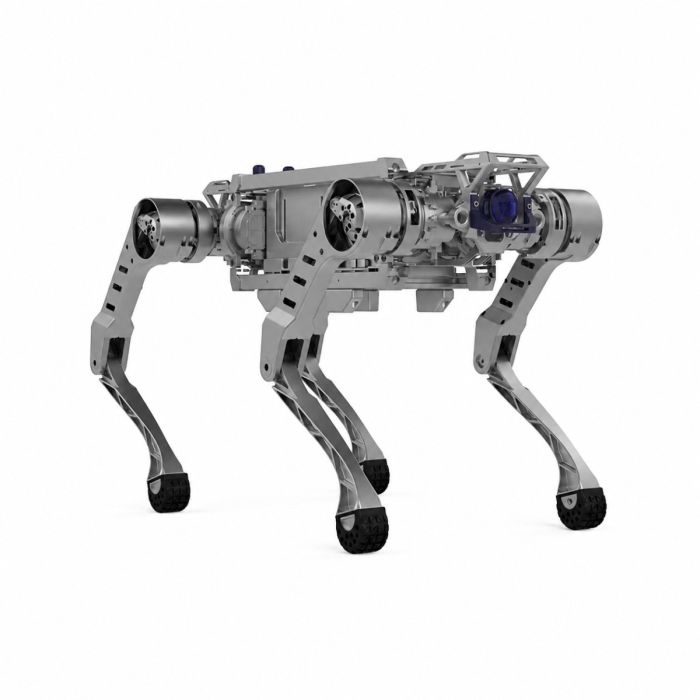
MirrorMe Black Panther X Open Industrial-Grade Quadruped Robot
In stock
- BRAND:
- MIRRORME
- MODEL:
- Black Panther X
- ORIGIN:
- China
- Warranty:
- 12 MONTHS
- AVAILABILITY:
- SUBJECT TO AVAILABILITY
- SKU:
- MirrorMe-Black-Panther-X
MirrorMe Black Panther X Open Industrial-Grade Quadruped Robot
Most quadruped robots arrive as sealed boxes: you may watch them walk, but you may not change how they think. The MirrorMe Black Panther X Open Industrial-Grade Quadruped Robot takes the opposite view. It is built to be opened, printed, reprogrammed and made your own, while still carrying the engineering of an industrial machine.
The product is available through this page, by quotation.
Background
Mirror Me Technology and its legged robots
Mirror Me Technology builds industrial-grade legged robots that prioritize precision, modularity and real-world capability. That sentence describes a whole philosophy: a legged robot is only useful if it can leave the demonstration floor, so the company designs for repeatable motion, parts that can be exchanged or extended, and behavior in the field rather than only in a lab.
The Black Panther X sits inside that lineage. Other robots from the same maker can be found on this site, among them the MirrorMe Black Panther II Quadruped Robot and the MirrorMe BPX Pro Quadruped Robot. Buyers who want to compare the wider range can start from the Standard Quadrupeds category.
An open platform by design
What sets the Black Panther X apart is openness. The manufacturer gives full access to interfaces, shells and code. The shells are 3D-printable, so a team that needs a different cover, a mounting point or a custom look can print it instead of waiting for a part. The code is open to the people who use the robot, which turns the machine into a platform for their own work rather than a finished appliance.
Twelve joints drive the legs, and the manufacturer lists a peak joint torque of 33 N·m and a peak joint speed of 22 rad/s. Those figures matter because they set the limits within which your own gaits and routines have to work. The robot also supports FPV cameras, lights and plug-in modules, so the body can be fitted for the task at hand.
Technical Specifications
| Specification | Value |
|---|---|
| Top speed | 4 m/s |
| Payload capacity | 8 kg |
| Stair height | 18 cm |
| Slope climb ability | 30° |
| Dimensions | 646 × 368 × 475 mm |
| Weight | 7 kg |
| Number of joints | 12 |
| Peak joint torque | 33 N·m |
| Peak joint speed | 22 rad/s |
| Maneuvers | 720° side flip |
| Battery life | Up to 1.5 hours of operation |
| Operating voltage | 26 ~ 33.6 V |
| Charging method | Standard Charger (33.6V / 6A) |
| Operating temperature | 0 ~ 40°C |
| Durability rating | IP43 (spray water + small particle protection) |
| Accessories | Supports FPV cameras, lights, and plug-in modules |
Specifications as published by the manufacturer; confirmed against the datasheet at quotation.
The manufacturer has not published the onboard computer, the sensors included, the wireless connectivity, the battery capacity, the box contents, the assembly time or the software SDK languages; they are confirmed at quotation.
What makes the Black Panther X different from a closed quadruped?
A closed robot gives you a fixed set of behaviors and a fixed way to reach them. The Black Panther X gives you the interfaces, the shells and the code. If you want a custom gait, a dance routine or an experimental controller, the manufacturer names exactly that kind of motion control development as part of the product's purpose. You are not asking permission to change the robot; you are expected to change it.
The physical side follows the same idea. Printable shells mean the outer body can be adapted, and support for FPV cameras, lights and plug-in modules means the robot can be fitted to a task. An 8 kg payload and a 4 m/s top speed give that work a practical frame, and the 7 kg body keeps the machine manageable for one person to carry and handle.
There is also a software helper. OpenClaw acts as a teammate to help you control, command and inspect the BPX and external module devices. For a team with several modules attached, having an assistant that can inspect and command those devices is a real convenience during setup and testing.
How does it handle real terrain?
Terrain is where a legged robot earns its place over a wheeled one. The Black Panther X climbs stairs with a height of 18 cm and handles slopes of 30°. It is rated IP43, which means protection against spray water and small particles, and it is listed for operation from 0 to 40°C. Together these figures describe a robot meant for ordinary outdoor and indoor sites, not only for a clean floor.
Agility is part of the picture too. The manufacturer lists a 720° side flip, which shows how much the legs and joints can do when the control code asks for it. Runtime is up to 1.5 hours, charged with a standard 33.6V / 6A charger, and the operating voltage is 26 ~ 33.6 V. Plan sessions around that runtime and you can build a dependable working routine.
Who is the Black Panther X for?
Universities and research labs are the obvious group. They need a platform whose control code they can change, and the open interfaces make that possible. Students can build and test gaits on real hardware rather than in simulation alone. Labs that want to see more research-oriented machines can also browse the Research Robots category.
Developers and integrators form the second group. A company building an inspection, filming or demonstration service can add FPV cameras, lights or plug-in modules and write its own behavior on top of the robot. Educators and makers form the third: the printable shells and the open code invite experimenting, and a quadruped that can be rebuilt in part is a strong teaching tool.
Buyers who want to compare alternatives within the maker's range can look at the MirrorMe BPX Pro Quadruped Robot or the MirrorMe Apollo Quadruped Robot, and ask us how they differ when requesting a quotation.
What is the Black Panther X used for?
- Gait development. Write and test custom gaits on the robot's 12 joints.
- Choreography. Program dance routines and show movements for demonstrations.
- Control research. Run experimental control methods on open interfaces and code.
- Remote viewing. Add an FPV camera and lights to look into places people prefer not to enter.
- Module testing. Attach plug-in modules and use OpenClaw to command and inspect them.
- Teaching. Give students a real legged robot whose shells can be printed and whose code can be read.
Pricing and Availability
This product is sold by quotation, and no price is shown on the page. Send us your request describing the intended use and any accessories you have in mind. Delivery, customs and support are arranged together with the quotation. The MirrorMe Black Panther X Open Industrial-Grade Quadruped Robot is available on this page.
Frequently Asked Questions
How fast and how strong is the Black Panther X?
Its top speed is 4 m/s and its payload capacity is 8 kg. The peak joint torque is 33 N·m.
How long does the battery last?
The manufacturer lists up to 1.5 hours of operation. It is charged with a standard charger rated 33.6V / 6A.
Is the robot protected against water and dust?
It carries an IP43 rating, meaning spray water and small particle protection. It is listed for operation between 0 and 40°C.
Can I change the robot's software and body?
Yes. The manufacturer gives full access to interfaces, shells and code, and the shells are 3D-printable.
What accessories does it support?
It supports FPV cameras, lights and plug-in modules. OpenClaw helps you control, command and inspect the BPX and external module devices.
What obstacles can it climb?
It handles stairs 18 cm high and slopes of 30°. It can also perform a 720° side flip.
Where can I buy the Black Panther X and what does it cost?
You can buy it through this page by requesting a quotation. The cost is confirmed in the quotation, together with delivery, customs and support arrangements.
Summary
Many robots are admired and then left untouched. The Black Panther X is meant to be used, changed and rebuilt: twelve joints, printable shells, open code and room for cameras, lights and modules, in a body of 646 × 368 × 475 mm that weighs 7 kg. It climbs, carries, runs and flips, and it leaves the choice of behavior to you. For teams that want a legged robot they can truly own, this page is the starting point.


