
Galaxea R1 Wheeled Humanoid Robot
In stock
- BRAND:
- GALAXEA
- PART #:
- R1
- ORIGIN:
- China
- AVAILABILITY:
- SUBJECT TO AVAILABILITY
- SKU:
- Galaxea-R1
Galaxea R1 Wheeled Humanoid Robot
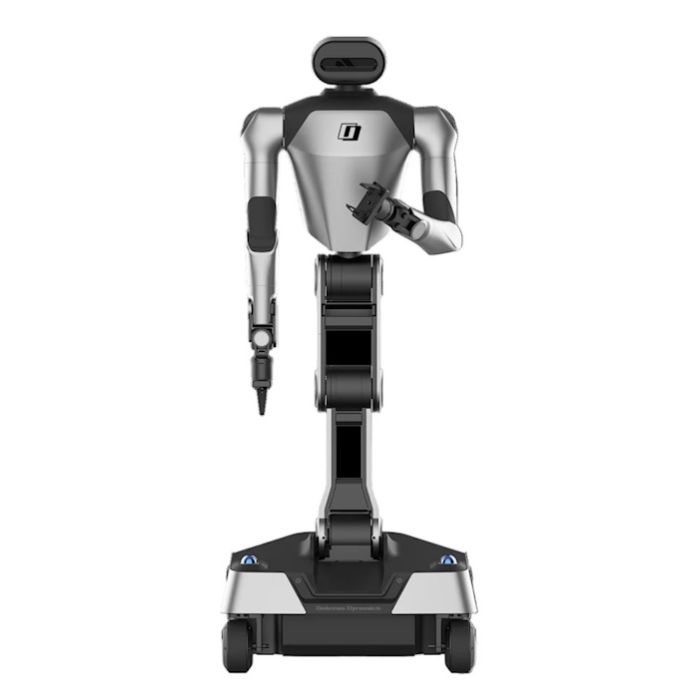
Most humanoid robots ask you to trust two legs; the Galaxea R1 Wheeled Humanoid Robot asks you to trust three steering wheels, and in exchange it gives you a working body that stays upright, keeps moving and reaches from the floor to head height. For teams that care about getting objects moved and handled rather than about walking on stage, that trade is a sensible one.
This product is available through this page, by quotation.
Background
Galaxea AI and its lineage
The R1 comes from Galaxea AI, a robotics company based in Suzhou, China. The company was founded in September 2023 by a team that came from Tsinghua and Stanford. That is a young company, and its product line reflects a focus on embodied intelligence: robots that act in the physical world, not only in simulation. Galaxea builds its own arms and grippers, and those same components appear in the R1. If you want to look at the arm on its own, the Galaxea A1 Robotic Arm is listed in our catalog.
The R1 is also part of a small family. Galaxea names an R1 Pro and an R1 Lite alongside the R1, so a buyer can compare versions before choosing. We keep each version's details with its own page, and nothing here should be read across from one to another.
Positioning and key technology
The R1 is described by its maker as a full-size dual-arm humanoid robot. It combines an upper-body humanoid layout with a mobile base. The result is a machine that handles objects with two hands at human scale and moves around a room without the balance problems of a legged robot. It belongs in our Wheeled Humanoids category, which sits within the wider Humanoids range.
The build is straightforward to describe. Two 6-DoF Galaxea A1 robot arms, each described as lightweight and highly dynamic, carry two Galaxea G1 grippers. A 4-DoF torso lets the upper body change height and posture. A three-wheel steering vector chassis carries everything. In total the robot has 24 degrees of freedom: 6 for the chassis, 4 for the torso and 14 for the dual arms with grippers.
Technical Specifications
| Specification | Value |
|---|---|
| Product type | Full-size dual-arm humanoid robot |
| Arms | Two 6-DoF Galaxea A1 robot arms |
| Grippers | Two Galaxea G1 grippers |
| Torso | 4-DoF |
| Chassis | Three-wheel steering vector chassis |
| Degrees of freedom | 24 in total: 6 chassis, 4 torso, 14 dual arms with grippers |
| Operating range (height) | 0 ~ 200 cm |
| Operating radius | 70 cm per arm; 86 cm per arm with gripper |
| Max. payload | 5 [email protected] m |
| Gripper stroke | 0 ~ 100 mm |
| Cameras | Head: 1, Wrist: 2, Chassis: 5 |
| LiDAR | 1 * 360° (2 for Optional) |
| Height | 1700 mm when standing |
| Width | 675 mm |
| Weight | 96 kg with battery |
| Communication interface | Ethernet, USB |
Specifications as published by the manufacturer; confirmed against the datasheet at quotation.
The manufacturer has not published the battery runtime, the charging time, the IP rating, the operating temperature range, the maximum travel speed, the gripper payload or the software and OS version; they are confirmed at quotation.
What makes the Galaxea R1 different from a legged humanoid?
The first difference is how the robot stands. A legged humanoid spends a large share of its effort on balance. The R1 rolls on a three-wheel steering vector chassis, so its body is not working to stay upright and its effort goes to the task. For work such as carrying, sorting and handing over objects at a bench, that is a practical advantage, and it is why many research teams pick a wheeled body for manipulation work.
The second difference is reach. The operating range runs from 0 to 200 cm in height, which means the robot can work at floor level and also at the height of a high shelf. Each arm has an operating radius of 70 cm, or 86 cm with the gripper fitted. The 4-DoF torso is what allows the upper body to adjust, so the arms are not limited to one working height.
The third difference is perception. The R1 carries one camera in the head, one at each wrist and five on the chassis, plus a 360° LiDAR, with a second LiDAR available as an option. Wrist cameras are valuable when you are teaching a robot to grasp, because they show what the hand sees at the moment of contact. The chassis cameras and LiDAR support moving through a space.
How much can the Galaxea R1 lift and how large is it?
The maximum payload is stated as 5 [email protected] m, so the figure is tied to a distance of 0.5 m. The gripper stroke is 0 ~ 100 mm, which sets the width of objects the hands can open around. The robot stands 1700 mm tall, is 675 mm wide and weighs 96 kg with its battery. At that width it is built for rooms with ordinary doorways and aisles, but you should measure your own site before ordering. The communication interfaces are Ethernet and USB.
Who is the Galaxea R1 for?
University and institute laboratories are the most natural buyers. A two-armed robot with a movable torso, wrist cameras and LiDAR gives a research group a complete platform for studying manipulation and learning from demonstration, without building the hardware first.
Companies running pilot projects in logistics, light assembly or service settings will also find it useful. A mobile bimanual robot lets you test whether a task can be automated before you commit to a fixed installation.
Training centers and technical institutes in the Caribbean can use it to show students what a modern humanoid platform looks like, from the arms and grippers to the sensors and the chassis.
If you are weighing options within the family, look at the Galaxea R1 Pro if you want to see what the higher version offers, or the Galaxea R1 Lite if a lighter configuration may suit your project better. Their details are on their own pages.
What is the Galaxea R1 used for?
- Mobile pick-and-place. The robot moves to the object, then picks it up with two hands at heights from the floor to 200 cm.
- Bimanual manipulation research. Two 6-DoF arms with grippers allow tasks that need both hands, such as holding a container while opening it.
- Teaching by demonstration. Wrist cameras and a head camera record what the robot sees while operators show it a task.
- Indoor navigation studies. The 360° LiDAR and chassis cameras support work on mapping and moving through rooms.
- Teaching and demonstration. Schools and training centers can show a full-size humanoid platform at work.
- Pilot automation projects. Businesses can test handling tasks at shelves, benches and floor level before committing to a larger deployment.
Pricing and Availability
We do not publish prices on this page. Please request a quotation, and we will set out the configuration you need, including the optional second LiDAR if you want it. Delivery, customs and support are arranged with the quotation. The Galaxea R1 Wheeled Humanoid Robot is available on this page.
Frequently Asked Questions
How many degrees of freedom does the Galaxea R1 have?
It has 24 in total. Six belong to the chassis, four to the torso and 14 to the dual arms with grippers.
How high and how far can the robot reach?
The operating range in height is 0 ~ 200 cm. The operating radius is 70 cm per arm, or 86 cm per arm with the gripper.
What is the maximum payload?
The maximum payload is 5 [email protected] m.
What sensors does the robot carry?
It has one head camera, two wrist cameras and five chassis cameras. It also has one 360° LiDAR, with a second available as an option.
How big and heavy is it?
It stands 1700 mm tall, is 675 mm wide and weighs 96 kg with the battery.
What communication interfaces does it offer?
The robot connects through Ethernet and USB.
Where can I buy the Galaxea R1 Wheeled Humanoid Robot and what does it cost?
You can buy it through this page by requesting a quotation. We do not list a price here; the quotation sets out the cost for your configuration and destination.
Summary
The Galaxea R1 answers a simple question: what if a humanoid robot did not have to balance on legs? With a three-wheel steering vector chassis, a 4-DoF torso, two 6-DoF arms with grippers and a reach from the floor to 200 cm, it is built to work rather than to walk. Add the wrist, head and chassis cameras and the LiDAR, and it is a capable platform for research, training and pilot projects. If it fits your plans, this page is the starting point.


