
Engineered Arts RoboThespian Humanoid Robot
In stock
- BRAND:
- ENGINEERED ARTS
- MODEL:
- RoboThespian
- ORIGIN:
- United Kingdom
- AVAILABILITY:
- SUBJECT TO AVAILABILITY
- SKU:
- Engineered-Arts-RoboThespian
Engineered Arts RoboThespian Humanoid Robot
Most robots are asked to carry, weld or walk. The Engineered Arts RoboThespian Humanoid Robot is asked for something harder: to make a room full of strangers look up, smile and stay for the whole show. It is a life-size, interactive, fully programmable humanoid, and everything about it is tuned for presence rather than payload.
The product is available through this page, by quotation.
Background
The company and its lineage
Engineered Arts was founded by Will Jackson in 2004. From the start the company has built machines whose job is to communicate with people, not to replace them on a factory floor. RoboThespian is the best-known result of that approach, and the model described here is the RT4. It is presented by the manufacturer as a robot exhibit suitable for public display, demonstration and academic research.
That description tells you a good deal about who the robot is for. A museum wants a guide that visitors will gather around. A university wants a platform on which students can test ideas about gesture, speech and human-robot interaction. A visitor attraction wants a host that can repeat a performance all day. All three needs are met by the same machine, and the rest of this article explains how. If you are comparing it with other robots in the same family, our Humanoids category and our Bipedal Humanoids category show the wider field.
Positioning and key technology
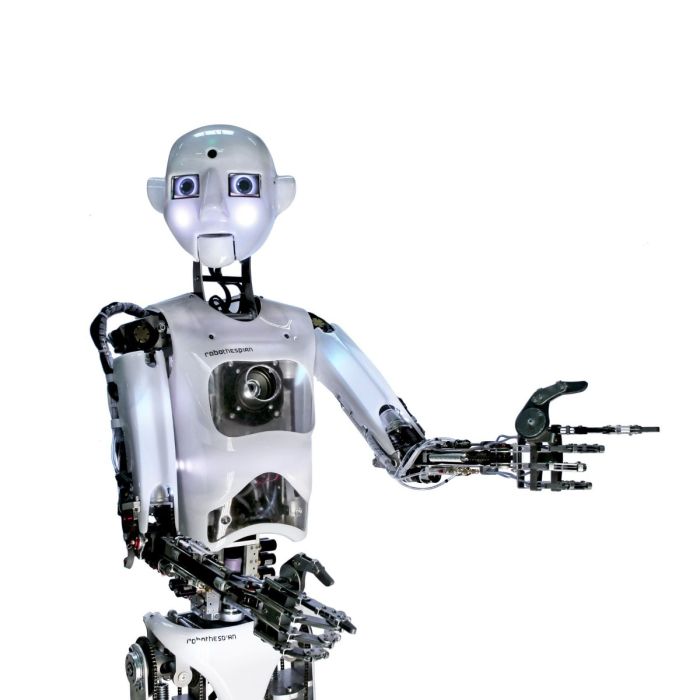
RoboThespian has an actuated upper body, arms, fingers, head and jaw, all designed to mimic human expression and gestures. Its body offers over 30 axes of movement. It stands 1.75 metres (5 ft 9 in) tall and weighs 33 kilograms (73 lb). It has an aluminium chassis and a body shell made of polyethylene terephthalate plastic, so the frame is rigid and the outer skin is light.
On the software side, Engineered Arts chose not to use an off-the-shelf operating system such as ROS. The company runs its own operating system, called Tritium. For a buyer this means the robot, its performance content and its updates come from one maker, which keeps support simple.
One more feature sets the robot apart from a machine on wheels or a mobile base: it uses compressed air as part of its power supply. That is a practical point to plan for, and it is covered in the specification table below.
Technical Specifications
| Specification | Value |
|---|---|
| Model | RT4 |
| Height | 1.75 metres (5 ft 9 in) |
| Weight | 33 kilograms (73 lb) |
| Chassis | Aluminium |
| Body shell | Polyethylene terephthalate plastic |
| Axes of movement | Over 30 |
| Operating system | Tritium (Engineered Arts) |
| Mains power | Standard domestic mains power, 100v - 250v AC |
| Compressed air supply | Un-oiled, 6bar (87psi), filtered to 10µm |
| Peak air consumption | 30L/min (7.9 US gpm) at 6bar (87psi) maximum; average consumption is much less |
| Airline connection | 8mm (5/16in) outside diameter Push-In-Fitting |
| Environment | Indoor use only |
| Recommended room temperature | 10°C - 30°C |
| Recommended relative humidity | 45% - 60% |
| Network | Wired internet connection with good bandwidth |
Specifications as published by the manufacturer; confirmed against the datasheet at quotation.
The manufacturer has not published the dimensions of the base and console, the payload, the battery or runtime, the power consumption, the contents of the box or the IP rating; they are confirmed at quotation.
What makes RoboThespian different from a general-purpose humanoid?
A general-purpose humanoid is usually judged by what it can lift, how it balances and how far it can travel. RoboThespian is judged by how it behaves in front of an audience. Its actuated head, jaw, arms and fingers are designed to mimic human expression and gestures, and the body offers over 30 axes of movement to do it with. The aim is a convincing performance, not a heavy workload.
That choice has consequences you can see in the specification. The robot is for indoor use only, within a recommended room temperature of 10°C - 30°C and relative humidity of 45% - 60%. It needs an un-oiled compressed air supply at 6bar (87psi), filtered to 10µm, connected through an 8mm (5/16in) outside diameter Push-In-Fitting. Peak air consumption is 30L/min (7.9 US gpm) at 6bar (87psi) maximum, and the manufacturer notes that average consumption is much less. It also needs a wired internet connection with good bandwidth.
The network connection is more than a convenience. It is required for TinMan Telepresence, for remote administration and support, and for the application of updates and new software and content features. In other words, the robot is designed to be looked after and refreshed over its lifetime, so that an exhibit installed this year can carry new content next year.
For a buyer, the trade is clear. You give up the freedom to roam outdoors or carry loads. In return you get a figure that stands at human height and uses its whole upper body to speak, point and react.
Which head and hand options can RoboThespian be ordered with?
The fact sheet names several versions of the robot. Each differs in the head, the hands or the legs, and each figure stays with its own version.
RoboThespian Hard Face. In this head, 2 LCD screens bring the robot's eyes to life. RGB LEDs capable of any colour add colour to the cheeks, and a high speed servo synchronises mouth movements with speech. The fingers can be independently opened and closed, which is ideal for forming most gestures, pointing, counting on fingers and similar actions.
RoboThespian Projected Face. A different head design contains a pico projector that projects the entire face of the robot. This suits a project where the character of the face matters as much as the body.
RoboThespian Gripping Hands. For projects that need the robot to grasp objects with the same fluid motion as its gestures, Engineered Arts offers hands with adaptive grip.
RoboThespian Active Legs. This is a customer specific variant with a further axis of movement, enabling RoboThespian to bend at the knees.
Which combination suits you depends on the story you want the robot to tell. Please tell us the use case when you request a quotation, and we will confirm what each configuration includes.
Who is RoboThespian for?
Museums and science centers are the obvious first group. They want an exhibit that draws people in, explains a topic and can be reprogrammed as exhibitions change. The robot's life-size form and expressive face make it a natural host.
Universities and research labs form the second group. Because the robot is fully programmable, it gives students and researchers a real humanoid for work on gesture, speech and interaction. The remote support and update path through the network also helps when a lab has limited technical staff.
Visitor attractions, showrooms and event organizers make up the third. For them the robot is a presenter that never tires and delivers the same message every time. If your project involves handing over or pointing out objects, ask about the Gripping Hands option. If you want a head that can take on many faces, ask about the Projected Face. If a stage routine needs a bend at the knees, the Active Legs variant was made for that.
It is not the right choice for outdoor use or for heavy lifting, and buyers with those needs should look at other robots in our Humanoids category.
What is RoboThespian used for?
- Museum guide. It stands among the displays and presents the story of the exhibition to visitors.
- Science center demonstrator. It shows the public what a humanoid robot can do, using gesture and speech.
- Academic research platform. Researchers program it to study expression, gesture and human-robot interaction.
- Public display and showroom host. It greets guests and holds their attention at events and attractions.
- Remote presence. With a network connection, it supports TinMan Telepresence.
- Teaching tool. Students learn programming and robotics on a full-size humanoid.
Pricing and Availability
We do not print prices on this page. Quotation is the way to buy: tell us which version and options you need, and where the robot will be installed. Delivery, customs and support are arranged with the quotation, so you receive one clear plan. The Engineered Arts RoboThespian Humanoid Robot is available on this page.
Frequently Asked Questions
Can RoboThespian be used outdoors?
No. The manufacturer states that it is suitable for indoor use only, with a recommended room temperature of 10°C - 30°C and relative humidity of 45% - 60%.
What power and air supply does it need?
It runs from standard domestic mains power in the range 100v - 250v AC. It also needs un-oiled compressed air at 6bar (87psi), filtered to 10µm, connected with an 8mm (5/16in) outside diameter Push-In-Fitting.
How much compressed air does it use?
Peak air consumption is 30L/min (7.9 US gpm) at 6bar (87psi) maximum. On average, consumption is much less.
Does it need an internet connection?
Yes, a wired internet connection with good bandwidth. It is required for TinMan Telepresence, remote administration and support, and for updates and new software and content features.
What operating system does it use?
Engineered Arts uses its own operating system, called Tritium, rather than an off-the-shelf system such as ROS.
Can it grasp objects or bend at the knees?
Both are offered as versions. RoboThespian Gripping Hands have adaptive grip for grasping objects, and RoboThespian Active Legs add an axis of movement so the robot can bend at the knees.
Where can I buy RoboThespian and what does it cost?
You can buy it through this page, by quotation. We do not publish a price; send us your version and project details and we will prepare the quotation.
Summary
RoboThespian is built to win an audience, not to carry a load. At 1.75 metres (5 ft 9 in) tall, with an actuated upper body, over 30 axes of movement and a choice of Hard Face or Projected Face heads, it gives museums, universities and attractions a presenter people remember. Gripping Hands and Active Legs extend what it can do, and Tritium software with network support keeps it current. If a performer that holds a crowd is what your project needs, this page is the starting point.


