
DaxAI Qiji X1 Cyber Horse Quadruped Robot
In stock
- BRAND:
- DAXAI
- PART #:
- Qiji X1
- ORIGIN:
- China
- Warranty:
- 12 MONTHS
- AVAILABILITY:
- SUBJECT TO AVAILABILITY
- SKU:
- DaxAI-Qiji-X1
DaxAI Qiji X1 Cyber Horse Quadruped Robot
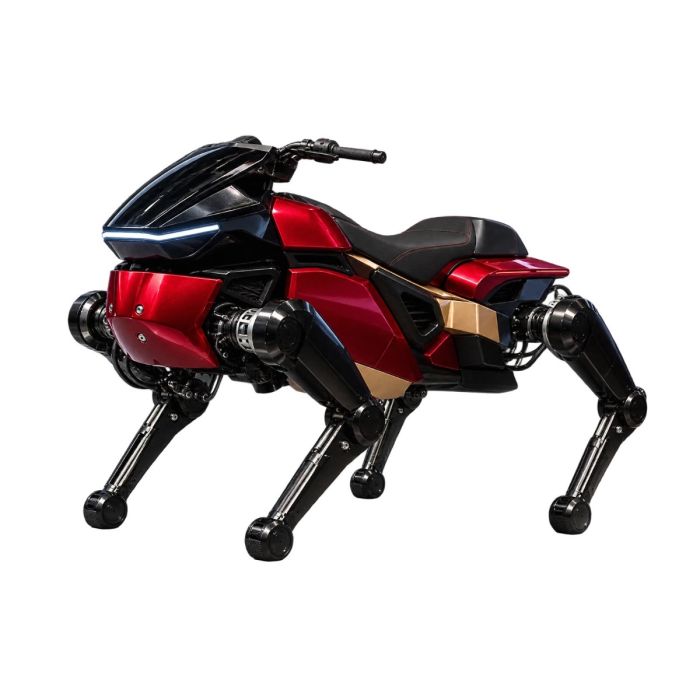
Most robots ask you to watch them. The DaxAI Qiji X1 Cyber Horse Quadruped Robot asks you to climb on. It has a saddle, handlebars at the front and four bionic legs, and it was built so that artificial intelligence stops being lines of code on a screen and becomes something you can ride across rough ground.
The product is available through this page, by quotation.
Background
DaxAI and the road to the Cyber Horse
DaxAI Robotics emerged in Beijing around 2025. It was founded by Wang Kun, who had previously worked on robotics and autonomous driving technology. That history shows in the product: a machine that has to sense its surroundings, decide how to place each limb and carry a person is as much a vehicle problem as a robotics problem.
The Qiji X1 drew crowds of visitors at the 2026 WAIC in Shanghai, where it was presented as the All-Terrain Intelligent Mount, a quadruped Cyber Horse. The company shows two robotic horse models: the Qiji X1, a point-foot, pure quadruped, and the Qiji XS, a wheel-foot model. This page covers the Qiji X1.
Positioning and key technology
The Qiji X1 is built for premium off-road leisure. Its structure is a pure quadruped bionic design without wheels, so every meter of travel is made on legs. The intelligence behind the gait is the DaxBrain-WM (Dualis) world model, which runs as on-device local inference. Combined with adaptive bionic gait and all-terrain dynamic self-balancing algorithms, it lets the robot adjust the landing angle and depth of its limbs for steep slopes, gravel roads and muddy depressions.
Power comes from a 165V high-voltage power battery pack. High-voltage fast charging and riding data monitoring come standard, and OTA upgrades allow cloud-based updates to the gait library and optimization of riding plans, so the machine can keep learning after delivery.
Technical Specifications
| Specification | Qiji X1 (point-foot) | Qiji XS (wheel-foot) |
|---|---|---|
| Structure | Pure quadruped bionic structure, no wheels | Integrated wheel-foot composite structure |
| Total weight | 300 kg | 320 kg |
| Top speed | 7 to 10 km/h | 40 km/h |
| Maximum joint torque | 1,400 Nm | — |
| Dynamic load capacity | 300 kg | — |
| Battery | 165V high-voltage power battery pack | — |
| Range | 40 kilometers | 60 kilometers |
| Continuous operating time | 8 to 10 hours | — |
| On-device AI | DaxBrain-WM (Dualis) world model, local inference | — |
Specifications as published by the manufacturer; confirmed against the datasheet at quotation.
The manufacturer has not published the dimensions, the IP rating, the charging time, the battery capacity in Wh, the maximum slope angle, the sensors, the contents of the box, the rider weight limit or the operating temperature range; they are confirmed at quotation.
What makes the Qiji X1 different from the Qiji XS?
The difference starts at the ground. The Qiji X1 is a point-foot machine: four legs, no wheels, and a top speed of 7 to 10 km/h. The Qiji XS combines wheels and feet in one structure and reaches a top speed of 40 km/h with a range of 60 kilometers, against 40 kilometers for the X1. On paper the XS is the faster and longer-reaching of the two.
The X1 is the answer when the point is the walking itself. Because it has no wheels, it places each foot deliberately and adjusts the landing angle and depth of its limbs to the surface under it. That is the behavior built for steep slopes, gravel and mud. The X1 also offers a maximum joint torque of 1,400 Nm and a dynamic load capacity of 300 kg.
Both models share the same ecosystem: high-voltage fast charging, riding data monitoring and OTA upgrades come standard on both. The choice therefore comes down to whether you value the legged gait or the higher road speed.
How does the Qiji X1 move over difficult ground?
The robot coordinates its steps smoothly. It can walk straight, sidestep, back up and even turn in place, movements that a wheeled vehicle of similar size would find difficult in a tight space. The rider sits on a saddle and steers with handlebars mounted at the front.
Behind those movements is the DaxBrain-WM world model, running locally on the machine rather than depending on a remote connection. The adaptive bionic gait and the dynamic self-balancing algorithms work together so that the robot can autonomously navigate steep slopes, gravel and mud. Beyond walking, the platform supports obstacle avoidance on multiple surfaces, body-form switching and voice interaction.
Who is the DaxAI Qiji X1 for?
The first group is premium off-road leisure operators: resorts, adventure parks and experience venues that want a ride nobody else on the island offers. A rideable legged robot is a draw in itself, as the crowds at WAIC showed.
The second group is exhibition and demonstration teams. A machine that walks, sidesteps and turns in place with a person on its back makes the capabilities of embodied AI easy to see and easy to explain.
The third group is research and development teams working on legged locomotion, on-device world models and riding interfaces. OTA upgrades to the gait library and riding plans suit those who plan to iterate. If your work is autonomous inspection rather than carrying a rider, look at the Inspection Robots category, and for smaller walking platforms see Standard Quadrupeds. If road speed matters more to you than a pure legged gait, ask us about the Qiji XS, the wheel-foot sibling.
What is the Qiji X1 used for?
- Premium off-road leisure. The use it was built for: a rideable machine for recreation away from paved roads.
- Rough-terrain riding. Steep slopes, gravel roads and muddy depressions are handled by adjusting limb landing angle and depth.
- Public demonstrations. Walking straight, sidestepping, backing up and turning in place make an immediate impression at shows.
- Embodied AI showcases. The on-device DaxBrain-WM world model turns an AI concept into a real, rideable device.
- Gait and riding-plan development. OTA upgrades update the gait library and optimize riding plans from the cloud.
- Ride monitoring. Riding data monitoring comes standard, so each outing can be reviewed.
Pricing and Availability
We do not publish a price for this machine. Please request a quotation and we will respond with the details for your project. Delivery, customs and support are arranged with the quotation. The DaxAI Qiji X1 Cyber Horse Quadruped Robot is available on this page.
Frequently Asked Questions
What is the DaxAI Qiji X1?
It is a rideable, pure quadruped bionic robot from DaxAI Robot, also called the All-Terrain Intelligent Mount or Cyber Horse. It is built for premium off-road leisure.
How fast does the Qiji X1 go?
The top speed is 7 to 10 km/h. The wheel-foot Qiji XS is the faster sibling, with a top speed of 40 km/h.
How much can it carry?
The dynamic load capacity is 300 kg, and the total weight of the robot is 300 kg.
How long does the battery last?
The 165V high-voltage power battery pack gives a range of 40 kilometers and a continuous operating time of 8 to 10 hours. High-voltage fast charging comes standard.
How is the robot controlled?
The rider sits on a saddle and steers with handlebars mounted at the front. The robot also supports voice interaction and obstacle avoidance on multiple surfaces.
Can the software be updated?
Yes. OTA continuous upgrades allow cloud-based updates to the gait library and optimization of riding plans.
Where can I buy the DaxAI Qiji X1 and what does it cost?
You can request a quotation on this page. The price is given in the quotation, together with the arrangements for delivery, customs and support.
Summary
The Qiji X1 turns a robot you watch into a robot you ride. A saddle, handlebars and four wheel-free bionic legs, guided by an on-device world model, carry the rider over slopes, gravel and mud at 7 to 10 km/h, with 40 kilometers of range and 8 to 10 hours of continuous operation. If you want a legged ride rather than a wheeled one, this page is the starting point.