
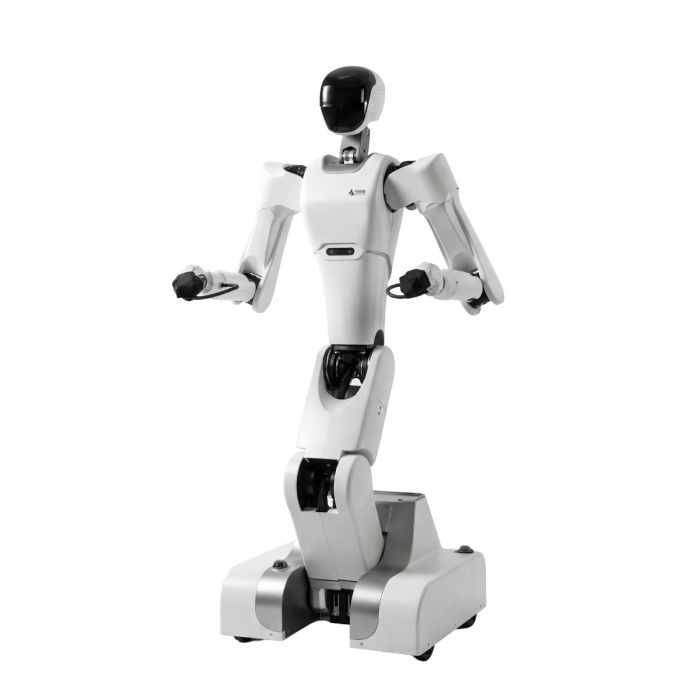
Astribot S1 Wheeled Humanoid Robot
In stock
- BRAND:
- ASTRIBOT
- PART #:
- S1
- ORIGIN:
- China
- AVAILABILITY:
- SUBJECT TO AVAILABILITY
- SKU:
- Astribot-S1
Astribot S1 Wheeled Humanoid Robot
Most robots make you choose between getting around and getting things done. The Astribot S1 Wheeled Humanoid Robot refuses the choice: a human-scale body with two arms, a head and a torso rides on an omnidirectional chassis, so one machine can travel to a task and then work on it with both hands. It is built for AI research and service automation, and it asks to be judged by what it can do in a room rather than by how it looks on a stage.
The product is available through this page, by quotation.
Background
Why a wheeled body with a humanoid upper half
Humanoid robots come in several layouts. Some walk on two legs, some are only an upper body on a fixed mount, and some put the upper body on wheels. The wheeled layout trades the spectacle of walking for steadiness, and steadiness matters when the work is lifting, handing over, placing and repeating. Wheels carry the machine across a floor smoothly, and the arms do the fine work once it stops.
The Astribot S1 follows this layout. Its mobile chassis moves omnidirectionally, which means the robot is not limited to driving forward and turning: it can reposition itself in tight spaces while keeping its arms oriented toward the work. For laboratories, demonstration spaces, workshops and service settings with level floors, this is a practical way to bring two-handed manipulation to wherever the task happens to be.
Positioning and key technology
The Astribot S1 is positioned as a wheeled humanoid robot for AI research and service automation. Its design brings together a dual-arm architecture, a torso that adds reach and posture, a head that carries vision, and a sensor suite of RGB-D cameras, stereo vision cameras and dual LiDAR systems. Together these let it perceive its surroundings and interact with objects.
Just as important for research teams, the platform supports VR-based whole-body motion data collection. An operator can demonstrate a movement, the system records it, and that data serves both training and live teleoperation. API access is also part of the picture, so software teams can connect their own work to the robot. If you are comparing it with other machines in this class, the Wheeled Humanoids category and the wider Humanoids category show the alternatives side by side.
Technical Specifications
| Specification | Value |
|---|---|
| Type | Wheeled humanoid robot |
| Height | 170 cm |
| Weight | 80 kg |
| Total degrees of freedom | 23 |
| Degrees of freedom per arm | 7 |
| Torso degrees of freedom | 4 |
| Head degrees of freedom | 2 |
| Hand degrees of freedom | 14 |
| Chassis | Mobile, omnidirectional movement |
| Continuous payload | 5 kg per arm |
| End-effector speed | Exceeding 10 m/s |
| End-effector acceleration | Above 100 m/s² |
| Sensors | RGB-D cameras, stereo vision cameras, dual LiDAR systems |
| Data collection and control | VR-based whole-body motion data collection, VR teleoperation, API access |
| Runtime | 4–6 hours |
Specifications as published by the manufacturer; confirmed against the datasheet at quotation.
The manufacturer has not published the battery capacity, the charging time, the connectivity, the IP rating, the onboard compute or the contents of the box; they are confirmed at quotation.
How does a wheeled humanoid differ from a walking one?
A walking humanoid has to spend a great deal of its engineering effort on balance. That is impressive, but it is not always what a research group or a service operator needs. A wheeled humanoid hands that effort back to the task: the chassis provides a stable base, and the upper body can concentrate on reaching, gripping and carrying.
The Astribot S1 is a clear example. Its 23 degrees of freedom are shared among two 7 DOF arms, a 4 DOF torso, a 2 DOF head and the mobile chassis, with a further 14 degrees of freedom in the hands. The arms carry 5 kg each continuously, and the end effectors reach speeds exceeding 10 m/s with accelerations above 100 m/s². For a buyer, the point is that the machine is built for two-arm work at human scale, standing 170 cm tall, rather than for locomotion experiments.
The trade-off is plain and worth stating: wheels suit level floors and prepared spaces. If your project lives in such places, the wheeled layout is a sensible fit.
What does the S1 offer an AI research team?
Embodied AI depends on data from real bodies doing real tasks. The S1 supports VR-based whole-body motion data collection, so an operator can demonstrate how a task is done and the recorded motion can feed training. The same VR link supports teleoperation, which is useful when a person needs to guide the robot directly, whether to gather examples or to step in during a trial.
On the perception side, RGB-D cameras, stereo vision cameras and dual LiDAR systems give a research team several kinds of input to work with. API access lets software developers build their own behavior on top of the platform. A team therefore gets a body, a way to teach it, and a way to program it in one system.
Who is the Astribot S1 for?
University and corporate laboratories are the most direct fit. They need a platform that can both move and manipulate, and they need tools for collecting demonstration data. The VR data collection and API access speak to that need.
Service robotics developers are the second group. Human-robot interaction, handing objects to people and carrying out tasks in service settings all call for a mobile machine with two capable arms. The S1's head, torso and sensor suite are arranged for exactly that kind of work.
Automation teams exploring advanced scenarios that require two-arm manipulation together with autonomous mobility form the third group. They can use the S1 to test whether a humanoid approach suits a task before committing to a larger program.
Not every project needs a mobile base. If your work happens at a fixed station, look at the Astribot S1-U Upper Body Humanoid Robot, which is listed as an upper-body version. If you want to compare another wheeled model from the same brand, the Astribot T1 Wheeled Humanoid Robot is on this site as well.
What is the Astribot S1 used for?
- Embodied AI research. A physical platform on which learning methods meet real objects and real rooms.
- Robot learning data collection. VR-based whole-body motion capture turns human demonstrations into training material.
- Teleoperation. An operator guides the robot through VR when a task needs a human in the loop.
- Service robotics development. A mobile, two-armed machine for building and testing service behaviors.
- Human-robot interaction studies. A human-scale body with a head and torso for work that involves people.
- Advanced automation trials. Two-arm manipulation combined with autonomous mobility for demanding scenarios.
Pricing and Availability
We do not print prices on this page. The Astribot S1 is supplied by quotation: tell us about your project, your location and the quantity you need, and we will prepare an offer. Delivery, customs and support are arranged together with the quotation, so you see the whole picture in one place. The Astribot S1 Wheeled Humanoid Robot is available on this page.
Frequently Asked Questions
How many degrees of freedom does the Astribot S1 have?
It has 23 degrees of freedom in total: 7 per arm, 4 in the torso, 2 in the head, plus the mobile chassis with omnidirectional movement. The hands add 14 degrees of freedom.
What can each arm carry?
Each arm supports a continuous payload of 5 kg. The end effectors reach speeds exceeding 10 m/s and accelerations above 100 m/s².
What sensors does it carry?
The sensor suite consists of RGB-D cameras, stereo vision cameras and dual LiDAR systems. It supports environmental perception and object interaction.
Can it be teleoperated?
Yes. The platform supports VR teleoperation and VR-based whole-body motion data collection for training.
How tall is it and how long does it run?
The robot stands 170 cm tall and weighs 80 kg. It runs for 4–6 hours.
Can software teams program the S1?
Yes. API access is supported alongside vision, LiDAR and VR teleoperation, so software teams can build their own behavior on the platform.
Where can I buy the Astribot S1 and what does it cost?
You can request it through this page, and the cost is given in a written quotation prepared for your project. No price is printed here.
Summary
The Astribot S1 answers a simple question: what if the robot could go to the work and then use both hands? A 170 cm wheeled body with 23 degrees of freedom, 5 kg of continuous payload per arm, a sensor suite of cameras and dual LiDAR, and VR-based data collection makes it a capable platform for AI research and service automation. Its limits are as clear as its strengths: it suits level floors and prepared spaces. If a mobile, two-armed humanoid fits your project, this page is the starting point.


