
Alpha Robotics Alphabot G1 Wheeled Humanoid Robot
In stock
- BRAND:
- ALPHA ROBOT
- MODEL:
- ALPHABOT G1
- ORIGIN:
- China
- SKU:
- Alpha-Robot-Alphabot-G1
Alpha Robotics Alphabot G1 Wheeled Humanoid Robot
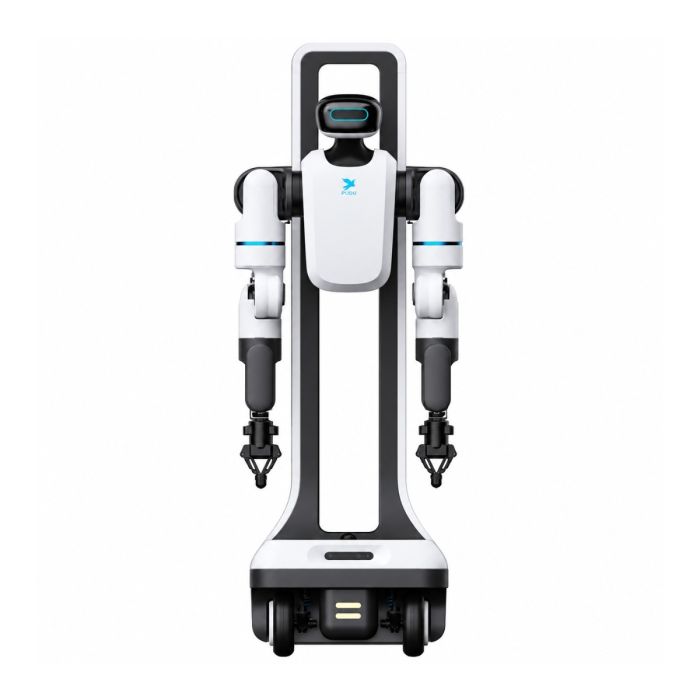
Most humanoid robots ask a building to adapt to them: flat floors, clear aisles, a task at one fixed height. The Alpha Robotics Alphabot G1 Wheeled Humanoid Robot takes the opposite approach. It rolls on four driven and steered wheels and carries a dual-column body built for work at variable heights, so it moves through a working space instead of waiting for the space to be rearranged.
The product is available through this page, by quotation.
Background
Where wheeled humanoids come from
Walking humanoids draw most of the headlines, but many practical jobs do not need legs. Warehouses, plants, hospitals and commercial buildings are mostly made of floors, corridors and lifts, and a wheeled base crosses those surfaces with less mechanical complexity than a bipedal gait. A wheeled humanoid keeps the human-like upper body, which suits shelves, counters and workstations laid out for people, and swaps legs for a drive base that is steadier and simpler to control.
That is the class the Alphabot G1 belongs to: a dual-column wheeled humanoid. The fact sheet researched for this page carries no company history, so this article does not narrate one. If the origin and track record of the maker matter to your purchasing decision, ask for them when you request a quotation.
Positioning and key technology
Three ideas define the Alphabot G1. The first is its patented dual-column body architecture for variable-height work. The second is the drive system: four-wheel drive combined with four-wheel steering for agile omnidirectional mobility. The third is an integrated AI large-model platform for perception, interaction and task planning.
Together these place the robot between a pure research platform and a single-purpose service machine. It is meant for work that mixes movement, handling and interaction with people. If you are comparing it with other machines of its type, our Wheeled Humanoids category and the wider Humanoids category show the alternatives.
Technical Specifications
| Specification | Value |
|---|---|
| Architecture | Dual-column wheeled humanoid |
| Body design | Patented dual-column body architecture for variable-height work |
| Mobility | Four-wheel drive and four-wheel steering |
| Rated payload | Up to 44.1 lb |
| Intelligence | Integrated AI large-model platform |
| Interaction | Face recognition and voice intercom |
| Workflows | Autonomous patrol and security-support; heavy-load handling and automatic sorting |
Specifications as published by the manufacturer; confirmed against the datasheet at quotation.
The manufacturer has not published the dimensions, the weight, the battery capacity, the runtime, the maximum speed, the degrees of freedom, the sensors, the connectivity, the compute platform, the IP rating, what is in the box, or the software and SDK details; they are confirmed at quotation.
What makes the Alphabot G1 different from a conventional service robot?
A typical service robot is a fixed-height body on wheels. It greets, carries a tray or follows a route, and its working envelope is set by the height of its housing. The Alphabot G1 is built around a different premise. Its dual-column body is made for variable-height work, which matters whenever the job involves reaching, loading or sorting at more than one level.
The drive base is the second difference. Four-wheel drive with four-wheel steering gives the robot omnidirectional movement, which is useful in aisles, around equipment and in rooms where turning space is limited. A robot that can reposition sideways or pivot in tight quarters wastes less time and needs less clear floor.
The third difference is the intelligence layer. The integrated AI large-model platform covers perception, interaction and task planning in one system, rather than leaving each to a separate add-on. Combined with face recognition and voice intercom, the robot can deal with people directly as well as move goods.
How much can it carry, and what does that mean in practice?
The rated payload is up to 44.1 lb. That is a meaningful figure for a humanoid platform: enough for totes, parcels, tools or supplies of moderate weight, and it fits the heavy-load handling and automatic sorting applications. Final capabilities depend on the selected configuration, software, environment and integration scope, so a quotation conversation should start from your actual load, route and floor conditions.
Who is the Alphabot G1 for?
Research and development teams are the first natural audience. A wheeled humanoid with an integrated AI platform gives laboratories and universities a body on which to test perception, interaction and planning without taking on the balance problems of a walking robot.
Industrial plants and warehouses form the second segment. Variable-height work, heavy-load handling and automatic sorting match the daily tasks of intralogistics, and autonomous patrol with security-support workflows adds value outside the busiest shifts.
Commercial service operators are the third group. Face recognition and voice intercom suit settings where the robot meets visitors or customers. If your need is purely front-desk reception, compare it with the Alpha Robotics Alice Reception Robot, which is a different type of machine.
The fourth group is household and assisted-service projects. These are best scoped carefully with the supplier, since the result depends on the configuration and integration chosen.
What is the Alphabot G1 used for?
- Research and development. A platform for work on perception, interaction and task planning with a wheeled humanoid body.
- Industrial plant tasks. Variable-height work and material handling inside production environments.
- Warehouse sorting. Heavy-load handling and automatic sorting, within the rated payload.
- Autonomous patrol. Patrol and security-support workflows that extend coverage of a site.
- Commercial service workflows. Face recognition and voice intercom for dealing with visitors and staff.
- Household and assisted service. Assisted-service applications scoped to the selected configuration and software.
Pricing and Availability
Every Alphabot G1 is quoted to the configuration, software and integration scope you need, so we do not print figures on the page. Request a quotation and tell us about your site, your loads and the workflows you have in mind. Delivery, customs and support are arranged together with the quotation. The Alpha Robotics Alphabot G1 Wheeled Humanoid Robot is available on this page.
Frequently Asked Questions
What drive system does the Alphabot G1 use?
It uses four-wheel drive and four-wheel steering for agile omnidirectional mobility.
What is the rated payload?
The rated payload is up to 44.1 lb.
What does the dual-column body do?
The patented dual-column body architecture is made for variable-height work. It lets the robot work at different levels instead of at a single fixed height.
Can it recognize people and talk to them?
Yes. Face recognition and voice intercom are part of its interaction features, supported by the integrated AI large-model platform.
Can it be used for security patrol?
Yes. Autonomous patrol and security-support workflows are among its applications, and the scope of a given deployment is agreed with the quotation.
Where do I find battery life, weight and IP rating?
These details are handled in the quotation, so please list them in your request if they matter to your site.
Where can I buy the Alphabot G1 and what does it cost?
You can request it through this page. The cost depends on the configuration and integration scope, so it is given in a quotation rather than printed here.
Summary
The Alphabot G1 answers a simple question: what if a humanoid robot did not need the building to change for it? Four-wheel drive and steering, a patented dual-column body for variable-height work, a rated payload of up to 44.1 lb and an integrated AI large-model platform make it a flexible tool for research, plants, warehouses, commercial service and assisted-service projects. To discuss your requirements, this page is the starting point.