
Agilex SCOUT 2.0
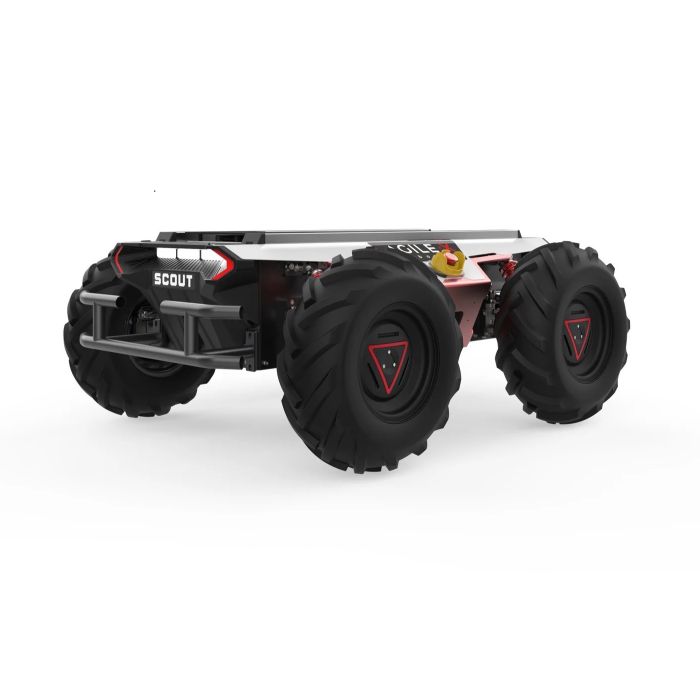
In stock
- BRAND:
- AGILEX
- PART #:
- SCOUT 2.0
- ORIGIN:
- China
- AVAILABILITY:
- SUBJECT TO AVAILABILITY
- SKU:
- AgileX-SCOUT-2.0
Agilex SCOUT 2.0
Most research robots arrive as a finished idea and leave you to fight it. The Agilex SCOUT 2.0 goes the other way: it is a four-wheeled ground vehicle that stays out of your way, so the sensors, the computer and the code you add are what define the project. It is built for robotics research and development, and it carries a CE certification.
The product is available through this page, by quotation.
Background
The company and its lineage
Agilex builds mobile robot platforms for laboratories, universities and development teams. The SCOUT 2.0 belongs to that family of chassis, which is made to be extended rather than used as is. Other platforms from the same maker are collected in the AgileX category, and the SCOUT 2.0 sits among them as the compact, differential-drive option for research work.
The idea behind this kind of vehicle is simple. A research team seldom needs a robot that performs one task. It needs a dependable body that moves, reports its state and accepts commands, so that effort goes into navigation, perception or teleoperation. The SCOUT 2.0 follows that approach.
Positioning and key technology
The SCOUT 2.0 is a four-wheeled, differential-drive unmanned ground vehicle. Its 400W brushless servo motors drive the wheels. A double-wishbone suspension with shock absorbers keeps the vehicle stable on rough ground, and it tackles obstacles up to 10cm tall.
Heat is handled by a circulating cooling system that combines internal and external circulation, made for all-weather operation and for high-intensity, high-temperature environments. For mounting, aluminum T-slot rails let you fix external sensors or kits securely. On the software side, the robot supports the CAN bus protocol. The master control offers a serial port or standard CAN bus as the communication interface, and open-source SDK and ROS_PACKAGE resources are provided.
Technical Specifications
| Specification | Value |
|---|---|
| Product type | Unmanned ground vehicle (UGV) for robotics research and development |
| Certification | CE |
| Drive | Four-wheeled, differential drive, 400W brushless servo motors |
| Speed | 1.67 m/s |
| Maximum speed with the 400W motors | 1.5 m/s (3.3mph) |
| Payload rating | Up to 50kg (110lb) |
| Obstacle height | Up to 10cm |
| Wheelbase | 498mm |
| Minimum ground clearance | 135mm |
| Battery, standard | 24V / 30Ah |
| Battery, optional | 60Ah |
| Ingress protection | IP22 as standard; customizable to IP44 or IP64 |
| Operating temperature | 0°C to 40°C |
| Communication | Serial port / standard CAN bus |
| Software | Open-source SDK and ROS_PACKAGE |
| Mounting | Aluminum T-slot rails |
Specifications as published by the manufacturer; confirmed against the datasheet at quotation.
The manufacturer has not published the ingress rating of the optional upgrades by model, the onboard sensors, the remote control range, the total power consumption or the service life; they are confirmed at quotation.
What makes the SCOUT 2.0 different from a fixed-purpose robot?
A fixed-purpose robot arrives with its job decided. The SCOUT 2.0 arrives with a job description left blank. The T-slot rails give you a mounting surface for whatever your project requires, and the CAN bus and serial interfaces give you a way to talk to the vehicle. Because the SDK and ROS_PACKAGE are open source, your team can read how the vehicle is controlled and build on it instead of working around a closed system.
That openness matters most to teams that change their minds. A laboratory may begin with simple teleoperation, move on to autonomous navigation and later test a different sensor arrangement. The same body serves each stage, and nothing about the chassis has to be replaced.
What do the battery and protection options change?
The standard vehicle uses a 24V / 30Ah battery. An optional 60Ah battery is also available for a long operation time. If your trials are long or your payload is heavy, the larger battery is the option to raise when you ask for a quotation.
Protection works the same way. The robot is rated IP22 as standard, and it can be customized up to IP44 or IP64. If your work will take the robot near damp or dusty conditions, say so early. The operating temperature range is 0°C to 40°C, which is worth comparing with your site before you decide.
Who is the SCOUT 2.0 for?
University laboratories and teaching programs are the clearest fit. A student team can start from a working vehicle and put its time into algorithms rather than welding and wiring. Research institutes use the same approach for navigation, mapping and perception experiments.
Companies developing prototypes form the second group. If you are testing an inspection or transport idea and want a proof of concept before committing to a purpose-built machine, a configurable chassis is a sensible first step. Integrators who already work in ROS will find the ROS_PACKAGE and CAN bus interface familiar.
The SCOUT 2.0 is a development platform and not a finished application robot. If you are still comparing platforms, the AgileX category shows the wider range.
What is the SCOUT 2.0 used for?
- Navigation research. Mount sensors on the T-slot rails and develop autonomous movement on a real vehicle.
- Teleoperation trials. Drive the robot remotely and test control interfaces; a remote control transmitter is an optional item.
- Teaching robotics. Give students a platform that exposes open-source software and standard communication interfaces.
- Payload carrying tests. Use the 50kg (110lb) rating to try out carrying tasks with your own equipment.
- Outdoor prototyping. Use the suspension and the 10cm obstacle capability to test on uneven ground.
- Custom sensor integration. Attach external kits and link them to the vehicle over CAN bus or serial.
Pricing and Availability
We do not publish prices. Quotation is the way to buy: tell us your configuration, including battery and protection options, and we respond with an offer. Delivery, customs and support are arranged with the quotation. The Agilex SCOUT 2.0 is available on this page.
Frequently Asked Questions
What is the SCOUT 2.0 designed for?
It is an unmanned ground vehicle designed for robotics research and development. It is a base platform to which you add your own sensors and software.
How much can it carry?
It is rated to carry up to 50kg (110lb), with a maximum speed of 1.5m/s (3.3mph) on its 400W brushless servo motors.
How fast is it?
Speed figures of 1.67 m/s and 1.5 m/s both appear in the sources. Tell us your configuration and we will state the figure that applies to it.
Can it work in wet conditions?
The standard rating is IP22, and the robot can be customized up to IP44 or IP64.
What battery does it use?
The standard battery is 24V / 30Ah. An optional 60Ah battery is also available.
What is in the box?
The box holds the robot body, a battery charger (AC 220V), an aviation plug (male, 4-pin) and a USB to CAN communication module. A remote control transmitter is optional.
Where can I buy the SCOUT 2.0 and what does it cost?
You can buy it through this page by requesting a quotation. We do not list prices, and the offer reflects your chosen configuration.
Summary
The Agilex SCOUT 2.0 is a research vehicle that stays out of your way. It brings a suspension, brushless drive, T-slot mounting, CAN bus and open-source software, and leaves the purpose of the robot to you. For teams that want to build rather than adapt, that is the whole attraction. If you are ready to plan your configuration, this page is the starting point.


